On this page
JEE (Advanced) 2027 will be held on 23 May 2027 (Sunday), organised by IIT Delhi, says the official JEE (Advanced) website. To sit it, you need to be among the top 2,50,000 candidates in the B.E./B.Tech paper of JEE (Main) 2027, as the eligibility page states. The 2026 Information Brochure describes two papers of three hours each, and appearing in both is compulsory. Don't assume a fixed pattern; our note on JEE Advanced question types explains why.
What does the JEE Advanced syllabus say about rotational mechanics?
The official JEE (Advanced) 2026 syllabus lists: "Rigid body, moment of inertia, parallel and perpendicular axes theorems, moment of inertia of uniform bodies with simple geometrical shapes; Angular momentum; Torque; Conservation of angular momentum; Dynamics of rigid bodies with fixed axis of rotation; Rolling without slipping of rings, cylinders and spheres; Equilibrium of rigid bodies; Collision of point masses with rigid bodies." The same document notes that the 2026 syllabus is unchanged from 2025. As of 19 November 2026, the 2027 syllabus has not been published; check again before your final months.
Compare this with Unit 5 of NTA's JEE (Main) 2027 syllabus: it covers torque, angular momentum, moment of inertia and equilibrium, but does not name rolling without slipping or collisions of point masses with rigid bodies. If the basics feel shaky, start with our rotational motion guide for JEE Main.
Advanced-level problems often chain ideas and leave friction's direction for you to find, and some questions may have more than one correct option.
Which conservation law survives a hit on a pivoted rod?
A uniform rod (mass 3 kg, length 1.2 m) hangs from a frictionless pivot at its top end. A 0.5 kg lump of clay moving horizontally at 6 m/s strikes it 0.9 m below the pivot and sticks. Take g = 9.8 m/s².
Linear momentum is not conserved: the pivot pushes during impact. Angular momentum about the pivot is, since the pivot force has no torque there.
Moment of inertia after impact: I = (3)(1.2)²/3 + (0.5)(0.9)² = 1.44 + 0.405 = 1.845 kg m².
Angular momentum before: (0.5)(6)(0.9) = 2.7 kg m²/s, so ω = 2.7/1.845 ≈ 1.46 rad/s.
Momentum after: (3 × 0.6 + 0.5 × 0.9) × 1.463 ≈ 3.29 kg m/s, against 3.0 before. The pivot added about 0.29 N s forwards.
Swing: ½Iω² ≈ 1.98 J equals (3 × 9.8 × 0.6 + 0.5 × 9.8 × 0.9)(1 − cos θ) = 22.05(1 − cos θ), so θ ≈ 24.4°.
Checks: zero clay mass gives ω = 0, and kg m²/s ÷ kg m² is 1/s. About 7.0 J of the clay's 9.0 J is lost in the sticky impact, so energy is not conserved across it.
Does it roll or slip? A multiple-correct style example
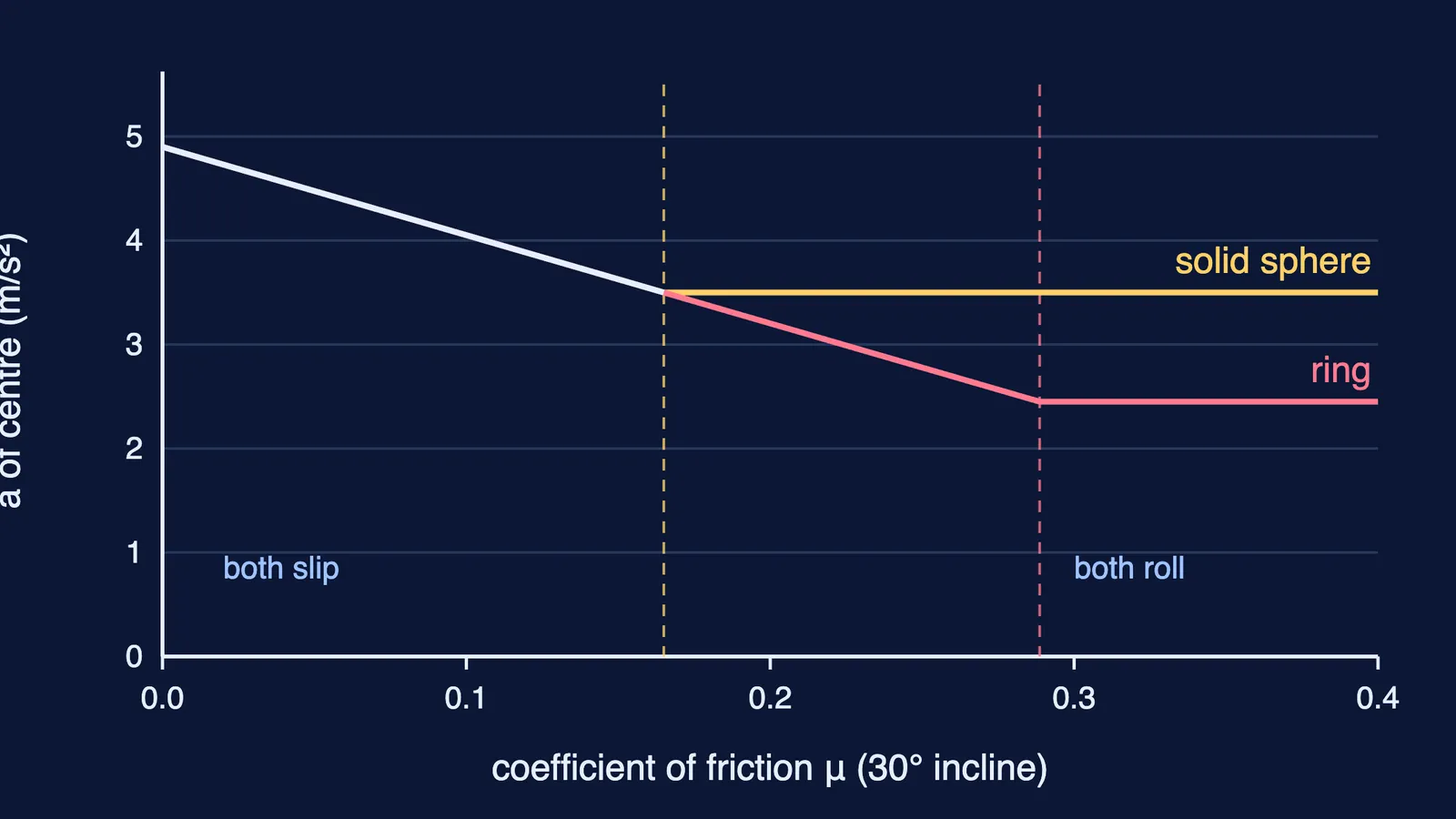
A solid sphere and a ring start from rest on a 30° incline with μ = 0.2. Rolling needs μ ≥ tan θ · k²/(R² + k²), the general condition OpenStax derives and applies to a cylinder. For the sphere (k² = 2R²/5) that is 0.165, so it rolls with a = (5/7)g sin 30° = 3.5 m/s². For the ring (k² = R²) it is 0.289, so it slips, and a = g(sin 30° − 0.2 cos 30°) ≈ 3.20 m/s².
The sphere rolls without slipping: true.
Friction on the ring is static: false, it slides, so friction is kinetic.
The ring's acceleration is 2.45 m/s²: false, that value assumes rolling.
The sphere reaches the bottom first: true, 3.5 > 3.20.
Not sure which way friction acts in a problem like this? The Fermi Problem Library has worked problems with a step-by-step solver that explains the reasoning rather than printing an answer.
How should you practise rotational mechanics for JEE Advanced?
Week 1: moments of inertia and the axes theorems; derive each one.
Week 2: fixed-axis dynamics and equilibrium; choose the torque axis before writing equations.
Week 3: rolling, deciding first whether the body rolls.
Week 4: collisions with rigid bodies and mixed problems; note which law held and why.
Find rolling hard to picture? Fermi Simulation Lab has interactive simulations for the ideas that are easier to see than to read.
Try these, then check:
A 2 kg solid cylinder rolls on a rough floor, pulled by a horizontal 6 N force at its axle. Find a and friction. Repeat with the force at the top.
A uniform 6 kg, 2 m rod is hinged to a wall and held horizontal by a string tied 1.5 m from the hinge at an angle with sine 0.6 to the rod. Find the tension and hinge force (g = 9.8 m/s²).
Answers: at the axle, a = 2 m/s² and friction is 2 N backwards; at the top, a = 4 m/s² and friction is 2 N forwards. Tension ≈ 65.3 N; hinge force ≈ 55.8 N (52.3 N horizontal, 19.6 N up).
For Class 11 foundations, see our System of Particles and Rotational Motion guide.