

On this page
Most hydrocarbons hold on to their hydrogens. Cyclopentadiene gives one up almost as easily as an alcohol does, and cycloheptatriene can lose a hydride (H-) to become a carbocation stable enough to bottle as a salt. Both behaviours have the same cause: the ion left behind is aromatic. Count the electrons yourself and it becomes a check you can run on any ring.
What makes a ring aromatic?
Hückel's rule, as summarised on Wikipedia's Hückel's rule page, says a planar ring molecule is aromatic if it has 4n + 2 π electrons, where n is 0, 1, 2 and so on.
Erich Hückel laid out the quantum theory behind it in 1931 in the journal Zeitschrift für Physik. In practice you check three conditions:
The ring is cyclic and flat.
Every ring atom has a p orbital, so the π cloud runs all the way round (no sp3 carbon breaking it).
The π electron count is 2, 6, 10, 14 and so on.
Benzene passes with 6. Our post on predicting aromatic rings with Hückel's rule has more practice rings.
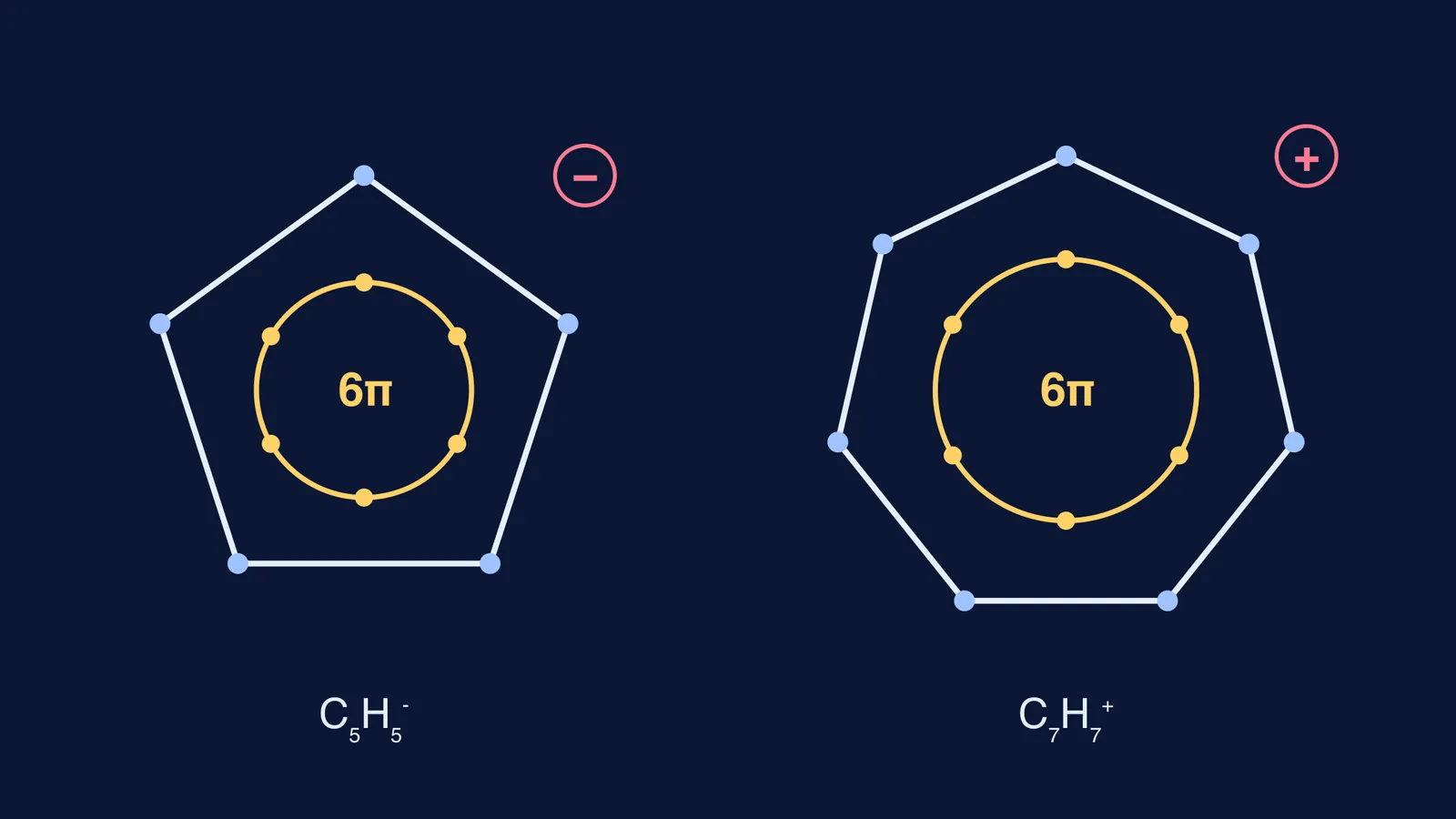
Why is the cyclopentadienyl anion aromatic?
Start with neutral cyclopentadiene, C5H6. It has two C=C double bonds and one CH2 carbon. That sp3 CH2 carbon breaks the π system, so the molecule is not aromatic.
Now remove H+ from the CH2 carbon. The bonding pair stays behind on carbon. Here is the count:
First C=C: 2 π electrons.
Second C=C: 2 π electrons.
The lone pair on the old CH2 carbon, which rehybridises to sp2 and puts the pair in a p orbital: 2 π electrons.
Total: 6 π electrons over 5 carbons, in a flat ring. That is 4n + 2 with n = 1.
The negative charge is spread over all five carbons, not stuck on one.
Why is the tropylium cation aromatic?
Cycloheptatriene, C7H8, has three C=C bonds (6 π electrons) and one sp3 CH2 carbon that breaks the circuit. Remove a hydride ion from that carbon. The pair leaves with the hydrogen, and the carbon becomes sp2 with an empty p orbital.
Now the count is 2 + 2 + 2 + 0 = 6 π electrons over 7 carbons in a flat ring. Again n = 1, so C7H7+ is aromatic, with the charge shared by all seven carbons.
The Wikipedia tropylium article records that G. Merling made a water-soluble bromine compound from cycloheptatriene and bromine in 1891. It also says W. von E. Doering and L. H. Knox showed in 1954, from its infrared and ultraviolet spectra, that this compound is a salt, C7H7+ Br-. Their paper is 'The Cycloheptatrienylium (Tropylium) Ion' in the Journal of the American Chemical Society. A carbocation that forms a stable ionic salt is unusual; aromaticity is the reason.
By contrast, the cyclopentadienyl cation, C5H5+, has only 4 π electrons; it is destabilised and thought to be antiaromatic, according to the same Hückel's rule page.
Why is cyclopentadiene so acidic for a hydrocarbon?
An acid is strong when its conjugate base is stable, and losing H+ from cyclopentadiene gives an aromatic anion. In the Evans pKa table, compiled by D. H. Ripin and D. A. Evans from Bordwell and other data:
Cyclopentadiene: pKa 15 in water, 18.0 in DMSO.
Water: pKa 15.7.
tert-Butanol: pKa 17.0.
Propene, whose allylic anion is stabilised by resonance but is not aromatic: pKa 43.
Methane: pKa 48.
The table footnote says water values above 14 were extrapolated, which covers every hydrocarbon value here, so treat them as estimates. Even so, a gap of about 28 pKa units between cyclopentadiene and propene points to a difference of roughly 10^28 in acid strength. The DMSO value of 18.0 comes from F. G. Bordwell's measurements, reviewed in Accounts of Chemical Research in 1988.
Compare the acidity of alpha hydrogens in carbonyl compounds, where oxygen, not aromaticity, stabilises the anion.
How do you answer this in an exam?
Use this check on any ring ion in JEE or board questions:
Draw the ring and mark any sp3 carbon. If one remains, the ion is not aromatic.
Count 2 for each C=C, 2 for a carbanion lone pair, 0 for a carbocation's empty p orbital.
Check the total: 2, 6, 10 means aromatic; 4 or 8 in a flat ring means antiaromatic.
Link it to the property asked: an aromatic conjugate base means a stronger acid; an aromatic carbocation means an easier ionisation.
For the energy side of delocalisation, see how to calculate the resonance energy of benzene. The Fermi Concept Library gives each chemistry concept its own lesson and its place in the map, so you can see where aromaticity sits next to acidity and resonance. When you get a counting question wrong, the Fermi Problem Library has worked problems with a step-by-step solver that explains the reasoning rather than printing an answer.


