

On this page
“Calculate the resonance energy of benzene from the given heats of hydrogenation” is a common question in thermochemistry and organic chemistry. You only need two numbers and one subtraction. This post walks you through the calculation, explains why your textbook may say “about 150” when the arithmetic gives 148, and then uses the same method on two other rings to show it really works.
What is the resonance energy of benzene?
Resonance energy is the difference between how much energy a molecule would have if its electrons sat in fixed, ordinary double bonds and how much it actually has. You can't measure the “fixed bonds” molecule because it doesn't exist, so chemists estimate it from a model compound that has a normal, isolated C=C bond: cyclohexene.
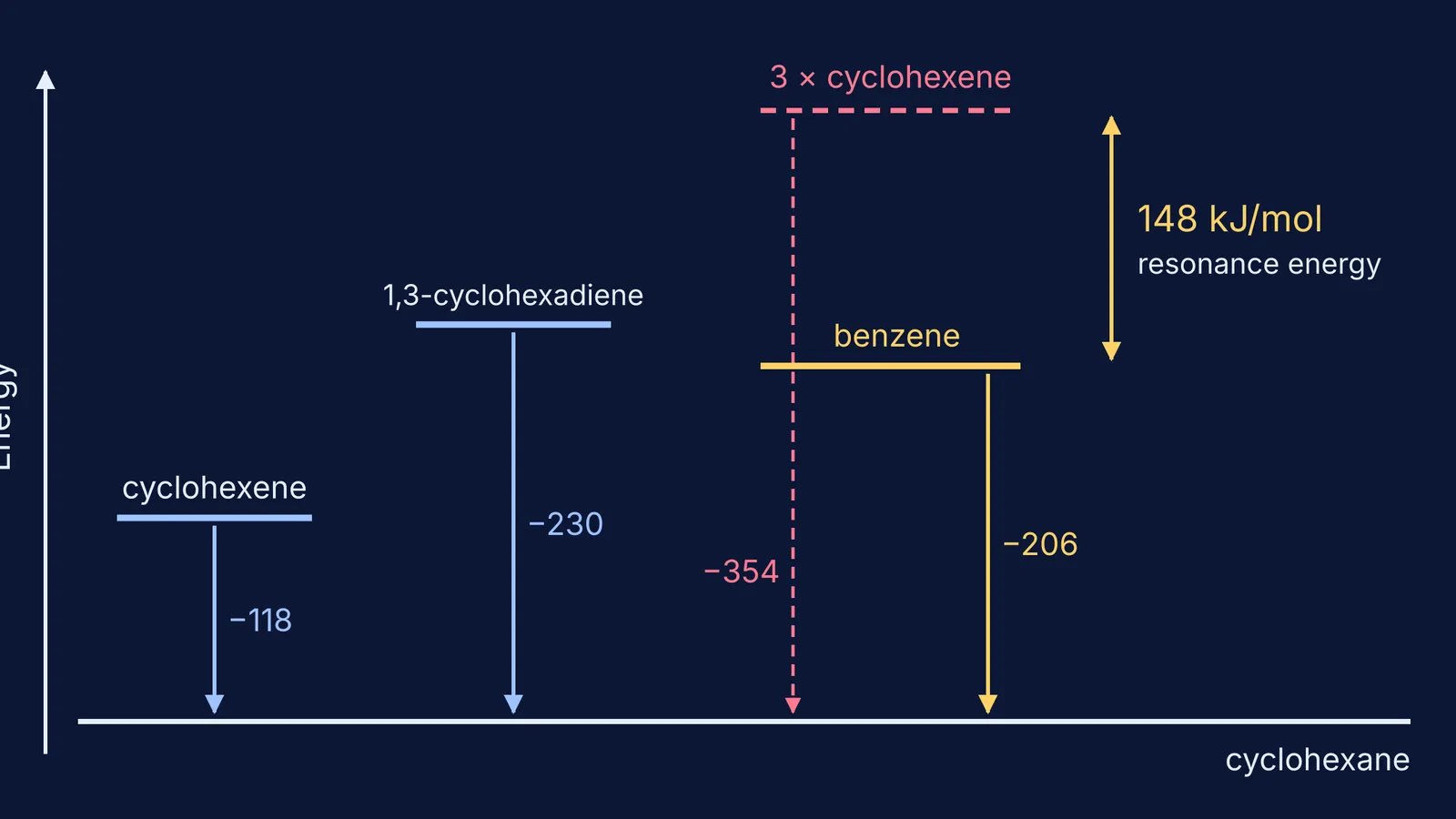
Hydrogenation means adding H2 across a double bond, and it releases heat. The OpenStax Organic Chemistry text on LibreTexts/15%3A_Benzene_and_Aromaticity/15.02%3A_Structure_and_Stability_of_Benzene) gives these values, each ending at cyclohexane:
Cyclohexene + H2: ΔH = −118 kJ/mol.
1,3-Cyclohexadiene + 2H2: ΔH = −230 kJ/mol.
Benzene + 3H2: ΔH = −206 kJ/mol.
The cyclohexene figure matches the NIST Chemistry WebBook, which lists −118 ± 6 kJ/mol as the average of 8 values. If heats of hydrogenation are new to you, start with our post on ranking alkene stability from heats of hydrogenation.
How do you calculate the resonance energy of benzene step by step?
Here is the method, using the OpenStax values/15%3A_Benzene_and_Aromaticity/15.02%3A_Structure_and_Stability_of_Benzene) above.
Pick the model. One isolated C=C in a six-membered ring is cyclohexene: −118 kJ/mol.
Build the imaginary molecule. A Kekulé “cyclohexatriene” has three such double bonds, so expect 3 × (−118) = −354 kJ/mol.
Write down the real value. Benzene's heat of hydrogenation is −206 kJ/mol.
Subtract the magnitudes. 354 − 206 = 148 kJ/mol.
Interpret it. Benzene releases 148 kJ/mol less heat than predicted, so it started 148 kJ/mol lower in energy. That is its resonance energy.
The hero diagram at the top of this post shows the same thing, drawn to scale: all four arrows end at cyclohexane, and the gap between the dashed line and the gold line is the answer.
Why do books say 150 kJ/mol when the sum gives 148?
It depends on which data your book uses. An older LibreTexts module on benzene and aromatic compounds/Arenes/Properties_of_Arenes/Aromaticity/Aromaticity/Benzene_and_Other_Aromatic_Compounds) uses 28.6 kcal/mol for cyclohexene and finds benzene 36 kcal/mol more stable than expected. That converts to about 151 kJ/mol. Different books start from slightly different measurements, so 148, 150 and 151 are all fair answers. Use the numbers printed in your question and show every step of the working.
Does the same method work for other conjugated rings?
Yes. Multiply the heat of hydrogenation of the one-double-bond ring by the number of double bonds, then compare with the measured value.
1,3-Cyclohexadiene. Expected: 2 × 118 = 236 kJ/mol. Measured: 230 kJ/mol (OpenStax/15%3A_Benzene_and_Aromaticity/15.02%3A_Structure_and_Stability_of_Benzene)). The bonus is only about 6 kJ/mol, the small stabilisation from conjugation that our post on why conjugated dienes are more stable explains. Benzene's 148 kJ/mol is far bigger than conjugation alone gives.
Cyclooctatetraene (C8H8). The model is cis-cyclooctene, measured at −96.1 kJ/mol in acetic acid by Turner and Meador in 1957 (NIST WebBook; original paper). Four double bonds predict 4 × 96.1 = 384.4 kJ/mol. The measured value, in the same solvent, is 409.9 kJ/mol (NIST WebBook; original paper). The molecule releases about 26 kJ/mol more than predicted, so it has no resonance bonus at all. That fits its structure: cyclooctatetraene is tub-shaped, not flat, and undergoes addition reactions typical of alkenes, as LibreTexts notes/Arenes/Properties_of_Arenes/Aromaticity/Aromaticity/Aromatic_Ions_and_Antiaromaticity). Our post on counting π electrons with Hückel's rule explains why benzene's 6 π electrons make it aromatic.
What should you check before writing your answer?
Did you use the heat of hydrogenation for one isolated double bond in a ring of the same size?
Did you multiply by the number of double bonds in the imaginary structure?
Did you subtract magnitudes and give a positive answer with units (kJ/mol or kcal/mol)?
Did you say what it means: the real molecule is more stable than the model by that amount?
If the answer is near zero or negative, did you conclude “no aromatic stabilisation”?
For a complete answer, link the number to structure. All six C–C bonds in benzene are 139 pm long, between a typical single bond (154 pm) and double bond (134 pm), according to OpenStax/15%3A_Benzene_and_Aromaticity/15.02%3A_Structure_and_Stability_of_Benzene). The same delocalisation that equalises the bonds also lowers the energy.
If you lose marks on these questions because you set up the wrong comparison, the Fermi Problem Library has worked problems with a step-by-step solver that explains the reasoning rather than printing an answer. If the gap is the idea of delocalisation itself, revise it in the Fermi Concept Library, which gives each chemistry concept its own lesson.


