

On this page
When you draw the structure of a diene, you might place the two double bonds right next to each other, separated by exactly one single bond, or keep them far apart. This spacing makes a massive difference to the molecule's chemical potential energy. Conjugated dienes (where double and single bonds alternate) are uniquely stable compared to their isolated counterparts.
What does heat of hydrogenation tell us?
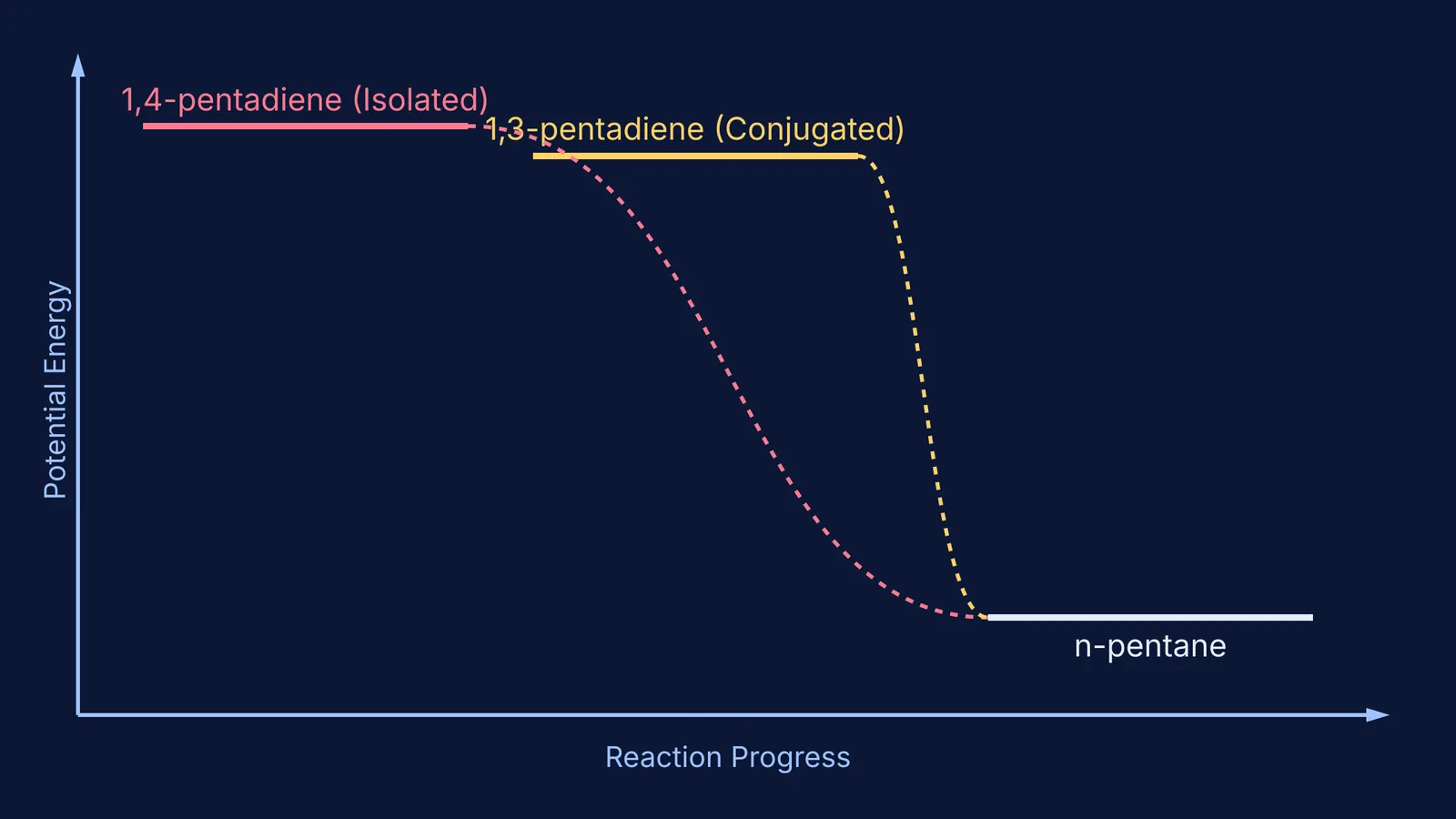
To measure the stability of an alkene, chemists use its heat of hydrogenation: the amount of energy released when the double bonds are fully broken and hydrogen is added to yield an alkane. A lower release of heat means the starting molecule was already resting at a lower, more stable energy state. Conjugated dienes are more stable than other dienes because of resonance.
How do the structures of 1,3-pentadiene and 1,4-pentadiene compare?
If you are mapping out Structural isomers in Class 10: butane and pentane drawn out, you will find several ways to build pentadiene, a five-carbon chain with two double bonds.
In 1,4-pentadiene, the double bonds are separated by a central CH₂ group. This is an isolated diene.
In 1,3-pentadiene, the double bonds are separated by just one single carbon-carbon bond. This is a conjugated diene.
When reacting with hydrogen to form n-pentane, a comparison of their heats of hydrogenation estimates that 1,3-pentadiene gives off about 3.5 kcal/mol (15 kJ/mol) less energy than 1,4-pentadiene. This fact proves the conjugated version is thermodynamically more stable.
Why are conjugated dienes more stable than isolated dienes?
According to standard chemical principles, there are two physical reasons for this drop in energy:
p-Orbital Overlap (Resonance): In a conjugated setup, every carbon atom involved in the alternating sequence is sp² hybridized. Because they sit next to each other, the unhybridized p-orbitals on all four carbon atoms overlap sideways to create a continuous, delocalised π system. Just as with Average bond order from resonance: nitrate, ozone and oxyanions, electrons move freely across a larger volume, dropping the overall potential energy.
Stronger Sigma Bonds: The single carbon-carbon bond connecting the two double bonds in a conjugated diene forms from the overlap of two sp² hybridized orbitals. Because sp² orbitals are smaller and possess more s-character than sp³ orbitals, this central single bond is shorter and stronger than the typical sp²-sp³ single bond found in isolated dienes.
How to spot resonance stabilization
When working through reaction pathways, predicting the major product often depends on identifying the most stable intermediate. Use this simple framework to judge a molecule's layout:
Count the single bonds: If exactly one single bond separates two double bonds, the system is conjugated and gains resonance energy.
Check for an insulating carbon: If a carbon atom with four single bonds (sp³ hybridized) sits between the double bonds, it acts as an insulator. The p-orbitals cannot interact, meaning the system is isolated and less stable.
How Fermi's AI tutor helps with organic chemistry
Organic chemistry requires you to see how molecules behave in three dimensions rather than simply memorising their names. If you struggle to picture how orbitals overlap or how electrons shift during a reaction, Fermi's AI tutor can help. The tutor teaches rather than answers: it holds a line of reasoning across a session, notices where you are stuck, and decides whether to explain, ask or show. By exploring the Fermi Concept Library, you can sit down to a clear next step and confidently trace the logic behind chemical stability.


