On this page
A JEE Advanced question on this unit makes you track a carbocation, a stereocentre or a count of active hydrogens through two or three steps. Here are 8 original questions.
The JEE (Advanced) 2026 syllabus lists carbocation rearrangements, Grignard reactions and substitution stereochemistry under alkyl halides; reactions of alcohols with sodium, ZnCl₂/conc. HCl and thionyl chloride, dehydration and oxidation; and Williamson's synthesis. Facts follow the NCERT Class 12 units on haloalkanes and alcohols, phenols and ethers (Reprint 2026-27); every answer was checked in Python with RDKit. Chapter plan: alkyl halides, alcohols and ethers for JEE Advanced: how to prepare.
How should you use this practice set?
Allow 25 minutes, solutions covered.
In "one or more options correct", judge each option alone.
Draw the intermediate before choosing.
Read the trap line even when right.
On multi-correct scoring, see our explainer on partial marking in JEE Advanced multi-correct questions.
Easy: are the core reactions automatic?
Q1 (easy, single correct). Which pair, followed by hydrolysis of the adduct, gives 3-methylpentan-3-ol, (C₂H₅)₂C(OH)CH₃?
(A) C₂H₅MgBr and butanal (B) C₂H₅MgBr and butan-2-one (C) CH₃MgBr and pentan-2-one (D) CH₃CH₂CH₂MgBr and propanone
Answer: (B). The carbinol carbon carries CH₃, C₂H₅ and C₂H₅, so it comes from butan-2-one and an ethyl group. An aldehyde gives a secondary alcohol, so (A) gives hexan-3-ol. Trap: (C) and (D) both give 2-methylpentan-2-ol, with a propyl group instead of two ethyls.
Q2 (easy, one or more options correct). Which statements are correct?
(A) Thionyl chloride gives a pure alkyl chloride because the other products, SO₂ and HCl, escape as gases. (B) Butan-1-ol is converted to 1-chlorobutane by simply shaking it with conc. HCl at room temperature. (C) With a given haloacid, the reactivity order is 2-methylpropan-2-ol > butan-2-ol > butan-1-ol. (D) Ethanol reacts with sodium to give sodium ethoxide and hydrogen.
Answer: (A), (C), (D). NCERT gives the 3° > 2° > 1° order and why thionyl chloride is preferred; Unit 7 says alcohols and active metals give alkoxides and hydrogen. Trap: (B). Plain shaking with conc. HCl works for tertiary alcohols; primary ones need ZnCl₂.
Q3 (easy, single correct). (R)-3-Bromo-3-methylhexane undergoes SN1 hydrolysis in aqueous acetone. The substitution product is
(A) (S)-3-methylhexan-3-ol only (B) (R)-3-methylhexan-3-ol only (C) a racemic mixture of 3-methylhexan-3-ol (D) 3-methylhexan-2-ol, formed after a hydride shift
Answer: (C). The planar tertiary carbocation is attacked from either face; NCERT says SN1 at an optically active halide gives racemisation. Trap: (A) applies SN2 inversion to a tertiary halide. (D): the cation is already tertiary, so no shift.
Medium: can you count, match and follow a cation?
Q4 (medium, numerical). 3.05 g of 2-aminoethanol, HOCH₂CH₂NH₂, is added to excess CH₃MgBr in dry ether. What volume of methane, in litres at STP (22.4 L mol⁻¹), forms? (C = 12, H = 1, N = 14, O = 16)
Answer: 3.36. M = 61 g mol⁻¹, so 0.050 mol. NCERT notes that alcohols and amines turn a Grignard reagent into a hydrocarbon. Each molecule has three such hydrogens (one O–H, two N–H): 0.150 mol CH₄ = 3.36 L. Trap: 1.12, which counts only the O–H.
Q5 (medium, list match). Match each alcohol and reagent with its main product.
List I: (P) hexan-1-ol, PCC (Q) hexan-1-ol, acidified KMnO₄ (R) hexan-2-ol vapour over Cu at 573 K (S) 2-methylpropan-2-ol vapour over Cu at 573 K
List II: (1) hexanal (2) hexanoic acid (3) hexan-2-one (4) 2-methylpropene (5) 2-methylpropanal
(A) P-1, Q-2, R-3, S-4 (B) P-2, Q-1, R-3, S-4 (C) P-1, Q-2, R-3, S-5 (D) P-1, Q-1, R-3, S-4
Answer: (A). PCC stops at the aldehyde; acidified KMnO₄ goes to the acid. Over copper at 573 K, NCERT says primary and secondary alcohols are dehydrogenated, tertiary ones dehydrated. Trap: (C). A tertiary carbinol carbon has no C–H to lose.
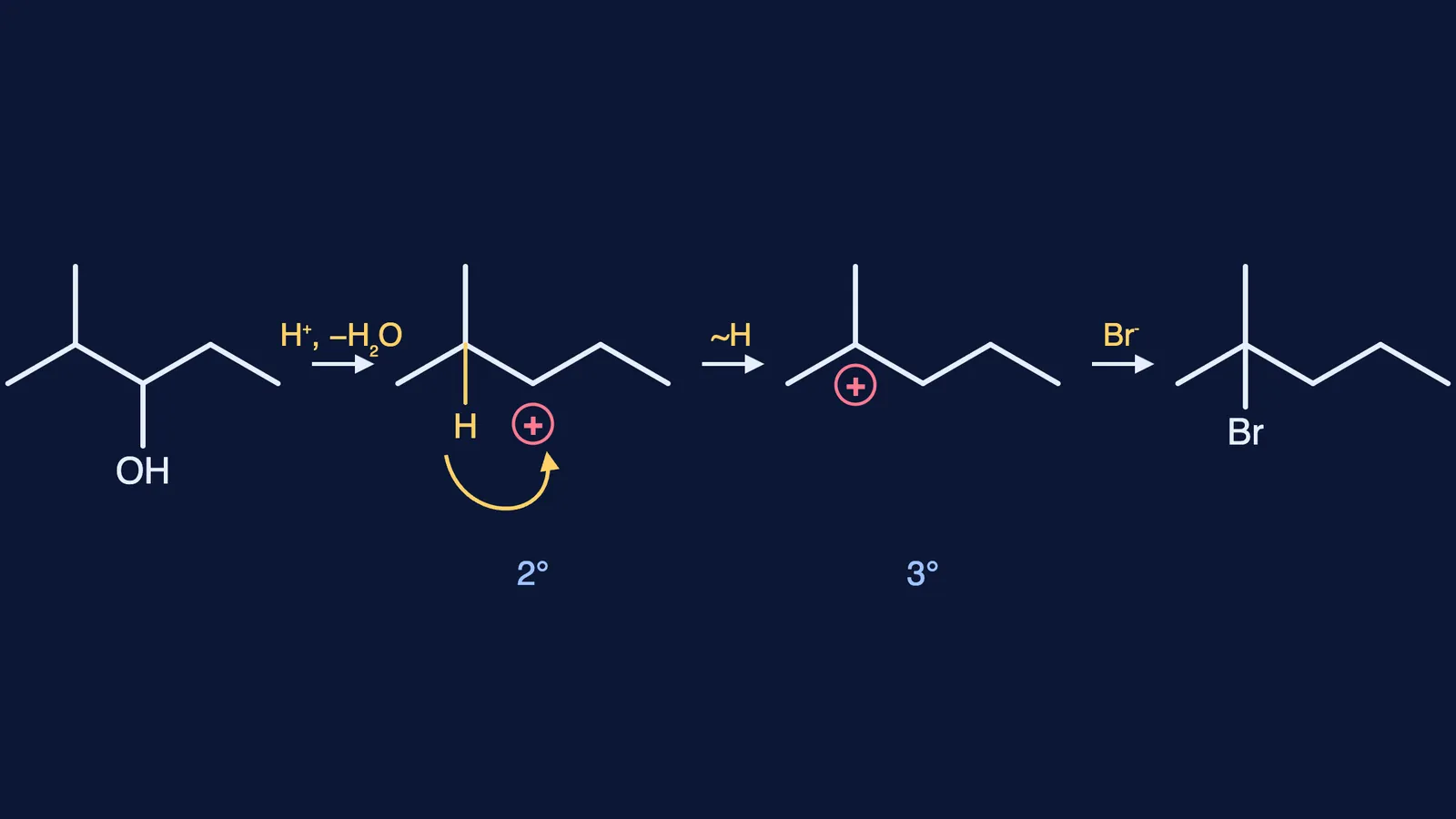
Q6 (medium, one or more options correct). 2-Methylpentan-3-ol, (CH₃)₂CH–CH(OH)–CH₂CH₃, is heated with HBr. Which statements are correct?
(A) The major product is 2-bromo-2-methylpentane. (B) The first carbocation is secondary and becomes tertiary by a 1,2-hydride shift. (C) An optically active alcohol gives an optically active major product. (D) With hot conc. H₂SO₄, the same alcohol gives mainly 2-methylpent-2-ene.
Answer: (A), (B), (D). Losing water leaves the charge on C3; the C2 hydrogen shifts with its electron pair, putting the charge on tertiary C2 (diagram at the top). Bromide adds there. In (D), losing a proton next to C2 gives the trisubstituted alkene. Trap: (C). C2 in the product carries two methyls, so the product is achiral.
Hard: can you carry stereochemistry through two steps?
Q7 (hard, numerical). (S)-2-Methylpentanal is treated with C₂H₅MgBr and hydrolysed. Let a be the number of stereoisomers in the alcohol obtained. This alcohol is then oxidised completely with CrO₃; let b be the number of stereoisomers in the ketone. Assume the existing stereocentre is undisturbed. Find a + b.
Answer: 3. The product is 4-methylheptan-3-ol. C4 keeps its configuration; the new C3 forms from a planar C=O, so a = 2 diastereomers. CrO₃ turns C3 back into C=O, so both give (S)-4-methylheptan-3-one: b = 1. Trap: 6, treating the aldehyde as racemic.
Q8 (hard, one or more options correct). Optically active X, C₅H₁₂O, is oxidised by PCC to an optically active aldehyde. Which statements are correct?
(A) X is 2-methylbutan-1-ol. (B) X turns Lucas reagent turbid immediately at room temperature. (C) X treated with sodium and then CH₃I gives an optically active ether. (D) The bromide of X (from PBr₃), heated with sodium in dry ether, gives an optically inactive alkane.
Answer: (A), (C). Of the four primary C₅H₁₂O alcohols, only 2-methylbutan-1-ol is chiral, and its aldehyde keeps the stereocentre. (B): NCERT says primary alcohols give no turbidity at room temperature. In (C), the Williamson step never touches the stereocentre. Trap: (D). The Wurtz product, 3,6-dimethyloctane, has two centres with the same configuration ((S,S) from (S)-X). It looks symmetrical, but meso needs one R and one S, so it is optically active.
What should you revise after this set?
Missed Q1 or Q4: write the bond each Grignard reagent makes, or the H it removes.
Missed Q2 or Q5: reread NCERT section 6.4.1 and the oxidation part of Unit 7.
Missed Q3, Q6, Q7 or Q8: revise carbocation stability and chirality with our guide to GOC for JEE Advanced.
For more practice, the Fermi Problem Library has worked problems with a step-by-step solver that explains the reasoning rather than printing an answer.