On this page
These eight original questions mix single-correct, one-or-more-correct, numerical and list-match types, each with a solution and trap. All stay inside the JEE (Advanced) 2026 syllabus: extraction of iron, copper, zinc and aluminium, the cyanide process, refining, and salt analysis of twelve listed cations and six anion groups. Metallurgy has left NCERT Class 12, so facts follow NIOS Chemistry, Lesson 16 and the NCERT lab manual, Unit 7. New to it? Read how to prepare metallurgy and salt analysis for JEE Advanced.
How should you use this practice set?
Allow 30 minutes; commit to a reason before reading solutions.
Judge each option of a one-or-more-correct question on its own; our guide to multi-correct questions has more.
Give numerical answers to two decimal places unless told otherwise.
Easy: do you know which step does what?
Q1 (easy, single correct). Which ore is correctly paired with its heating step after concentration?
(A) Zinc blende: calcination (B) Calamine: calcination (C) Bauxite: roasting (D) Galena: calcination
Answer: (B). Calamine is ZnCO₃, and calcination gives ZnO + CO₂. Sulphides such as ZnS and PbS are roasted in free air; bauxite is calcined to lose water (NIOS Lesson 16). Trap: (A); ZnS is roasted.
Q2 (easy, one or more correct). A solution of Ag⁺, Hg²⁺, Cu²⁺ and Mn²⁺ is treated with dilute HCl and filtered; H₂S is passed through the acidic filtrate. Which are correct?
(A) Ag⁺ is removed as AgCl, which dissolves in aqueous ammonia. (B) Hg²⁺ is removed by HCl as white Hg₂Cl₂. (C) H₂S precipitates black HgS and CuS. (D) Mn²⁺ comes down as MnS in the same step.
Answer: (A), (C). AgCl dissolves in ammonia as [Ag(NH₃)₂]⁺ (LibreTexts, silver). Hg²⁺ gives no chloride precipitate but forms black HgS (LibreTexts, mercury), beside black CuS. Mn²⁺ is Group IV (NCERT lab manual, Unit 7). Trap: (B) mixes up Hg²⁺ and Hg₂²⁺.
Q3 (easy, numerical). In the cyanide process, Ag₂S + 4NaCN → 2Na[Ag(CN)₂] + Na₂S, and then 2Na[Ag(CN)₂] + Zn → Na₂[Zn(CN)₄] + 2Ag (NIOS Lesson 16). What minimum mass of zinc (g) recovers all the silver from 37.17 g of Ag₂S? Use Ag 107.87, S 32.06 and Zn 65.38 (CIAAW).
Answer: 9.81. 37.17 g is 0.1500 mol Ag₂S (247.80 g/mol), giving 0.3000 mol complex. One Zn frees two Ag: 0.1500 mol Zn = 9.81 g. Trap: 19.61 g uses one Zn per Ag.
Medium: can you link a process to a number?
Q4 (medium, numerical). An ore is 80.0% Fe₂O₃ and 12.0% SiO₂ by mass. In the blast furnace, CaCO₃ → CaO + CO₂ and CaO + SiO₂ → CaSiO₃ (NIOS Lesson 16). With full iron recovery and all silica slagged, what minimum CaCO₃ (kg, nearest integer) is needed per tonne of iron? Use Fe 55.845, Ca 40.078, Si 28.085, C 12.011, O 15.999 (CIAAW).
Answer: 357. A tonne of ore gives 559.5 kg Fe and holds 1.997 kmol SiO₂, needing 199.9 kg CaCO₃. Per tonne of iron: 199.9 ÷ 0.5595 = 357 kg. Trap: 200 is per tonne of ore. See blast furnace reactions zone by zone.
Q5 (medium, one or more correct). Blister copper with traces of Fe, Zn, Ag and Au is the anode in acidified CuSO₄, with a pure copper cathode. Which are correct?
(A) Ag and Au settle below the anode as anode mud. (B) Fe and Zn dissolve and stay in solution. (C) The cathode gains exactly the mass the anode loses. (D) [Cu²⁺] in the electrolyte stays constant.
Answer: (A), (B). More electropositive impurities stay in solution; less electropositive ones fall as anode mud (NIOS Lesson 16). Part of the anode current oxidises Fe and Zn, yet the cathode deposits only copper, so ideally [Cu²⁺] falls. The anode also sheds mud, so (C) fails. Trap: (D) treats the anode as pure copper.
Q6 (medium, one or more correct). A Group III precipitate P (NH₄Cl + NH₄OH) is boiled with NaOH and H₂O₂, leaving a brown residue and a yellow filtrate. With acetic acid and lead acetate the filtrate gives a yellow precipitate; the residue in dilute HCl turns blood red with KSCN. Which conclusions follow?
(A) P contained chromium(III). (B) P contained iron(III). (C) Al³⁺ was absent, as no white solid stayed with the residue. (D) The brown residue shows Mn²⁺ was in P.
Answer: (A), (B). Basic H₂O₂ oxidises chromium(III) to yellow chromate (LibreTexts, chromium), precipitated as PbCrO₄; thiocyanate confirms Fe³⁺ (NCERT lab manual). Trap: (C). Al(OH)₃ dissolves in excess NaOH, so it would sit in the filtrate. Mn(OH)₂ dissolves in ammonium salt solutions (LibreTexts, manganese), so Mn²⁺ is not in P.
Hard: can you combine tests and thermodynamics?
Q7 (hard, list match). Match each salt to its observation.
List I: (P) anhydrous Na₂CO₃; (Q) NaHCO₃; (R) Na₂S; (S) KI.
List II: (1) CO₂ with dilute H₂SO₄, but no mass loss on gentle heating; (2) loses mass on gentle heating, giving CO₂; (3) a gas with dilute H₂SO₄ that blackens lead acetate paper; (4) violet vapours with conc. H₂SO₄, and yellow AgX insoluble in NH₄OH; (5) white precipitate with BaCl₂, insoluble in dilute HCl.
(A) P→1, Q→2, R→3, S→4 (B) P→2, Q→1, R→3, S→4 (C) P→5, Q→2, R→3, S→4 (D) P→2, Q→1, R→3, S→5
Answer: (A). NaHCO₃ releases CO₂ when heated above 80 °C (sodium bicarbonate); anhydrous Na₂CO₃ simply melts at 851 °C (sodium carbonate). H₂S blackens lead acetate; iodide gives violet vapour and yellow AgI (NCERT lab manual). Trap: (C). BaCO₃ is white but dissolves in dilute HCl; (5) is sulphate.
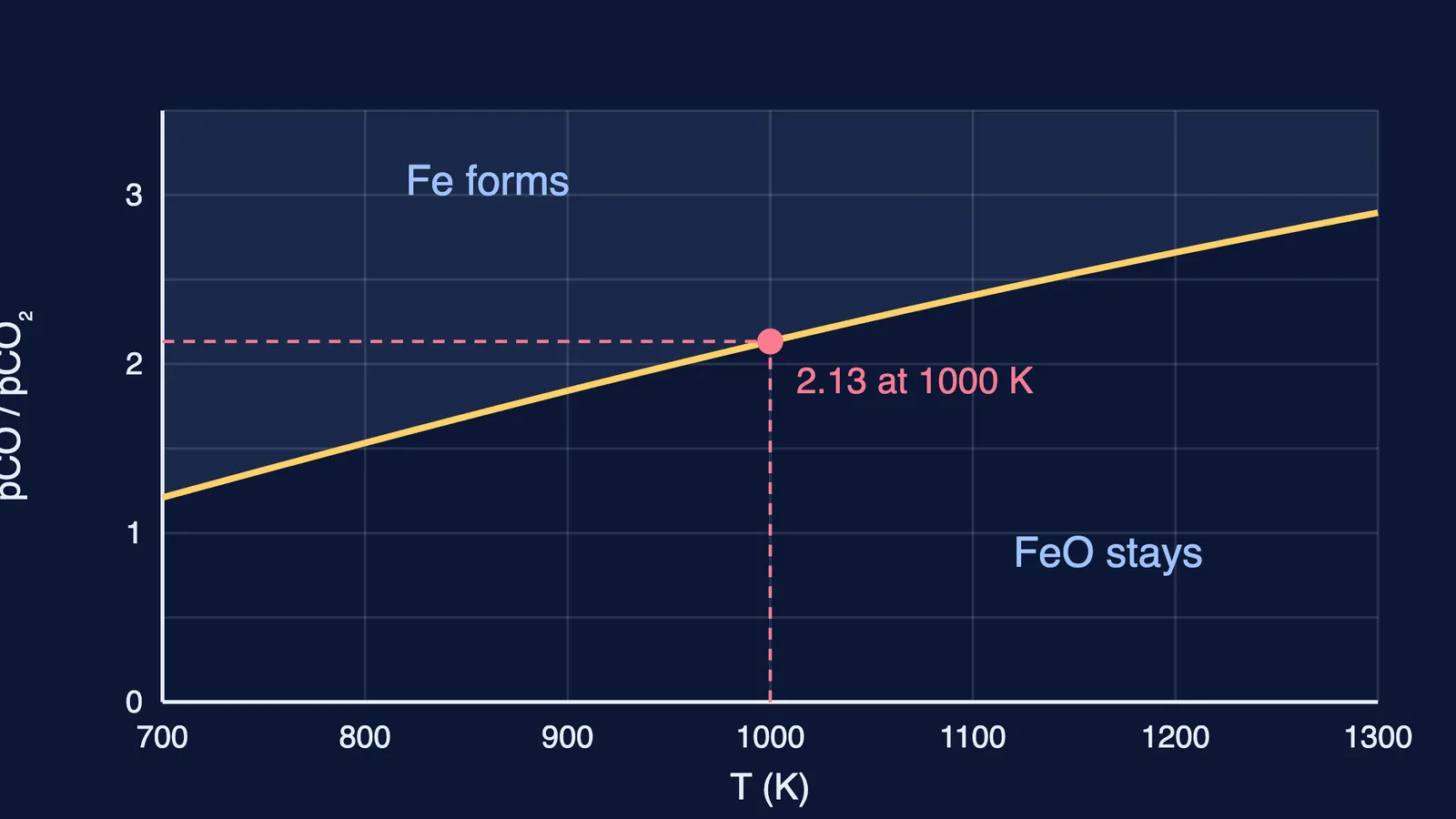
Q8 (hard, numerical). For FeO(s) + CO(g) ⇌ Fe(s) + CO₂(g), use 298 K data from the LibreTexts table: ΔfH° (kJ/mol) FeO −272.0, CO −110.5, CO₂ −393.5; S° (J/mol K) FeO 60.7, Fe 27.3, CO 197.7, CO₂ 213.8. With ΔH° and ΔS° constant, find the minimum pCO/pCO₂ that reduces FeO at 1000 K (R = 8.314 J mol⁻¹ K⁻¹).
Answer: 2.13. ΔH° = −11.0 kJ and ΔS° = −17.3 J/K, so ΔG°(1000 K) = +6300 J and K = pCO₂/pCO = e^(−6300/8314) = 0.469. Reduction needs pCO/pCO₂ above 1/K = 2.13. Trap: 0.47 is K itself, the inverse ratio.
What should you do after this set?
Missed Q1, Q3, Q4 or Q5? Write each extraction as a chain of equations. Missed Q2, Q6 or Q7? Redo the group table with reagents, not just colours.
If a method keeps slipping, the Fermi Problem Library has worked problems with a step-by-step solver that explains the reasoning rather than printing an answer.