On this page
It is Sunday night. You write a neat timetable: Rotational Motion done by Wednesday, Organic revision by Friday, a full mock on Saturday. By Thursday you are still on torque. That is not laziness. It is a well-documented habit of human judgement, and it has a name.
What is the planning fallacy?
The planning fallacy is the tendency to underestimate how long your own tasks will take, even when you know similar tasks ran late before. Daniel Kahneman and Amos Tversky described it in 1979, and psychologists Roger Buehler, Dale Griffin and Michael Ross tested it on students in a 1994 study in the Journal of Personality and Social Psychology.
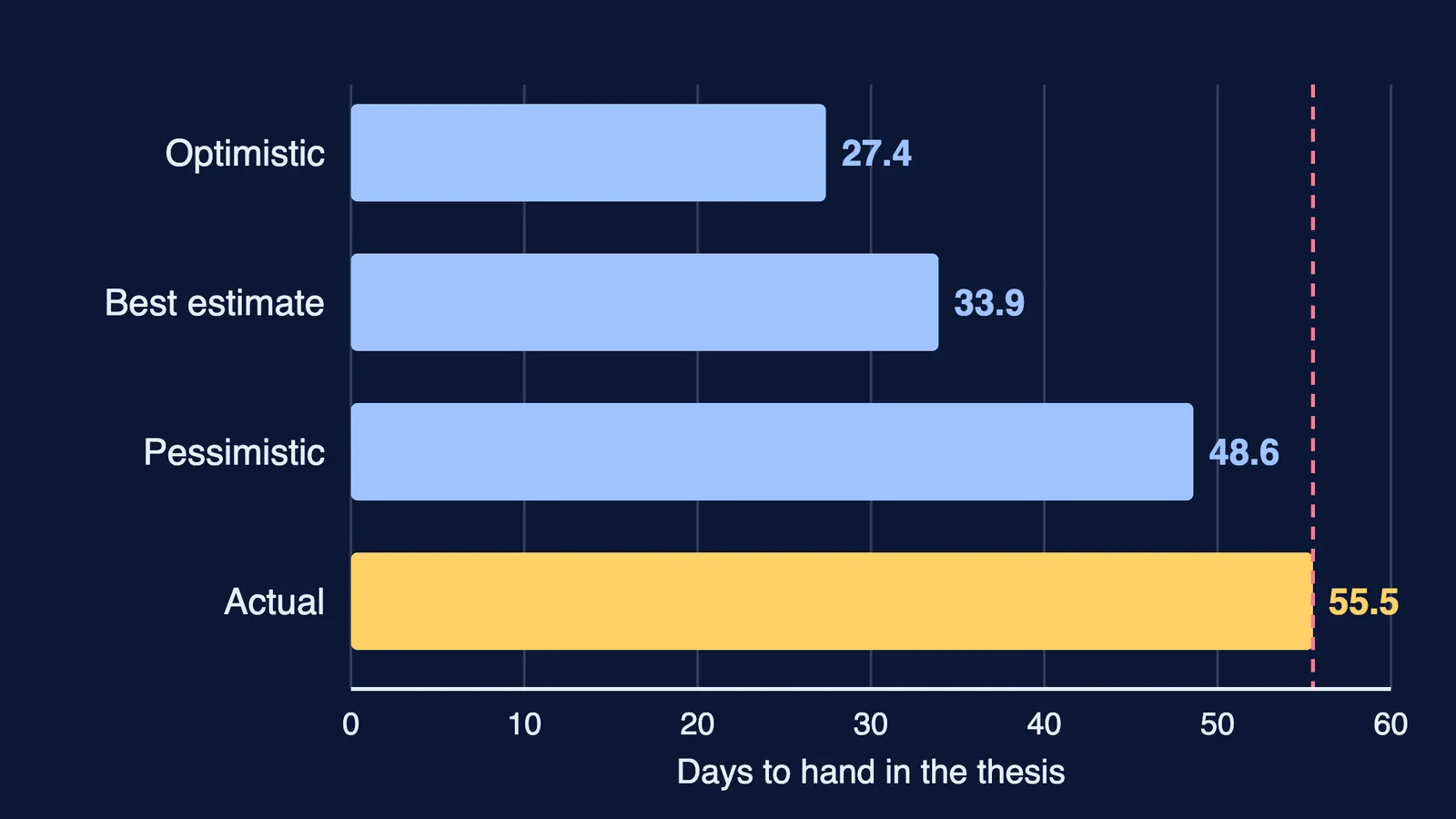
In their first study, 37 final-year psychology students at the University of Waterloo were asked when they would submit their honours thesis. Among the 33 who finished, the average best estimate was 33.9 days; the actual average was 55.5 days. Of all 37 students, only 29.7% finished by their own best estimate. Even their "if everything goes as poorly as it possibly could" estimate, 48.6 days, was too early on average.
The same paper reports a classroom survey in which students said they had finished about two thirds of their previous projects (68%) later than expected. They knew their history. They still believed this time would be different.
Why does your study timetable always run late?
Buehler and colleagues, building on Kahneman and Tversky, contrast two ways to predict, often called the inside and outside view. The "inside view" imagines how this particular task will go: open the book, read, solve. The "outside view" asks how long tasks like this have taken you before. When students thought aloud while predicting, they mostly talked about future plans and rarely about past experience. When they did remember being late, they blamed causes that were external, temporary and specific to that one time. In your life that might be a cousin's wedding, a fever or a surprise test.
An inside-view plan has no room for what always happens: a doubt that takes an hour, a chapter test, a slow morning. Each feels like an exception. Together, they are your normal week.
How do you make a study timetable you can actually keep?
Use your own past weeks as the reference. In Buehler's fourth study, students who recalled similar past assignments and connected them to the new one finished by their predicted time 60% of the time, against 29.3% in the control group. Their predictions were less biased, though no more precise. Planners call the same idea reference-class forecasting: base the forecast on how comparable projects actually went, as Bent Flyvbjerg described for large projects.
Unpack the task. Justin Kruger and Matt Evans found that listing a task's parts before estimating reduced the planning fallacy. A later review by Wiese, Buehler and Griffin notes that results for unpacking are mixed: it helps less when a task has few parts or the parts look easy.
Keep a buffer. This one is practical rather than from a single study: if your weeks keep running late, leave part of the week empty on purpose so overflow has somewhere to go.
To build your reference, you need a record. A daily done-list and a 20-minute Sunday review give you exactly that.
What does this look like in a JEE or NEET week?
Aarav (an example, with made-up numbers) is in Class 12 preparing for JEE. His gut says Rotational Motion will take 4 hours this week.
Unpack it. Theory of moment of inertia, torque and rolling: 2 hours. NCERT examples: 1 hour. 30 previous year questions: 3 hours. Checking and redoing wrong answers: 1 hour. Formula sheet: 30 minutes. Total: 7.5 hours, not 4.
Check his reference class. In his last four Sunday reviews, he planned 20, 18, 22 and 20 hours of tasks and actually needed about 26, 25, 29 and 27. His work takes roughly 1.3 times what he plans.
Adjust. 7.5 hours × 1.3 is about 10 hours. Rotational Motion gets 10 hours across the week.
Buffer. He keeps Friday evening blank.
A NEET student can run the same steps on, say, Human Physiology plus a biology mock analysis.
If you do not know where to begin in a chapter, Fermi's AI tutor can work out what you already know and build a plan for the session, so you sit down to a clear next step.
What if your plan still falls apart?
Some weeks will. Start the next with a fresh-start reset rather than trying to repay every missed hour. If falling behind leaves you feeling low or anxious for weeks, talk to a parent, teacher or school counsellor, or call Tele MANAS, India's toll-free 24x7 tele-mental health line, on 14416 (Press Information Bureau).
This Sunday, look at last week's plan next to what actually happened, work out your multiplier, and write next week's timetable with it.