On this page
You have been solving the same chemistry chapter for two hours. You read a line, then read it again. Most students reach for the phone here. Attention restoration research suggests a different break; here is what it found and where it falls short.
What is attention restoration theory?
Attention restoration theory says that focused effort uses up a limited capacity called directed attention, and that natural settings let it recover. Psychologist Stephen Kaplan set it out in 1995, and he and his University of Michigan colleagues summarise it in their 2008 paper in Psychological Science.
The idea rests on two kinds of attention. Directed attention is what you use to stay on a derivation while a pressure cooker whistles next door. Involuntary attention is pulled by things that are interesting on their own, such as leaves moving or clouds. Nature holds attention gently, the authors argue, so the directed kind rests. A busy road does the opposite: horns grab you, and you must still concentrate to avoid traffic.
What did the nature walk study actually find?
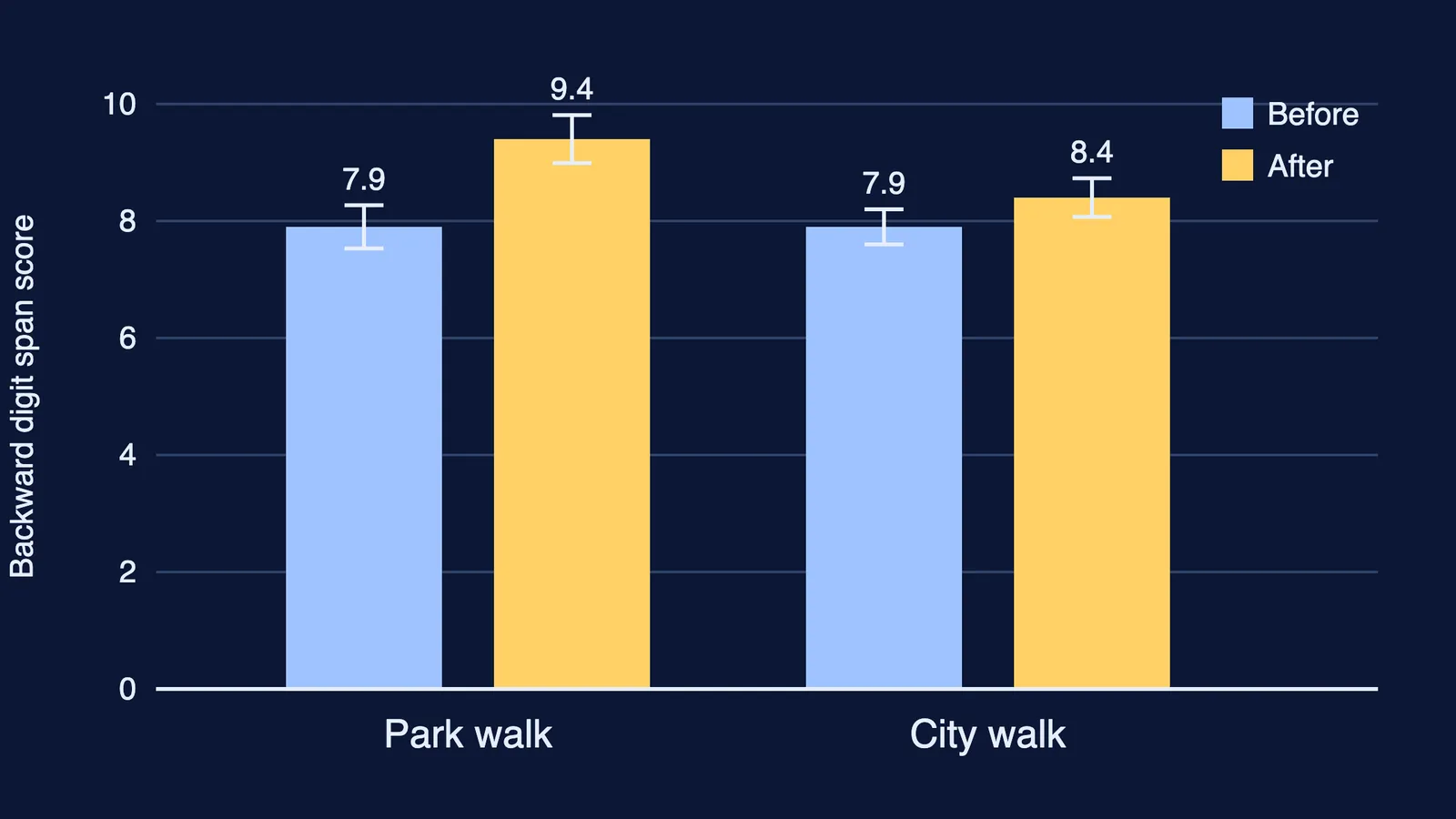
In the first experiment of that paper, Marc Berman, John Jonides and Stephen Kaplan tested 38 University of Michigan students, one of whom was later excluded (Berman, Jonides and Kaplan, 2008). Each student first did a 35-minute task designed to tire attention. Then they walked for 50 to 55 minutes, either through a tree-lined arboretum or along a busy downtown street, and a week later did the other walk.
The test was backward digit span: hear a string of numbers and say it in reverse, scored out of 14 correct sequences. After the park walk, average scores rose by 1.5 points (7.9 to 9.4); after the city walk, by 0.5 points (7.9 to 8.4). Mood improved more after the park walk too, but mood changes did not track score changes.
A second experiment with 12 students found that about 10 minutes of looking at nature photos, but not city photos, improved scores on a test of executive attention.
Do short green breaks work, and how strong is the evidence?
Shorter breaks have been tested. In a University of Melbourne study of 150 students, those who looked at a 40-second image of a flowering green roof made fewer errors on a dull attention task than those who saw a bare concrete roof (Lee and colleagues, 2015; university summary).
The wider evidence is mixed. A systematic review of 31 studies by Heather Ohly and colleagues found clear benefits on only 3 of 13 pooled measures, and it flagged small samples and inconsistent methods (Ohly et al., 2016). A follow-up review of 42 newer articles found low to moderate improvements in working memory and cognitive flexibility, with weaker support for attention control (Stevenson, Schilhab and Bentsen, 2018). That review also found real outdoor settings may help more than pictures or videos, though this could be because real exposures usually lasted longer.
The honest summary: a green break probably helps some kinds of focus a little, and is unlikely to hurt.
How can you take a 10-minute nature break in an Indian city?
You may not have an arboretum, but you probably have a terrace, a society garden, a tree on the lane or a window with a view. Try this after every 60 to 90 minutes of study:
Minute 0: stop at a natural point, and write the next step of the problem on a sticky note so you can restart fast.
Minutes 1 to 2: leave the phone on the desk. A break spent scrolling is not this experiment; our post on keeping your phone in another room while you study explains why.
Minutes 2 to 8: go to the greenest spot you can reach. Walk slowly or stand still and notice small things: the shape of a neem leaf, birds, the sky. Do not revise in your head.
Minutes 8 to 9: drink water and walk back.
Minute 10: read your sticky note and start.
In a hostel, a corridor window facing trees or a lap of the campus garden works; at home, a balcony with potted plants. If you cannot go out, the 40-second study suggests even a green view may help a little.
What should you do after the break?
Return to one clear task, not the whole syllabus. If a numerical is where you stalled, the Fermi Problem Library has worked problems with a step-by-step solver that explains the reasoning rather than printing an answer. Ticking off that one task counts; the daily done-list method for small wins shows how to keep track.
Breaks do not replace sleep; if a noisy hostel room is the real problem, see how to get your sleep back when a roommate snores.
If you feel low, anxious or unable to concentrate for weeks despite rest, talk to a parent, teacher or counsellor, or call Tele MANAS on 14416.