

On this page
Coaching hostel rooms are small, and a snoring roommate can wreck your nights before an 8 a.m. class. It is not their fault, but many cases get better with a few cheap changes made in the right order: block the sound, add distance, talk kindly, and only then go to the warden.
Why does a roommate's snoring cost you so much sleep?
You probably need more sleep than you get. The CDC recommends 8 to 10 hours a night for teens aged 13 to 17, and 7 or more hours for adults.
Night noise is a health matter, not fussiness. The World Health Organization's night noise guidelines for Europe set an average night-time level of 40 dB outside as the target to protect public health.
The NHS explains that snoring happens when the tongue, mouth, throat or nasal airways relax and narrow during sleep and vibrate as you breathe. Our explainer on why some people snore covers the physics.
What can I do tonight to block the snoring?
Foam earplugs. Roll one into a thin cylinder, pull the top of your ear up and back, slide it in and hold it while it expands. Try a couple of sizes before you decide they don't work.
An eye mask if room lights or a study lamp also keep you awake.
A quiet steady sound, such as a fan, only if you find it helps.
The best research on earplugs comes from a far noisier place than your hostel: hospital intensive care units. A 2015 Cochrane review of 30 trials found low-quality evidence, pooled from two small trials, that earplugs, eye masks or both increased total sleep time, although most earplug and eye-mask studies found no benefit on objective sleep measures. So earplugs deserve a fair trial, not blind faith.
White noise has weaker support still. A 2021 systematic review in Sleep Medicine Reviews of 38 articles rated the evidence that continuous noise improves sleep as very low, and warned it may also affect sleep and hearing. If a fan's hum helps you, fine; just don't play loud noise through earphones all night.
Does moving my bed away from the snorer help?
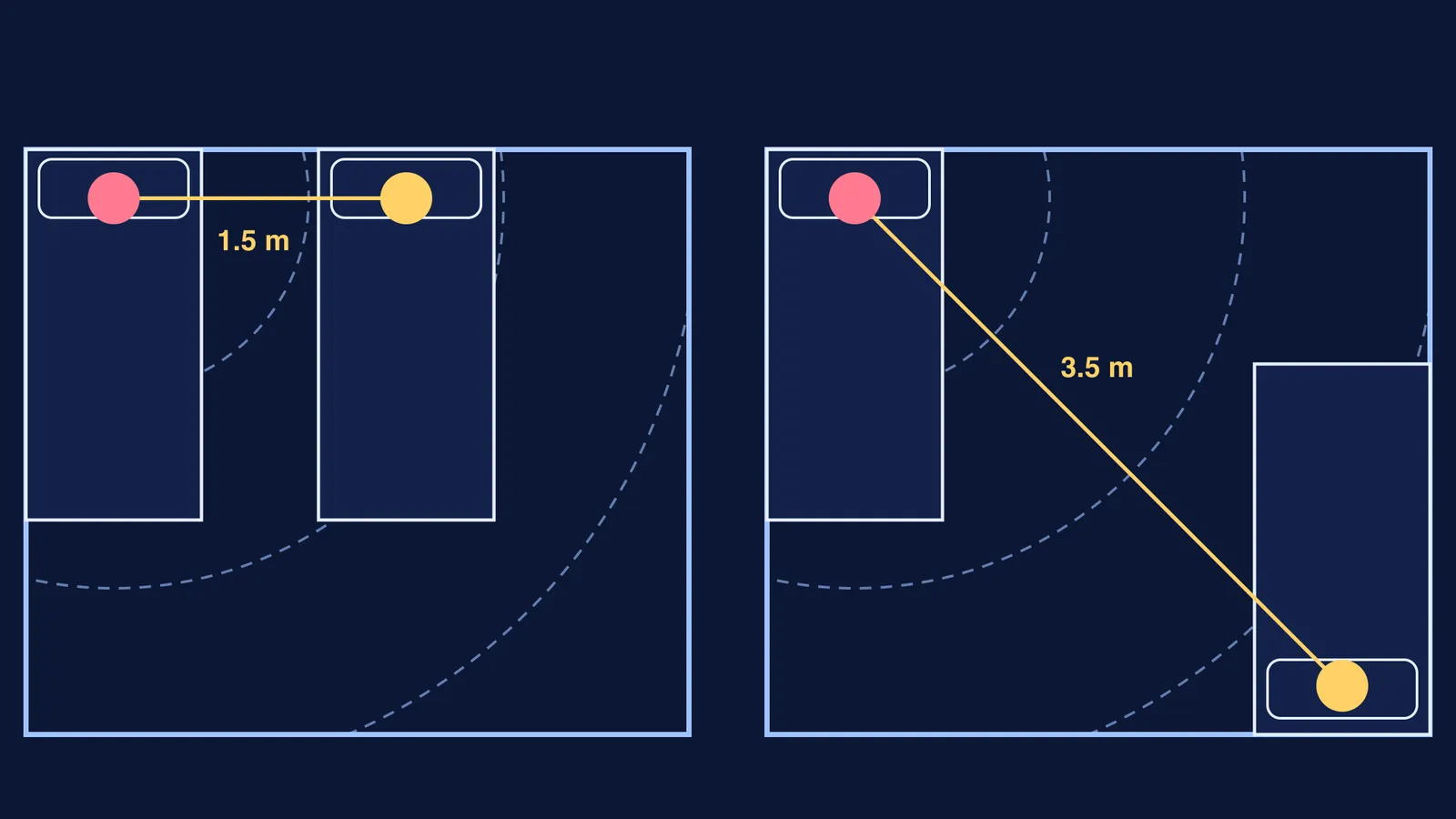
Often, yes, and it costs nothing. For a sound source in open air, intensity falls with the square of the distance, though reflections and reverberation in a room soften that drop (HyperPhysics, Georgia State University).
Here is a worked example. In a 3.4 m by 3 m room, two beds side by side with pillows against the same wall put your heads about 1.5 m apart. Move your bed to the opposite wall and sleep with your pillow at the far end, and your heads are about 3.5 m apart. In open air, that would cut the sound intensity reaching you to roughly a fifth, because (1.5 ÷ 3.5)² ≈ 0.18. A real room with hard walls gives you less than that, but the gain is still there.
Ask the warden before moving furniture, and agree the new layout with your roommate.
How do I tell my roommate they snore without hurting them?
Pick a calm daytime moment, not 2 a.m. when you are angry. Try something like:
"This is a bit awkward, but I've been sleeping badly. You snore at night, and I don't think you know."
"It's not something you're doing on purpose. Would you try sleeping on your side for a week? I'm using earplugs too."
"If it gets really loud, is it okay if I nudge you gently?"
The NHS suggests sleeping on your side, for example by taping or stitching a tennis ball to the back of your sleepwear, and losing weight if you're overweight. It also says to see a doctor if breathing stops and starts during sleep, or there are gasping or choking noises, because that can be sleep apnoea. If you notice this, tell your roommate kindly.
For bigger clashes, our guide on dealing with a difficult roommate goes further.
When should I ask the warden for a room change?
Use this two-week plan:
Nights 1 to 3: earplugs, eye mask and the new bed position.
Day 2 or 3: the kind conversation.
Days 4 to 14: your roommate tries side-sleeping, and you note your hours of sleep each morning.
Day 14: if you are still losing sleep most nights, go to the warden.
Ask in writing, keep it neutral and show what you tried: "We have tried earplugs, moving beds and side-sleeping for two weeks. I am still losing sleep most nights. Could I move to another room, or swap with someone who sleeps heavily?" Our tips on talking to your hostel warden can help you phrase it.
After a short night, revision feels heavier. Fermi's AI tutor can work out what you already know and build a plan for the session, so you sit down to a clear next step.
If poor sleep goes on for weeks, or you feel low or anxious, talk to a doctor or call Tele MANAS on 14416 or 1800-89-14416, which the Directorate General of Health Services lists as a 24x7 tele-mental health service.


