

On this page
Moving into a hostel gives you independence, but it also means adjusting to shared spaces, strict schedules and institutional food. When the Wi-Fi drops before an assignment is due, or the noise level makes studying impossible, it can be hard to know how to raise the issue without seeming difficult.
A 2022 study of 172 medical students in Mysuru found that while students were moderately satisfied overall, both boys and girls were dissatisfied with their hostel canteen's hygiene and facilities 1. This is a common story across India. The challenge is turning that dissatisfaction into a fix.
Whether you are dealing with broken amenities or unreasonable curfews, resolving the problem usually takes a clear, polite conversation with your warden. Here is a framework for how to have that conversation, keep a record, and know when to take the issue further.
What are the common problems faced by hostel students?
Hostel problems generally fall into three categories: infrastructure, environment and safety. The most frequent complaints involve food quality, hygiene in shared bathrooms, and inconsistent internet access.
The other major issue is noise. When you share a corridor with dozens of other students, finding a quiet hour can be rare. If you are struggling to focus in a noisy environment, you might need to adapt your routine, perhaps studying in a hostel or PG during the early morning. When you do find that quiet time, Fermi's AI tutor can work out what you already know and build a plan for the session, so you sit down to a clear next step.
How to raise an issue with your hostel warden politely?
Wardens manage many students, so they hear complaints daily. To get your problem solved, you need to separate the facts of the situation from your frustration. Complaining that "nothing works here" puts the warden on the defensive, whereas pointing out a specific broken lock gives them a task they can actually complete.
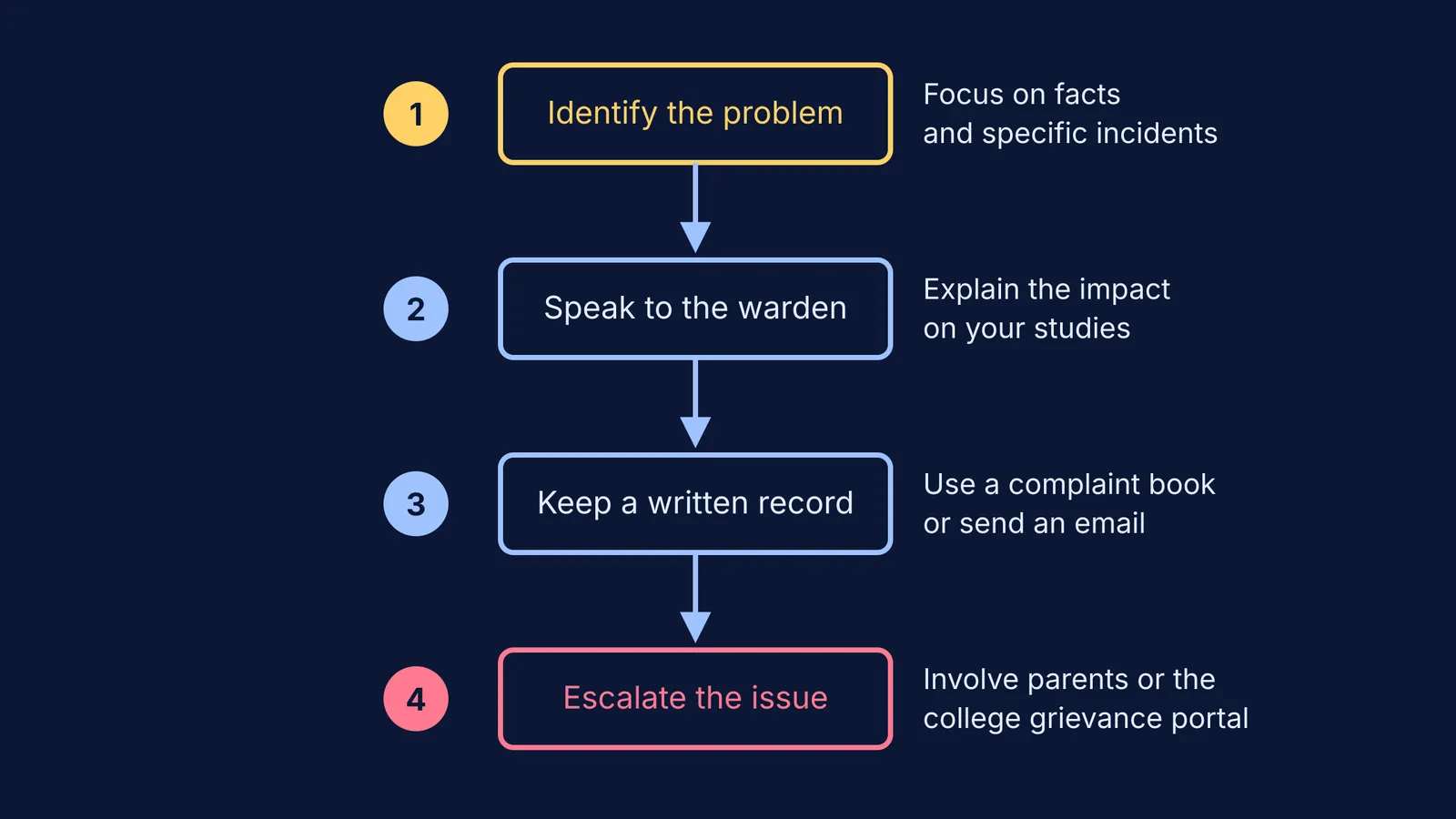
Try the three-step conversation framework:
State the fact: Describe exactly what is wrong, without exaggerating. "The Wi-Fi on the third floor has been dropping every evening since Tuesday" is better than "The internet here is terrible."
Explain the impact: Tell the warden how the issue affects your academic work, health or safety. "This makes it hard to complete our online assignments."
Propose a simple fix: Give them a clear action to take. "Could we have the router restarted or checked by the IT team?"
Why should you keep a written record?
Conversations are easily forgotten. If the problem is not fixed after you speak to the warden, you need a written record to show that you tried to resolve it informally. This is not about building a case against the warden, but about helping them track maintenance requests.
Most hostels have a maintenance register or a complaint book. If yours does, write the date, the specific issue, and your room number. Take a photo of the entry with your phone so you know exactly when you reported it.
If there is no register, send a polite email to the warden summarising your conversation. A simple message like, "Dear Sir/Ma'am, following our conversation this morning about the broken window latch in Room 304, I am just leaving a note here so it can be passed to maintenance. Thank you for your help," creates a clear paper trail without sounding aggressive. This is a good habit to build, much like building a study routine that lasts. It shows that you are organized and serious about the issue.
When should you involve your parents or the UGC?
If you have spoken to the warden and left a written record, but the issue remains unresolved after a week or two, it is time to escalate the problem to the next level.
For serious health, hygiene or safety concerns, involve your parents immediately. Explain the steps you have already taken. A phone call from a parent often carries more weight with hostel administration than a complaint from a student, simply because institutions feel accountable to the parents paying the fees.
For persistent institutional failures—such as unjustified fees, severe infrastructure neglect, discrimination or ignored safety issues—you can use official channels. The University Grants Commission (UGC) runs the e-Samadhaan portal, a unified platform for students to register and track grievances 2.
Higher education institutions are required by the UGC to have a Students' Grievance Redressal Committee and to address these complaints in a time-bound manner. If your college ignores your emails, filing a complaint through the portal ensures it is formally logged. By keeping a written record of your earlier attempts to fix the problem locally, you make your formal grievance much stronger and easier for the committee to understand.


