

On this page
Why do people snore while sleeping?
During waking hours, pharyngeal dilator muscles actively contract to keep your upper airway open against atmospheric pressure and the suction of breathing. When you fall asleep, motor tone dampens across both non-rapid eye movement (NREM) and rapid eye movement (REM) stages. Key dilators such as the genioglossus—which holds the tongue base forward—and the tensor veli palatini relax. Without rigid cartilaginous rings like those supporting the trachea, the flexible pharyngeal walls sag inward under gravity, narrowing the airway between the soft palate and the larynx.
A systematic review and meta-analysis led by researchers at the All India Institute of Medical Sciences (AIIMS), New Delhi, published in Sleep Medicine Reviews (Suri et al., 2023), revealed that sleep-disordered breathing affects 11% of Indian adults, with a prevalence of 13% in men and 5% in women. Despite affecting roughly 104 million working-age Indians, many families mistakenly view loud snoring as deep sleep rather than elevated upper airway resistance.
How does the Bernoulli principle trigger soft palate flutter?
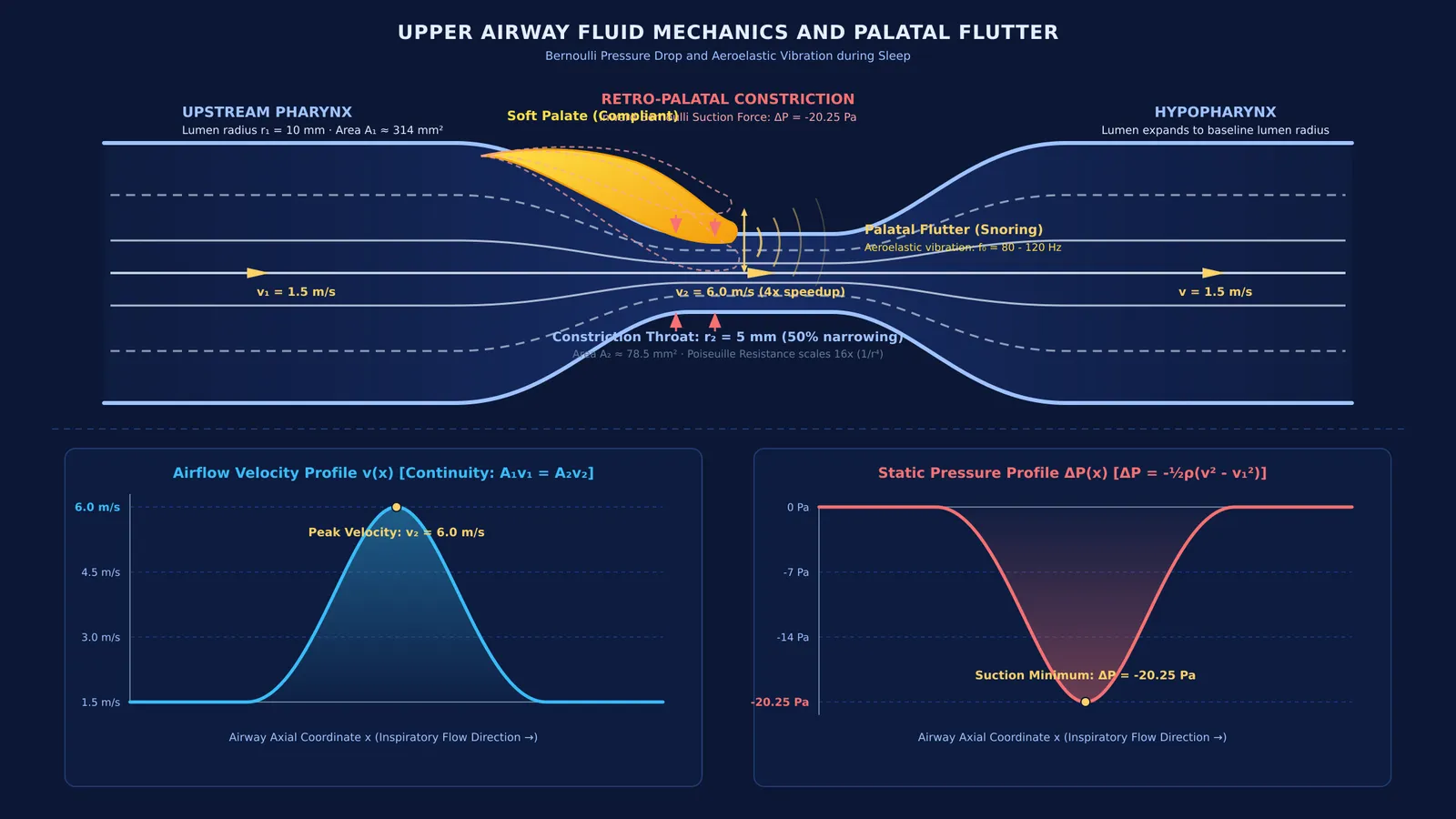
The acoustics of snoring stem directly from fluid dynamics. By the equation of continuity, volumetric flux is conserved: A₁v₁ = A₂v₂. When relaxed throat tissues reduce airway cross-sectional area, inhaled air must accelerate. As air speeds up, Bernoulli's principle dictates that static fluid pressure drops as dynamic pressure rises—an exchange often clarified when avoiding Bernoulli pressure mistakes. In a computed tomography study published in CHEST (Fajdiga, 2005), researchers imaged 40 patients across non-snoring (14 patients), moderately loud snoring (13 patients), and loud snoring (13 patients) cohorts. The scans confirmed that pharyngeal narrowing creates a Venturi effect: dropping static pressure sucks the elongated soft palate inward, causing repetitive airway closure.
This fluid-structure interaction is known as aeroelastic flutter. An acoustic modeling study in The Journal of the Acoustical Society of America (Huang, 1995) showed that once inspiratory airflow exceeds a critical velocity threshold, the soft palate acts like a cantilevered plate fluttering in axial flow. This self-sustained vibration produces sound waves with a fundamental frequency between 80 Hz and 120 Hz, accompanied by harmonic overtones.
Consider the numbers for a sleeping person. Normal resting inhalation through an open pharyngeal lumen with radius 10 mm (area A₁ ≈ 314 mm²) has flow velocity v₁ = 1.5 m/s. If relaxed tissues cause a 50% radius reduction to 5 mm (area A₂ ≈ 78.5 mm²), air speed quadruples to v₂ = 6.0 m/s. With air density ρ = 1.2 kg/m³, the Bernoulli static pressure drop is ΔP = 0.5 × ρ × (v₂² - v₁²) = 0.5 × 1.2 × (36.0 - 2.25) ≈ 20.25 Pa. By Poiseuille's law, flow resistance scales inversely with the fourth power of radius (R ∝ 1/r⁴), so halving the airway radius multiplies flow resistance by a factor of 16.
For students exploring how physical laws govern biological systems, the Fermi Simulation Lab provides interactive simulations for ideas that are easier to see than read, letting you observe how fluid velocity and pressure differentials interact in real time.
When does snoring signal obstructive sleep apnea?
In primary snoring, tissue vibration produces audible sound waves without choking off ventilation. These vibrations radiate as displacement and pressure waves in sound through oral and nasal cavities while blood oxygen remains stable. In obstructive sleep apnea (OSA), however, negative transmural pressure causes complete airway collapse (apnea) or a partial closure reducing airflow by at least 30% (hypopnea) for 10 seconds or longer, as detailed in Sleep Medicine Reviews (Suri et al., 2023).
When breathing halts, oxygen levels drop (hypoxia) and carbon dioxide accumulates (hypercapnia). Chemoreceptors trigger an emergency micro-arousal that briefly wakes the sleeper to restore muscle tone. When repeated dozens of times hourly, this fragmentation disrupts restorative slow-wave and REM sleep, causing daytime exhaustion, morning headaches, and reduced concentration in school.
How can students and families check airway risk and sleep quality?
To evaluate airway risk, clinicians rely on the validated STOP-Bang questionnaire published in Anesthesiology (Chung et al., 2008). It scores eight Yes/No indicators: loud Snoring, daytime Tiredness, Observed breathing pauses, high blood Pressure, BMI greater than 35 kg/m², Age older than 50, Neck circumference over 40 cm, and male Gender. Scoring 0 to 2 indicates low risk, 3 to 4 intermediate risk, and 5 to 8 high risk of obstructive sleep apnea.
For simple snoring without apnea, sleep posture makes an immediate difference. Sleeping on your side prevents gravity from pulling the tongue base and soft palate backward. Maintaining consistent sleep hours, staying hydrated, and avoiding heavy late meals help preserve upper airway muscle tone.
Connecting fluid mechanics to human physiology turns everyday observations into clear science, whether you are examining airway resistance at home or exploring wave mechanics in your next study session.


