On this page
The NCERT Class 12 Chemistry Part I (Reprint 2026-27) starts at Solutions, with no solid state unit, but the official JEE (Advanced) 2026 syllabus still lists crystal systems, close packing, nearest neighbours, radius ratio and point defects. Every question stays inside that list; descriptive facts follow the NIOS Senior Secondary Chemistry lesson on the solid state. For the chapter plan, read how to prepare solid state for JEE Advanced.
How should you use this practice set?
Allow 35 minutes; sketch the cell or void first.
In "one or more options correct" questions, judge each option alone; our guide to JEE Advanced question types explains the formats.
Use N_A = 6.022 × 10²³ mol⁻¹.
Easy: crystal systems and close packing
Q1 (easy, single-correct). A unit cell has a = b ≠ c and α = β = γ = 90°. Which crystal system is it, and which lattice types does that system allow?
(A) Tetragonal; primitive and body-centred only (B) Tetragonal; primitive, body-centred and face-centred (C) Orthorhombic; primitive, end-centred, body-centred and face-centred (D) Hexagonal; primitive only
Answer: (A). That is tetragonal, and the NIOS table allows only P and I lattices. Trap: (D) spots a = b ≠ c but forgets that hexagonal needs γ = 120°.
Q2 (easy, one or more options correct). Which statements about packing identical spheres are correct?
(A) hcp and ccp both give 12 nearest neighbours and the same packing fraction. (B) ccp follows an ABCABC stacking; hcp follows ABAB. (C) A close-packed array of N spheres has N tetrahedral and 2N octahedral voids. (D) A bcc arrangement is close packed, with 12 nearest neighbours.
Answer: (A), (B). Each sphere touches 6 in its layer and 3 above and below, and both fill π/(3√2), about 74%, of space. (C) swaps the voids: there are 2N tetrahedral and N octahedral. Trap: (D); bcc has 8 nearest neighbours and fills about 68%.
Medium: voids, formulas and structures
Q3 (medium, single-correct). Oxide ions form a ccp lattice; ions of metal M (M²⁺ and M³⁺ only) occupy a quarter of the tetrahedral voids and a quarter of the octahedral voids. What fraction of M is M³⁺?
(A) 1/3 (B) 1/2 (C) 2/3 (D) 3/4
Answer: (C). Per 4 oxide ions: 8 tetrahedral and 4 octahedral voids, so 2 + 1 = 3 M and the formula is M₃O₄. Then 2x + 3(3 − x) = 8 gives x = 1 M²⁺, so two of three are M³⁺. Trap: (A) is the M²⁺ fraction.
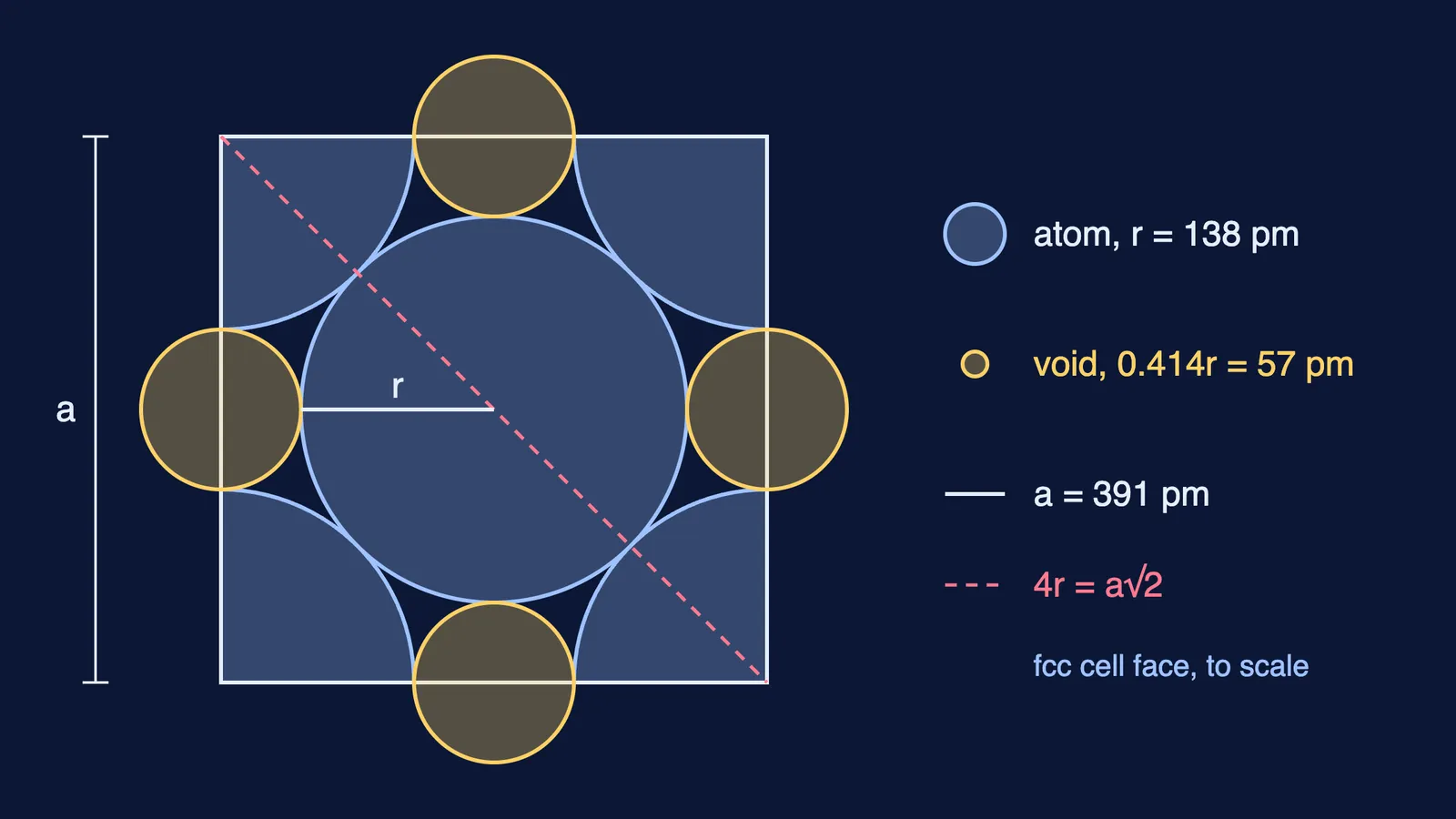
Q4 (medium, numerical-value). A metal of molar mass 92.0 g mol⁻¹ has an fcc lattice and density 10.2 g cm⁻³. Find the radius (nearest pm) of the largest sphere an octahedral void holds without distortion.
Answer: 57. a³ = 4M/(ρN_A) gives a = 391 pm. Atoms touch along the face diagonal, so r = √2a/4 = 138 pm, and the octahedral void holds 0.414r = 57 pm. Trap: 31 pm uses the tetrahedral factor 0.225.
Q5 (medium, list-match). Match List-I with the cation : anion coordination numbers in List-II.
List-I: (P) CsCl (Q) zinc blende, ZnS (R) fluorite, CaF₂ (S) antifluorite, Na₂O
List-II: (1) 8 : 4 (2) 4 : 4 (3) 6 : 6 (4) 8 : 8 (5) 4 : 8
(A) P→4, Q→2, R→1, S→5 (B) P→4, Q→3, R→1, S→5 (C) P→4, Q→2, R→5, S→1 (D) P→3, Q→2, R→1, S→5
Answer: (A). CsCl: each ion sits inside a cube of 8 opposite ions. Zinc blende: Zn²⁺ fills alternate tetrahedral voids of ccp S²⁻, so 4 : 4. Fluorite: F⁻ fills the tetrahedral voids of fcc Ca²⁺, giving F⁻ 4 neighbours and Ca²⁺ 8. Antifluorite swaps the ions. Trap: (C) reverses fluorite and antifluorite.
Hard: radius ratio, bcc versus fcc, and defects
Q6 (hard, numerical-value). In a zinc-blende-type compound MX (molar mass 112 g mol⁻¹), r(M²⁺) = 60 pm and r(X²⁻) = 200 pm. Find the density in g cm⁻³ to two decimal places.
Answer: 3.44. The ratio 0.30 is in the 0.225 to 0.414 tetrahedral range, so ions touch along a quarter of the body diagonal: √3a/4 = 260 pm, a = 600.4 pm. Anions are 424.6 pm apart (more than 400 pm), so they do not touch. With 4 formula units per cell, ρ = 4M/(N_A a³). Trap: the rock-salt shortcut a = 2(r₊ + r₋) gives 5.29.
Q7 (hard, one or more options correct). Atoms of radius r pack as bcc in one metal and fcc in another. Which are correct?
(A) At equal r and molar mass, the fcc metal is about 9% denser than the bcc one. (B) In bcc, each atom has 6 second-nearest neighbours, at 1.155 times the nearest-neighbour distance. (C) In fcc, the nearest-neighbour distance is a/2. (D) A sphere of radius 0.414r fits at a bcc face centre without distortion.
Answer: (A), (B). Density scales with packing fraction: 0.7405/0.6802 = 1.089. In bcc, nearest neighbours are √3a/2 away and the next 6 are a away: ratio 2/√3. (C) fails: fcc neighbours are a/√2 apart. (D) fails: the face centre is a/2 = 1.155r from the two body-centre atoms beside it, leaving room for only 0.155r. Trap: (D) borrows the fcc result.
Q8 (hard, one or more options correct). In a rock-salt-type crystal MX, 2.0% of the cations move into tetrahedral voids of the anion ccp lattice (Frenkel defects). Which are correct?
(A) The density of the crystal is unchanged. (B) About 1.0% of the tetrahedral voids are now occupied. (C) The formula becomes M₀.₉₈X. (D) Frenkel defects are favoured when cation and anion are of similar size.
Answer: (A), (B). A Frenkel defect moves an ion without removing it, so mass, volume and formula stay the same. Each cell has 4 cations and 8 tetrahedral voids: 0.08 ÷ 8 = 1.0%. NIOS links Frenkel defects to ions of very different size, such as AgBr. Trap: (C) counts moved ions as missing.
What should you do after this set?
Q1, Q2 or Q5 missed: redraw the crystal systems and structures from memory.
Q3, Q4 or Q6 missed: count voids per cell and write the contact line first.
Q7 or Q8 missed: track mass, volume and formula one at a time.
After a mock, see how to review a JEE Advanced paper.
Got the formula right but the method wrong? The Fermi Problem Library has worked problems with a step-by-step solver that explains the reasoning rather than printing an answer.