On this page
Solid state is an odd unit: the JEE (Advanced) syllabus still lists it, but the current NCERT book and the JEE Main syllabus no longer carry it, so board or Main preparation will not cover it.
Is solid state still in the JEE Advanced syllabus?
Yes. The official JEE (Advanced) 2026 syllabus lists Solid State under physical chemistry, and notes that the 2026 syllabus is the same as 2025's. Its topic list reads: "Classification of solids, crystalline state, seven crystal systems (cell parameters a, b, c, α, β, γ), close packed structure of solids (cubic and hexagonal), packing in fcc, bcc and hcp lattices; Nearest neighbours, ionic radii and radius ratio, point defects."
The 2027 syllabus has not been published yet (as of 19 November 2026). What the JEE (Advanced) 2027 website does say is that the exam is on 23 May 2027 (Sunday), organised by IIT Delhi. To sit it you must be among the top 2,50,000 in the B.E./B.Tech. paper of JEE (Main) 2027 (eligibility criteria).
Density is not named, but it follows from unit cells and packing, so expect to compute it.
Is solid state in NCERT and JEE Main?
No, and this is the honest catch. The NCERT Class 12 Chemistry Part I, reprint 2026-27, begins with Unit 1 Solutions; there is no Solid State unit. The JEE (Main) 2027 syllabus published by NTA lists 20 chemistry units, and none of them is solid state. See our guide to the 20 JEE Main chemistry units.
So study from an older NCERT edition or a standard physical chemistry text, read against the official list above, and skip topics it does not name.
How do Advanced questions on solid state work?
Practise problems that join two ideas: a unit cell plus a defect, or a radius ratio plus an edge length. The format changes yearly and is announced in the paper. For reference, JEE (Advanced) 2026 had two compulsory papers of three hours each (2026 Information Brochure). Our explainer covers JEE Advanced question types.
Worked example 1: density and a defect. A salt MX has the rock-salt structure, edge length a = 600 pm and molar mass 75 g/mol. Its measured density is 2.290 g/cm³. Which point defect is present, and what fraction of ion sites is vacant?
Rock salt has 4 formula units per cell, so the ideal density is ρ = 4M / (N_A a³).
a³ = (6.00 × 10⁻⁸ cm)³ = 2.16 × 10⁻²² cm³, so ρ = 300 / (6.022 × 10²³ × 2.16 × 10⁻²²) = 2.306 g/cm³.
The measured density is lower, so ions are missing: a Schottky defect. A Frenkel defect only moves an ion to an interstitial site, so density is unchanged.
Vacant fraction = 1 − 2.290/2.306 ≈ 0.0071, about 0.71% of the cation sites and the same fraction of the anion sites.
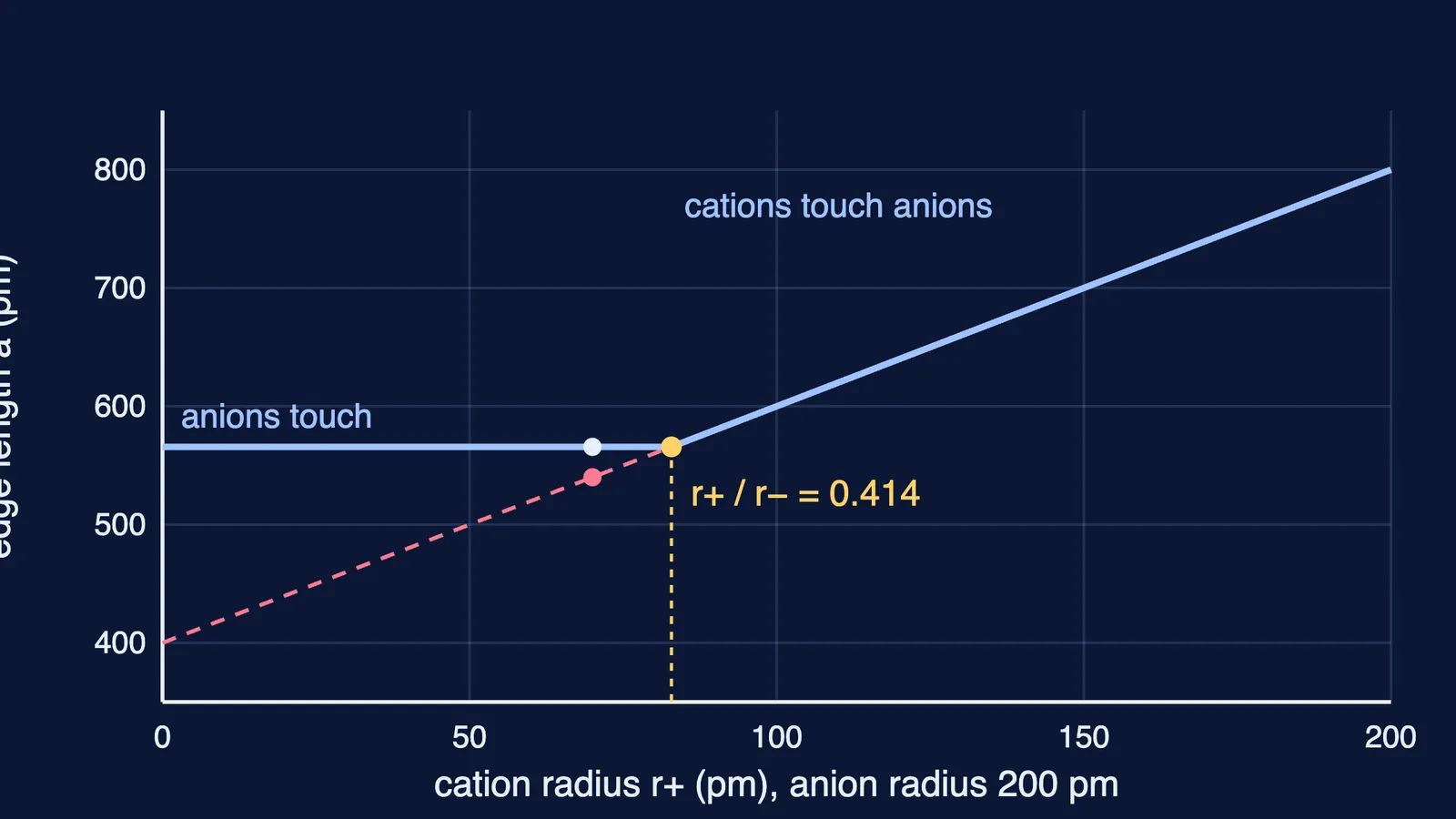
Worked example 2: when the radius ratio changes the geometry. A rock-salt-type crystal has anion radius 200 pm and cation radius 70 pm. Find the edge length.
The radius ratio is 70/200 = 0.35.
The quick formula a = 2(r₊ + r₋) gives 540 pm. Check it: neighbouring anions would sit 540/√2 = 382 pm apart, but they need 400 pm.
Below the limiting ratio √2 − 1 = 0.414 for octahedral holes, anions touch along the face diagonal, so a = 2√2 × 200 = 566 pm.
Limiting-case check: at exactly 0.414 both formulas give 566 pm. A ratio of 0.35 lies between 0.225 and 0.414, so the radius-ratio rule predicts tetrahedral (4-coordinate) sites instead.
What should your practice plan look like?
One way to split it over three weeks:
Week 1: crystal systems, atoms per cell, nearest neighbours for sc, bcc, fcc and hcp. Derive the packing fractions π/6, √3π/8 and π/(3√2) yourself.
Week 2: density, voids, formulas from void occupancy, radius ratio.
Week 3: point defects, then mixed problems against a timer.
Before each answer, check units and a limiting case.
Practice:
A metal is fcc with a = 400 pm and M = 60 g/mol. Find its density and atomic radius.
A bcc metal has atomic radius 150 pm. Find a, the nearest-neighbour distance and how many nearest neighbours each atom has.
Anions form a ccp lattice; cations fill all octahedral voids and a quarter of the tetrahedral voids. What is the formula?
Answers: (1) 6.23 g/cm³ and 141 pm; (2) 346 pm, 300 pm, 8; (3) C₃A₂ (6 cations to 4 anions per cell).
After a mock, use our guide on how to review a JEE Advanced paper.
Got the formula right but the method wrong? The Fermi Problem Library has worked problems with a step-by-step solver that explains the reasoning rather than printing an answer. If a 3D cell is hard to picture, the Fermi Simulation Lab has interactive simulations for the ideas that are easier to see than to read.