On this page
Eight original JEE Advanced-style questions, easy to hard, labelled by type: single correct, one or more correct, numerical or list match. Each solution ends with the trap behind the most tempting wrong answer.
How should you use this JEE Advanced set?
The official JEE (Advanced) 2026 syllabus lists Henry's law, Raoult's law, colligative properties and the van't Hoff factor under Solutions, and adsorption, the Freundlich isotherm and colloids under Surface Chemistry. Every question stays inside it.
Data come from NCERT Class 12 Chemistry, Unit 1 (Reprint 2026-27): KH at 293 K is 34.86 kbar for O₂ and 76.48 kbar for N₂; Kf is 1.86 K kg mol⁻¹ for water and 5.12 K kg mol⁻¹ for benzene. Current NCERT books drop surface chemistry, so those facts follow the NIOS Senior Secondary Chemistry lessons on adsorption and colloids.
Allow 30 minutes on paper, and in "one or more correct" questions judge each option on its own.
For the chapter plan, read how to prepare solutions and surface chemistry for JEE Advanced. For the formats, see JEE Advanced question types.
Easy: Henry's law and the two kinds of adsorption
Q1 (easy, single correct). Water at 293 K is saturated with 30 mol% O₂ and 70 mol% N₂ at 10 bar. Among the dissolved O₂ and N₂ molecules, the mole fraction of O₂ is closest to:
(A) 0.30
(B) 0.48
(C) 0.16
(D) 0.70
Answer: (B). By Henry's law, x = p/KH, so compare (gas fraction)/KH: 0.30/34.86 = 0.00861 and 0.70/76.48 = 0.00915. The O₂ share is 0.00861/(0.00861 + 0.00915) = 0.48. Trap: (C), from multiplying by KH; a larger KH means lower solubility.
Q2 (easy, one or more options correct). Which statements about adsorption of a gas on a solid are correct?
(A) Physical adsorption has an enthalpy of about 10 to 40 kJ mol⁻¹ and can build several layers.
(B) Chemisorption falls steadily as temperature rises from the start.
(C) Chemisorption is highly specific and forms a single layer.
(D) Physical adsorption needs a significant activation energy.
Answer: (A), (C). Physisorption needs no activation energy; chemisorption does, so it first rises, then falls with temperature. Trap: (B), which describes physisorption.
Medium: Freundlich, colloid charge and vapour pressure
Q3 (medium, numerical). For a gas on charcoal at fixed temperature, the plot of log(x/m) against log p is a straight line of slope 0.40. At 1.0 bar, x/m = 0.20 g g⁻¹. At what pressure, in bar, does x/m reach 0.60 g g⁻¹?
Answer: 15.6. Slope = 1/n, so tripling x/m needs p^0.40 = 3, so p = 3^2.5 = 15.6 bar. Trap: 7.5, from dividing 3 by 0.40 instead of raising 3 to the power 1/0.40.
Q4 (medium, one or more options correct). Which statements are correct?
(A) Freshly precipitated Fe(OH)₃ shaken with a little FeCl₃ solution gives a positively charged sol, because Fe³⁺ ions are adsorbed.
(B) Gelatin in hot water gives a lyophobic, irreversible sol.
(C) In electrophoresis, the particles of an As₂S₃ sol move towards the anode.
(D) Alum clears muddy water by giving clay particles a positive charge that keeps them suspended.
Answer: (A), (C). (A) is peptisation. Negative As₂S₃ particles move to the anode. Gelatin gives a lyophilic, reversible sol. Trap: (D). Al³⁺ neutralises the negative mud particles, so they settle.
Q5 (medium, single correct). An aqueous solution of a non-volatile non-electrolyte shows a relative lowering of vapour pressure of 0.0054. Its freezing point is closest to:
(A) −0.010 °C
(B) −0.16 °C
(C) −0.56 °C
(D) −0.30 °C
Answer: (C). Solute mole fraction = 0.0054; with 55.5 mol of water per kg, n = 0.0054 × 55.5/(1 − 0.0054) = 0.30 mol, so m = 0.30 mol kg⁻¹ and ΔTf = 1.86 × 0.30 = 0.56 K. Trap: (A), which treats the mole fraction as the molality.
Hard: particle counting across two chapters
Q6 (hard, list match). Match each 0.10 mol kg⁻¹ solution with its freezing-point depression.
List-I: (P) K₄[Fe(CN)₆] in water, fully dissociated; (Q) benzoic acid in benzene, 60% dimerised; (R) a weak monobasic acid in water, 20% ionised; (S) [Co(NH₃)₅Cl]Cl₂ in water, fully dissociated.
List-II: (1) 0.22 K; (2) 0.36 K; (3) 0.56 K; (4) 0.74 K; (5) 0.93 K.
(A) P-5, Q-2, R-1, S-3
(B) P-5, Q-2, R-1, S-4
(C) P-4, Q-2, R-1, S-3
(D) P-5, Q-1, R-2, S-3
Answer: (A). The van't Hoff factors are 5, 1 − 0.60/2 = 0.70, 1.20 and 3. That gives 1.86 × 0.10 × 5 = 0.93 K, 5.12 × 0.10 × 0.70 = 0.36 K, 0.22 K and 0.56 K. Trap: (B), which frees the Cl bound inside the coordination sphere, giving i = 4.
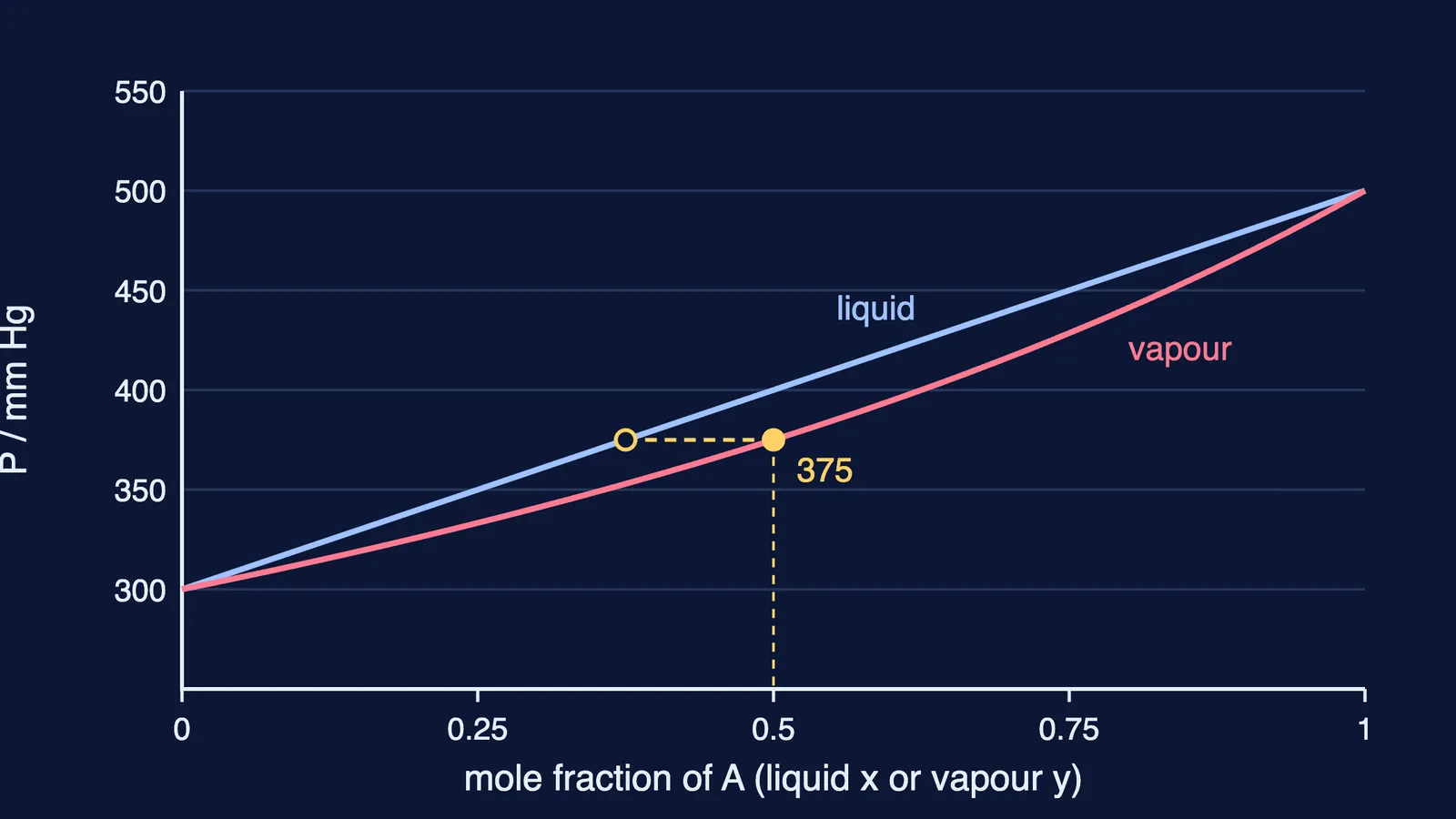
Q7 (hard, numerical). Liquids A and B form an ideal solution. At a fixed temperature, a liquid with x(A) = 0.40 has a total vapour pressure of 380 mm Hg, and one with x(A) = 0.80 has 460 mm Hg. A vapour with y(A) = 0.50 is slowly compressed at this temperature. At what pressure, in mm Hg, does liquid first form?
Answer: 375. P = p°B + (p°A − p°B)x(A) gives p°A = 500 and p°B = 300 mm Hg. At the dew point, 1/P = y(A)/p°A + y(B)/p°B = 0.50/500 + 0.50/300, so P = 375 mm Hg. The first drop has x(A) = 0.375. Trap: 400, the pressure of a liquid with x(A) = 0.50.
Q8 (hard, numerical). 0.030 mol of BaCl₂ is added to 1.00 kg of water holding 0.050 mol of Na₂SO₄. BaSO₄ precipitates completely; soluble salts dissociate fully. Find the freezing-point depression, in K, to two decimal places.
Answer: 0.33. Ba²⁺ removes 0.030 mol of SO₄²⁻, leaving 0.18 mol of ions: Na⁺ 0.10, SO₄²⁻ 0.020, Cl⁻ 0.060. ΔTf = 1.86 × 0.18 = 0.33 K. Trap: 0.45, which ignores the precipitate.
What should you do after checking your answers?
Sort each miss into a bin: gas and vapour (Q1, Q7), surface chemistry (Q2, Q3, Q4) or particle counting (Q5, Q6, Q8), and practise the fullest one first. For Q3, our walkthrough of the Freundlich isotherm graph shows how to read 1/n and k from a log plot.
If a whole method breaks down, the Fermi Problem Library has worked problems with a step-by-step solver that explains the reasoning rather than printing an answer.
Redo your misses in three days, answers covered.