On this page
Solutions and surface chemistry sit together in the JEE Advanced syllabus, but only solutions is still in your Class 12 NCERT books. Here are the official topics, three original worked examples and a plan.
What does the JEE Advanced syllabus say about solutions and surface chemistry?
The official JEE (Advanced) 2026 Syllabus notes that it is the same as the 2025 syllabus. Its Solutions section reads: "Henry's law; Raoult's law; Ideal solutions; Colligative properties: lowering of vapour pressure, elevation of boiling point, depression of freezing point, and osmotic pressure; van't Hoff factor."
Its Surface Chemistry section reads: "Elementary concepts of adsorption: Physisorption and Chemisorption, Freundlich adsorption isotherm; Colloids: types, methods of preparation and general properties; Elementary ideas of emulsions, surfactants and micelles (only definitions and examples)."
The 2027 syllabus is not published yet (as of 19 November 2026). The JEE (Advanced) 2027 website says the exam will be held on 23 May 2027 (Sunday), organised by IIT Delhi. Eligibility includes a place in the top 2,50,000 of the JEE (Main) 2027 B.E./B.Tech. paper (eligibility criteria).
Is surface chemistry still in NCERT and JEE Main?
No. The current NCERT Class 12 Chemistry books (Part I and Part II, Reprint 2026-27) list no Surface Chemistry unit. Unit 5 of the NTA's Syllabus for JEE (Main) - 2027 covers solutions, and that document names no adsorption or colloids.
So surface chemistry is the clearest item JEE Advanced adds. Learn it from a reference book, within the syllabus limits. For solutions, build on our solutions guide for JEE Main with multi-step problems.
JEE (Advanced) 2026 had two compulsory papers of three hours each (2026 Information Brochure); question types and marking are announced in each paper. See our post on JEE Advanced question types.
Worked example 1: why measure an enzyme's molar mass by osmotic pressure?
0.90 g of an enzyme in 150 mL of aqueous solution gives an osmotic pressure of 2.32 torr at 310 K. Find its molar mass. Use R = 0.0821 L atm mol⁻¹ K⁻¹.
π = 2.32 / 760 = 3.05 × 10⁻³ atm.
M = wRT / (πV) = 0.90 × 0.0821 × 310 / (3.05 × 10⁻³ × 0.150) ≈ 5.0 × 10⁴ g mol⁻¹.
Check: the solution is about 1.2 × 10⁻⁴ mol kg⁻¹, so with Kf for water = 1.86 K kg mol⁻¹ (NCERT Class 12 Chemistry, Unit 1) the freezing point drops by about 0.0002 K. Too small to measure, so use osmotic pressure for large molecules.
Worked example 2: how does vapour composition differ from liquid composition?
Liquids A and B form an ideal solution with p°A = 120 torr and p°B = 40 torr. The vapour above a mixture has equal moles of A and B. Find the liquid's composition and pressure, then the vapour over the condensed vapour.
Raoult's law: equal vapour moles means pA = pB, so 120xA = 40(1 − xA) and xA = 0.25.
Total pressure: P = 30 + 30 = 60 torr.
The condensed vapour is a liquid with xA = 0.50. Its pressure is 60 + 20 = 80 torr, and its vapour has yA = 60/80 = 0.75.
Each step enriches the more volatile A. Check the limits: P equals p°B at xA = 0 and p°A at xA = 1.
Worked example 3: what does a Freundlich isotherm predict?
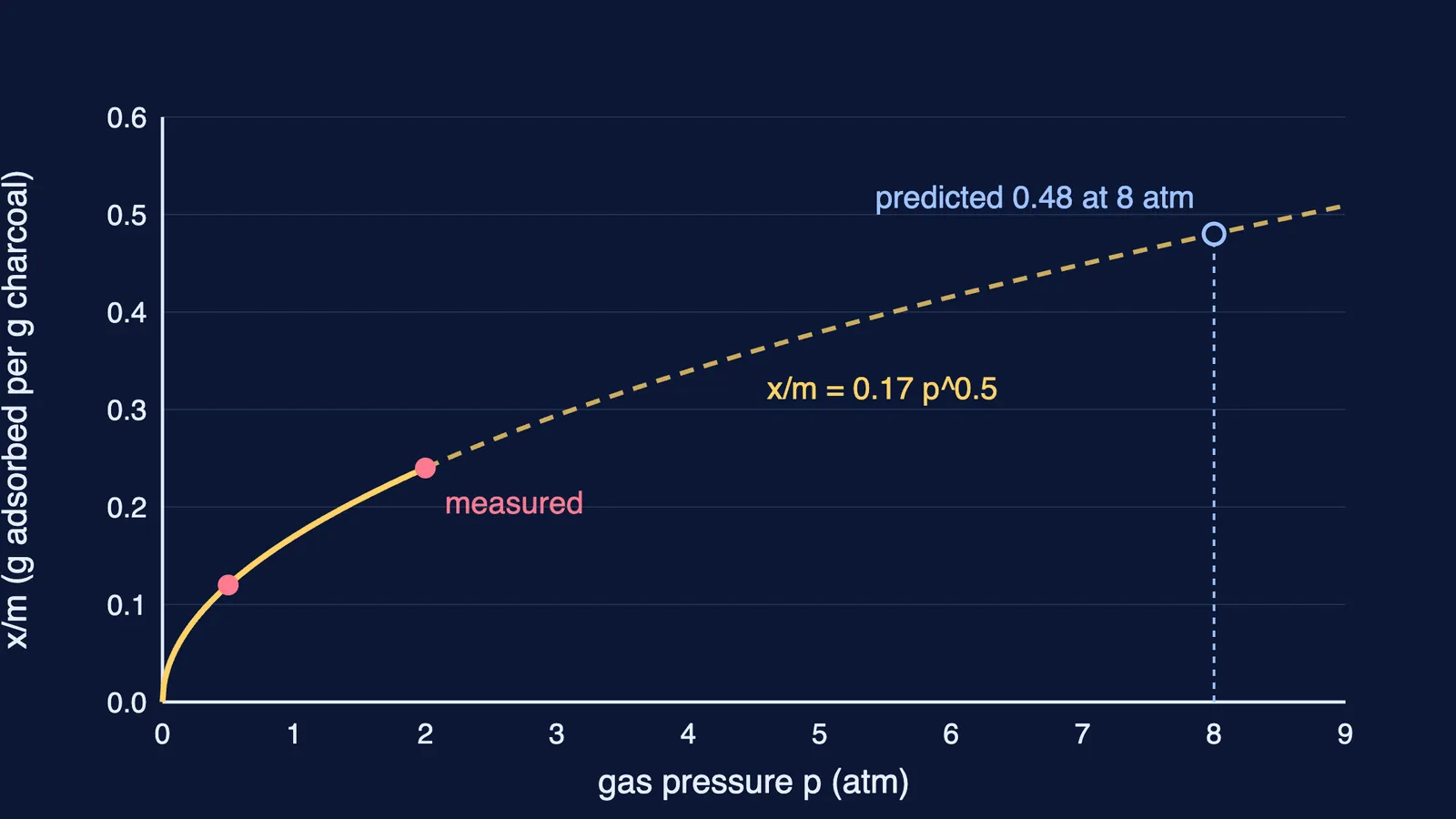
A gas on charcoal follows x/m = kp^(1/n), with x/m = 0.12 g per g at 0.50 atm and 0.24 g per g at 2.00 atm. Find 1/n and k, and predict x/m at 8.0 atm.
Divide: 2 = 4^(1/n), so 1/n = 0.50.
k = 0.12 / 0.50^0.5 ≈ 0.17 g per g at 1 atm.
At 8.0 atm: x/m = 0.17 × 8^0.5 ≈ 0.48 g per g.
The trap: Freundlich's equation misses the levelling-off at high pressure as the surface fills, so distrust long extrapolations. Our Freundlich isotherm graph explainer shows how to read 1/n and k from a log plot.
How should you practise for JEE Advanced?
About an hour a day for two weeks:
Days 1-3: Raoult's law, ideal solutions, vapour composition, Henry's law.
Days 4-6: the four colligative properties and molar mass from each.
Days 7-8: van't Hoff factor, dissociation and association.
Days 9-11: adsorption, physisorption versus chemisorption, Freundlich isotherm.
Days 12-13: colloids; definitions of emulsions, surfactants and micelles.
Day 14: a mixed timed set; note the failed step for each miss.
Stuck midway? The Fermi Problem Library has worked problems with a step-by-step solver that explains the reasoning rather than printing an answer.
Practice (Kf for water = 1.86 K kg mol⁻¹):
1.20 g of a non-electrolyte in 60.0 g of water lowers the freezing point by 0.248 K. Find its molar mass. Answer: 150 g mol⁻¹.
A 0.100 mol kg⁻¹ aqueous solution of a weak monoprotic acid freezes at −0.205 °C. Find its degree of dissociation. Answer: about 0.10.