On this page
A JEE Advanced-style carbonyl problem can chain steps: which aldehyde is oxidised, how many Grignard equivalents, then a haloform test.
What does the JEE Advanced syllabus include for aldehydes, ketones and carboxylic acids?
The official JEE (Advanced) 2026 Syllabus says it is unchanged from 2025. Under Aldehydes and Ketones it lists: "Preparation of: aldehydes and ketones from acid chlorides and nitriles; aldehydes from esters; benzaldehyde from toluene and benzene; Reactions: oxidation, reduction, oxime and hydrazone formation; Aldol condensation, Cannizzaro reaction; Haloform reaction; Nucleophilic addition reaction with RMgX, NaHSO3, HCN, alcohol, amine."
Under Carboxylic Acids it lists: "Physical properties; Preparation: from nitriles, Grignard reagents, hydrolysis of esters and amides; Preparation of benzoic acid from alkylbenzenes; Reactions: reduction, halogenation, formation of esters, acid chlorides and amides."
The 2027 syllabus is not published yet (as of 19 November 2026). The JEE (Advanced) 2027 website says the exam will be held on 23 May 2027 (Sunday), organised by IIT Delhi. To be eligible you must be among the top 2,50,000 candidates in the B.E./B.Tech. paper of JEE (Main) 2027, plus other eligibility criteria.
How is JEE Advanced different from JEE Main here?
Unit 17 of the NTA's Syllabus for JEE (Main) - 2027 (under "General methods of preparation, properties, reactions and uses") covers aldehydes and ketones through nucleophilic addition, Grignard reagent, Wolff-Kishner and Clemmensen reduction, aldol, Cannizzaro and haloform reactions. For carboxylic acids it names only "Acidic strength and factors affecting it". The JEE Advanced list names more routes:
aldehydes from esters, and aldehydes and ketones from acid chlorides and nitriles
benzaldehyde from toluene and benzene; benzoic acid from alkylbenzenes
addition of NaHSO3 and alcohols
acids from nitriles, Grignard reagents and hydrolysis of esters and amides; halogenation; acid chlorides and amides
Start from our aldehydes, ketones and carboxylic acids guide for JEE Main and the Class 12 board guide to this chapter. JEE (Advanced) 2026 had two compulsory papers of three hours each (2026 Information Brochure); do not rely on a fixed pattern. Practise single-correct, multiple-correct and numerical-answer thinking; our guide to JEE Advanced question types explains each.
Worked example 1: who gets oxidised in a crossed Cannizzaro reaction?
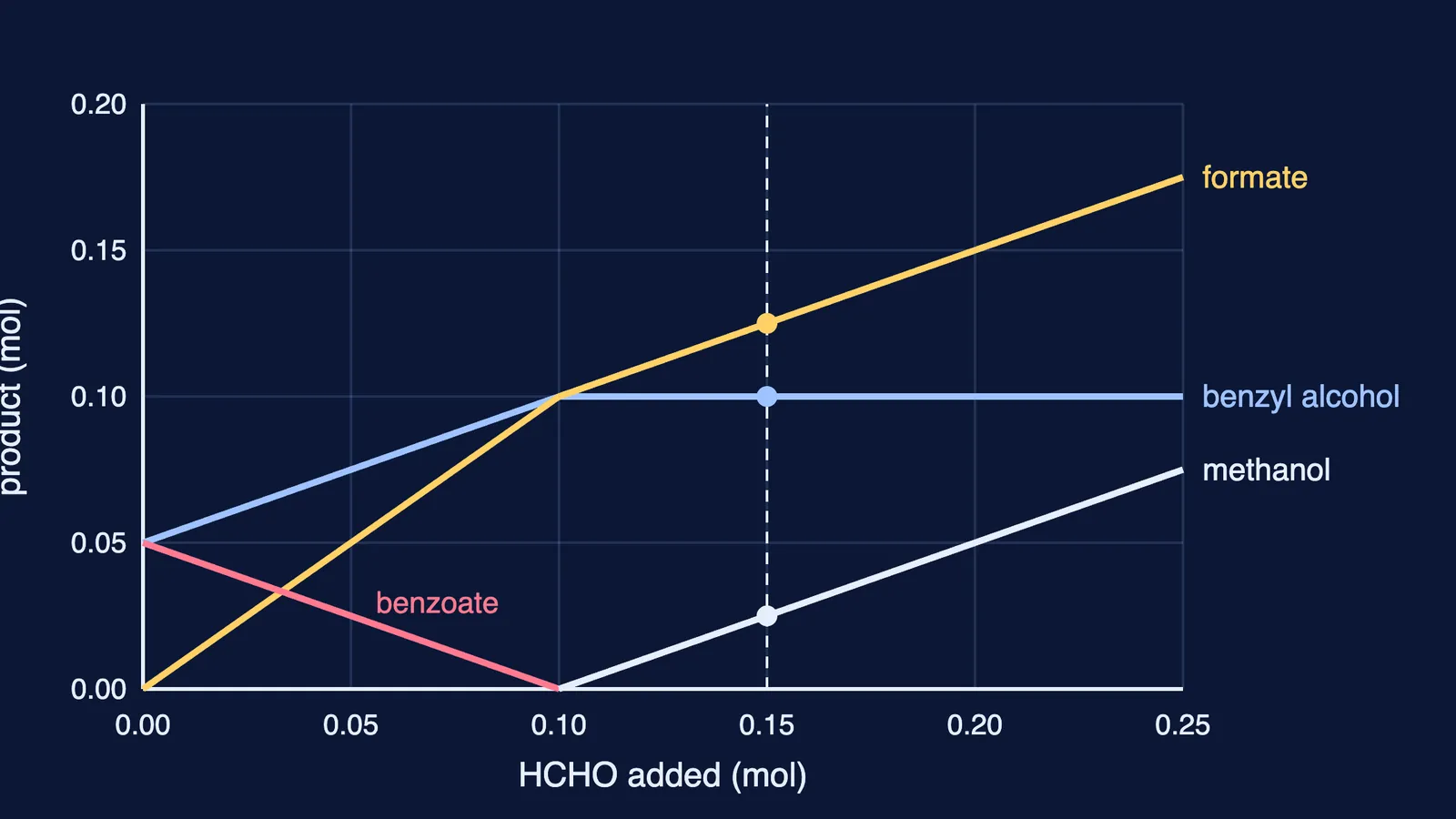
10.6 g of benzaldehyde (0.100 mol) and 4.50 g of formaldehyde (0.150 mol) are warmed with excess concentrated NaOH. Idealised model: the crossed step (HCHO oxidised) runs to completion first, then only leftover HCHO self-reacts. Find the moles of each product and of NaOH used.
Crossed step: PhCHO + HCHO + NaOH → PhCH2OH + HCOONa. Benzaldehyde runs out first: 0.100 mol benzyl alcohol and 0.100 mol sodium formate, with 0.050 mol HCHO left.
The leftover HCHO does its own Cannizzaro: 2HCHO + NaOH → CH3OH + HCOONa, giving 0.025 mol methanol and 0.025 mol more formate.
Totals: 0.100 mol benzyl alcohol (10.8 g), 0.025 mol methanol, 0.125 mol formate, and 0.125 mol NaOH used.
Check: reduced products (0.100 + 0.025 = 0.125 mol) must equal oxidised products (0.125 mol). Real mixtures also self-react in parallel. Limiting case: with no HCHO, ordinary Cannizzaro gives 0.050 mol each of benzyl alcohol and benzoate.
Worked example 2: why does a nitrile take only one Grignard?
5.15 g of benzonitrile (0.0499 mol) is treated with excess CH3MgBr, then aqueous acid, giving acetophenone in 80% yield. The ketone is then warmed with excess I2 and NaOH.
CH3MgBr adds once to C≡N. The imine salt carries a negative charge, so a second Grignard does not add. Hydrolysis gives PhCOCH3: 0.80 × 0.0499 = 0.0399 mol (4.80 g).
Haloform: PhCOCH3 + 3I2 + 4NaOH → PhCOONa + CHI3 + 3NaI + 3H2O. So 0.0399 mol iodoform (15.7 g), using 0.120 mol I2 and 0.160 mol NaOH.
Acidifying gives benzoic acid: 0.0399 mol, or 4.88 g.
The trap: methyl benzoate adds CH3MgBr twice, giving a tertiary alcohol with no haloform test.
How should you practise this unit for JEE Advanced?
Two weeks, about an hour a day:
Days 1-3: preparations from acid chlorides, nitriles and esters; benzaldehyde from toluene and benzene.
Days 4-6: nucleophilic addition with RMgX, NaHSO3, HCN, alcohols and amines; oximes and hydrazones.
Days 7-9: aldol, Cannizzaro and haloform, with mole counting.
Days 10-11: acids from nitriles, Grignard reagents and hydrolysis; benzoic acid from alkylbenzenes.
Days 12-14: acid derivatives, halogenation, then mixed timed sets; note the step behind each miss.
Not sure which step went wrong? The Fermi Problem Library has worked problems with a step-by-step solver that explains the reasoning rather than printing an answer.
Original practice questions:
How many moles of CH3MgBr does 1 mol of methyl 4-hydroxybenzoate consume when the reagent is in excess? Answer: 3 (one for the OH, two for the ester).
0.050 mol of propanoic acid is converted fully into 2-chloropropanoic acid with Cl2 and red phosphorus. Find the mass of product. Answer: 5.43 g.
Which give a positive iodoform test: (A) propan-2-ol (B) pentan-3-one (C) ethanal (D) 1-phenylethanol? Answer: A, C and D.