On this page
This guide is about CBSE board answers in Aldehydes, Ketones and Carboxylic Acids: reasons, tests, named reactions and how to lay them out. For entrance-exam work, see our aldehydes, ketones and carboxylic acids guide for JEE Main.
How many marks is Aldehydes, Ketones and Carboxylic Acids in Class 12?
The CBSE Chemistry curriculum for 2026-27 prints Aldehydes, Ketones and Carboxylic Acids as Unit 8 with 8 marks out of 70, the second-highest unit after Electrochemistry. The same document says no chapter-wise weightage is provided, so treat 8 as a guide to your time, not a promise about questions.
In the 2026-27 sample paper, this unit appears as a 3-mark question on named reactions (Q24) and a 5-mark long answer (Q31). Study from NCERT Unit 8 (Reprint 2026-27); every chemistry fact below is from it.
Which reasons, tests and named reactions does NCERT keep?
Give reasons. Aldehydes are more reactive than ketones in nucleophilic addition for two reasons. Steric: a ketone's two larger groups get in the nucleophile's way. Electronic: two alkyl groups lower the electrophilicity of the carbonyl carbon more than one does. NCERT's own order is butanone < propanone < propanal < ethanal. Benzaldehyde is less reactive than propanal because resonance reduces the polarity of its carbonyl group.
Acidity. Electron-withdrawing groups strengthen a carboxylic acid by stabilising the carboxylate ion; electron-donating groups weaken it. NCERT's pKa values make the point: 4-nitrobenzoic acid 3.41, benzoic acid 4.19, 4-methoxybenzoic acid 4.46. A lower pKa marks a stronger acid.
Tests.
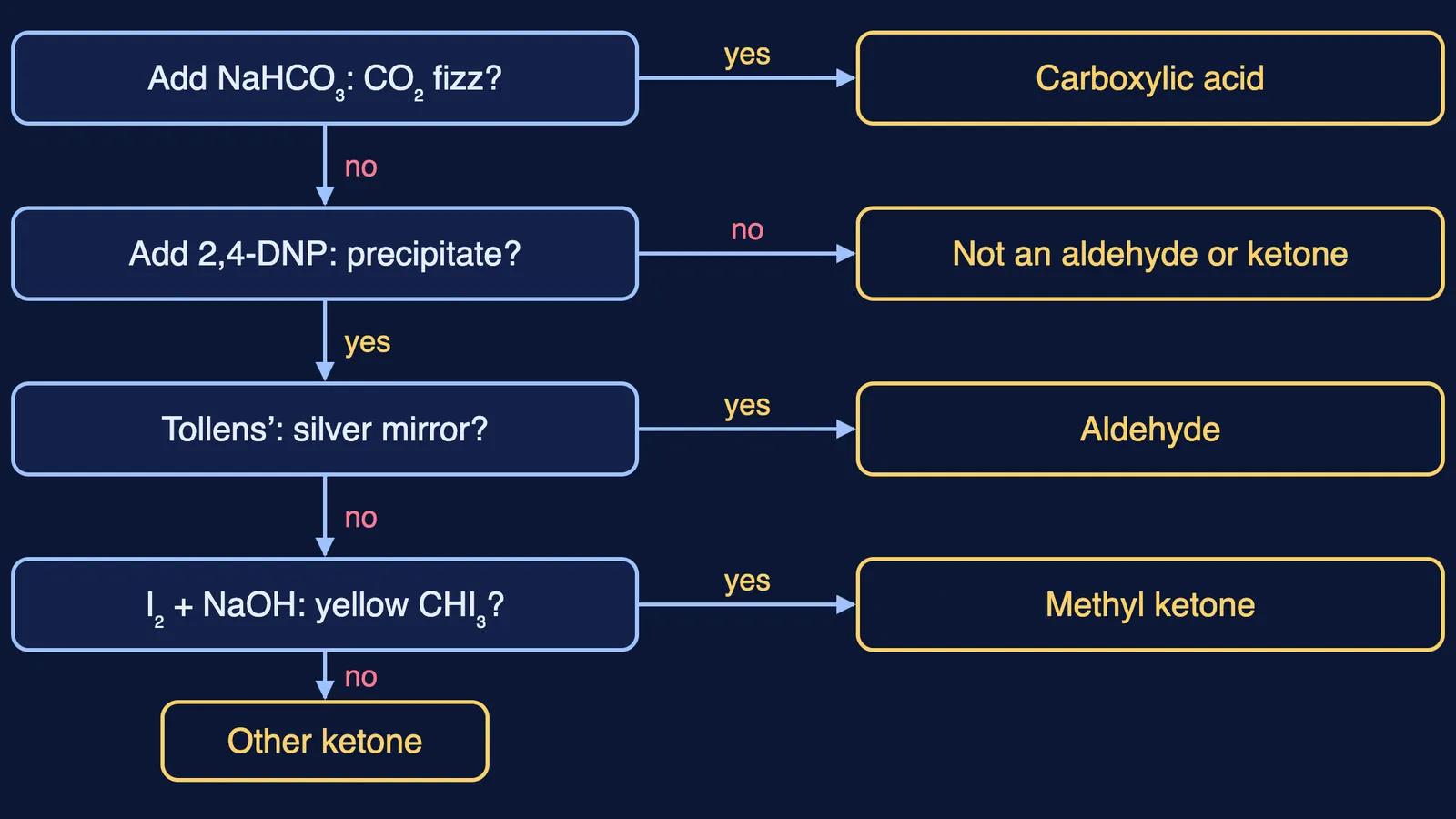
Tollens' reagent: a silver mirror with aldehydes.
Fehling's reagent: a reddish-brown precipitate with aliphatic aldehydes; benzaldehyde and other aromatic aldehydes give no such result.
Iodoform: a yellow precipitate from a CH3CO– or CH3CH(OH)– group.
NaHCO3: carbon dioxide from a carboxylic acid.
Named reactions, as NCERT gives them: Rosenmund (acyl chloride, H2, Pd-BaSO4), Stephen (nitrile, SnCl2/HCl, then hydrolysis), Etard (toluene, CrO2Cl2, then hydrolysis), aldol (at least one α-hydrogen, dilute alkali), Cannizzaro (no α-hydrogen, heated with concentrated alkali), Clemmensen (Zn-Hg, concentrated HCl), Wolff-Kishner (hydrazine, then heating with KOH in ethylene glycol) and HVZ (α-hydrogen, Cl2 or Br2 with red phosphorus).
Conversions. Practise NCERT exercise 8.15, such as ethanol to 3-hydroxybutanal: hot copper to ethanal, then dilute NaOH for aldol. Name every reagent above the arrow.
How do you set out 2-, 3- and 5-mark answers?
2 marks: two separate points. For a distinguishing pair, write the reagent, then what each compound does.
3 marks: the marking scheme gives Q24 half a mark for naming each reaction (aldol, Etard, Wolff-Kishner) and half for the missing reagent or product. Write both, every time.
5 marks: Q31 gives 1 mark per "account for" reason or per order, and ½ + ½ for each step of a test flowchart. Number the parts and put one idea per line.
Our post on comparing acidity step by step shows the layout for order questions.
A distinguishing test, solved twice
Question (NCERT 8.13): Distinguish propanal from propanone.
Route 1, Tollens'. Warm each with Tollens' reagent. Propanal gives a silver mirror; propanone does not.
CH3CH2CHO + 2[Ag(NH3)2]+ + 3OH– → CH3CH2COO– + 2Ag + 2H2O + 4NH3
Route 2, iodoform. Warm each with NaOH and iodine. Propanone has a CH3CO– group and gives yellow iodoform; propanal does not.
CH3COCH3 + 3NaOI → CHI3 + CH3COONa + 2NaOH
Each compound is positive in exactly one of the two tests, so running both gives a cross-check. For more pairs, see benzaldehyde vs acetophenone tests.
Which assertion-reason and case-study traps cost marks?
Both true, but not the reason. "Benzaldehyde does not give Fehling's test" and "aldehydes are oxidised to carboxylate ions" are both NCERT facts, but the second does not explain the first.
Alkali strength. Aldol needs dilute alkali and an α-hydrogen; Cannizzaro needs concentrated alkali and no α-hydrogen. HCHO and benzaldehyde have none, so no aldol.
Iodoform overreach. Ethanol gives iodoform because it oxidises to CH3CHO. Writing "only methyl ketones" leaves the answer incomplete.
Case-study numbers. When a passage gives pKa values, the smaller number is the stronger acid. When it gives a reaction, check the conditions before naming it.
If a wrong method keeps repeating, the Fermi Problem Library has worked problems with a step-by-step solver that explains the reasoning rather than printing an answer.
A seven-day revision plan
Day 1: NCERT 8.1-8.3; write every preparation reaction with reagents.
Day 2: Nucleophilic addition and the reactivity orders, as two-line reasons.
Day 3: Tollens', Fehling's, iodoform and NaHCO3; do all seven pairs in exercise 8.13.
Day 4: All eight named reactions from memory, with conditions.
Day 5: Acidity and substituent effects with NCERT's pKa values.
Day 6: Conversions from exercise 8.15, two steps at most.
Day 7: Q24 and Q31 of the sample paper, marked against the marking scheme.
If a concept such as resonance in the carboxylate ion is still shaky, the Fermi Concept Library covers every concept in chemistry, each with its own lesson.