On this page
For JEE Advanced, p-block chemistry is mostly named compounds. The official JEE (Advanced) 2026 syllabus lists specific compounds for every group from 13 to 18, and says it is the same as the 2025 syllabus. The 2027 syllabus is not yet published; the JEE (Advanced) website says the 2027 exam will be held on 23 May 2027, organised by IIT Delhi.
One problem: the current NCERT books have no p-block chapter. The Class 11 chemistry contents run from Some Basic Concepts of Chemistry to Hydrocarbons, and the Class 12 contents run from Solutions to Biomolecules. So work from the syllabus list.
What does the JEE Advanced syllabus list for p-block?
The general part covers oxidation states and reactivity trends for groups 13 to 17, and the anomalous properties of boron, carbon, nitrogen, oxygen and fluorine. The compounds, as the 2026 syllabus names them:
Group 13: borax, orthoboric acid, diborane, boron trifluoride, aluminium chloride and alums (preparation, properties, uses); reactivity towards acids, alkalis and halogens; uses of boron and aluminium.
Group 14: carbon monoxide, carbon dioxide, silicon dioxide, silicones, silicates, zeolites; allotropes and uses of carbon; reactivity towards water and halogen.
Group 15: reactivity towards hydrogen, oxygen and halogen; dinitrogen, ammonia, nitric acid, phosphine, phosphorus trichloride, phosphorus pentachloride; oxides of nitrogen; oxoacids of phosphorus; allotropes of phosphorus.
Group 16: reactivity towards hydrogen, oxygen and halogen; dioxygen, ozone, sulphur dioxide, sulfuric acid; simple oxides; allotropes of sulphur; oxoacids of sulphur.
Group 17: reactivity towards hydrogen, oxygen and metals; chlorine, hydrogen chloride, interhalogen compounds; oxoacids of halogens; bleaching powder.
Group 18: chemical properties and uses; compounds of xenon with fluorine and oxygen.
The p-block unit of NTA's current JEE (Main) syllabus covers groups 13 to 18 through general trends and the unique behaviour of the first element in each group, and names none of these. For the trends, see our p-Block Elements guide for JEE Main.
How should you study the named compounds?
Make one card per compound: preparation, structure, reaction with water, acid-base or redox behaviour, one use. Mix cards when testing yourself; problems join compounds.
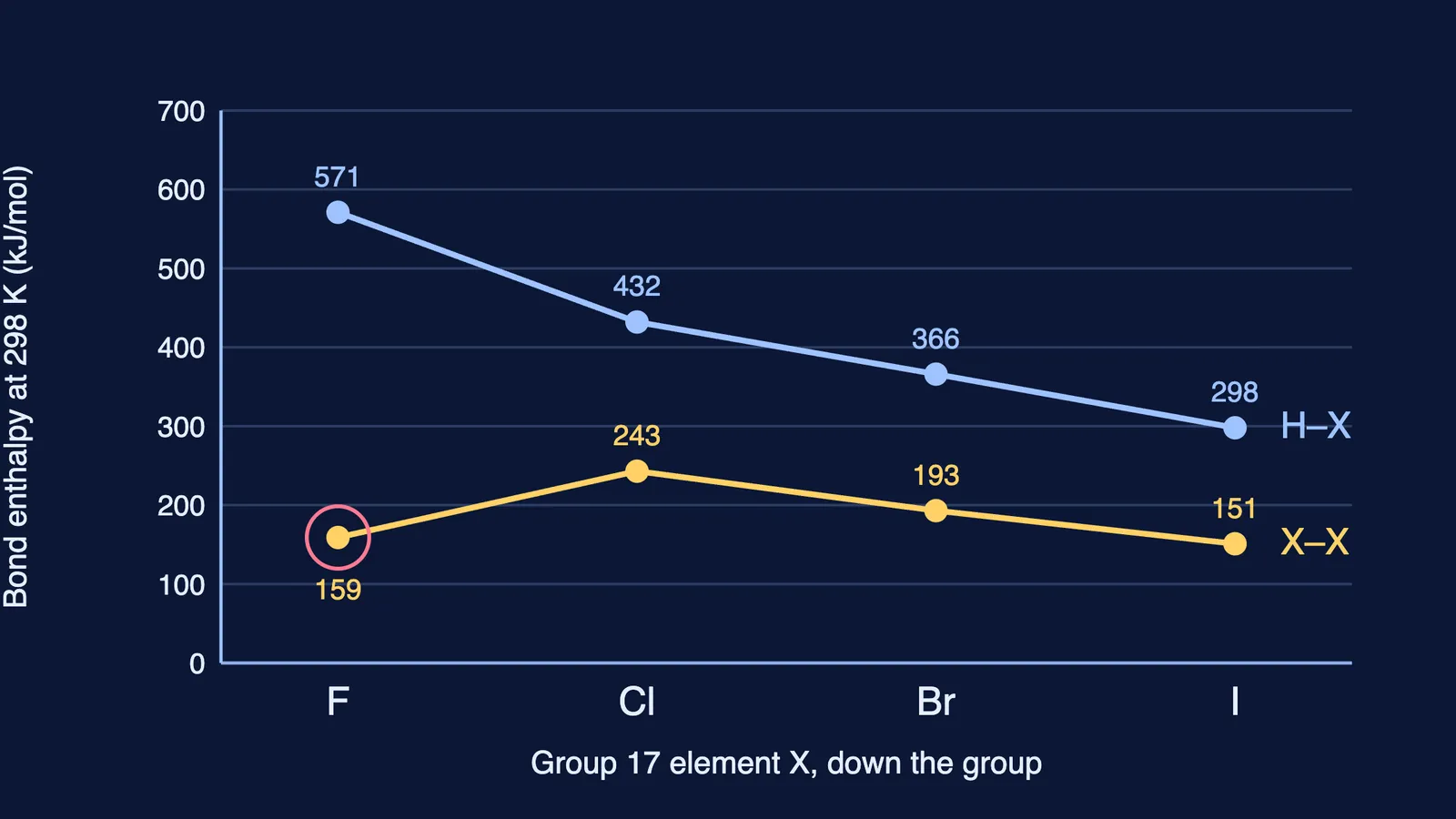
Learn the anomalies with numbers. From the enthalpies of formation in the CODATA Key Values for Thermodynamics, the H–X bond enthalpy at 298 K falls steadily from HF (571 kJ/mol) to HI (298 kJ/mol), but the F–F bond (159 kJ/mol) is weaker than Cl–Cl (243 kJ/mol). For group 18, our guide to xenon fluoride structures goes deeper.
Worked examples: what do multi-concept p-block questions look like?
Example 1 (borax, two titrations). 0.954 g of borax, Na2B4O7·10H2O (381.4 g/mol), is made up to 100 mL. A 25.0 mL portion is titrated with 0.0500 M HCl, then mannitol is added and it is titrated with 0.100 M NaOH. Find both volumes.
Borax in the portion: 0.954 / 381.4 × 25/100 = 6.25 × 10⁻⁴ mol.
In water, Na2B4O7 + 7H2O gives 2NaOH + 4H3BO3, so each borax needs 2 HCl: 1.25 × 10⁻³ mol, which is 25.0 mL of 0.0500 M HCl.
The portion now holds 4 × 6.25 × 10⁻⁴ = 2.50 × 10⁻³ mol of H3BO3. Boric acid is a monobasic Lewis acid, so with mannitol each takes one NaOH: 25.0 mL of 0.100 M NaOH.
The trap: treating H3BO3 as tribasic gives 75.0 mL.
Example 2 (xenon tetrafluoride in water). 0.828 g of XeF4 is fully hydrolysed: 6XeF4 + 12H2O → 4Xe + 2XeO3 + 24HF + 3O2. What volume of gas forms at 300 K and 1 bar?
Moles of XeF4: 0.828 / 207.3 = 3.99 × 10⁻³ mol.
Gas (HF stays dissolved in the water): Xe (4/6, 2.66 × 10⁻³ mol) plus O2 (3/6, 2.00 × 10⁻³ mol) = 4.66 × 10⁻³ mol.
V = nRT/P = 4.66 × 10⁻³ × 0.08314 × 300 / 1 = 0.116 L, or about 116 mL.
Electron check: four Xe go +4 to 0 (16 gained); two Xe go +4 to +6 and six O go −2 to 0 (4 + 12 = 16 lost).
Not sure where your method went wrong? The Fermi Problem Library has worked problems with a step-by-step solver that explains the reasoning rather than printing an answer.
How do you practise for multiple-correct and numerical questions?
JEE (Advanced) 2026 had two compulsory three-hour papers, with the marking scheme given in exam-day instructions (2026 Information Brochure). Past JEE Advanced question types have varied, so practise every format. For a multiple-correct set on, say, diborane, judge each statement separately with a one-line reason. For numerical answers, check units and a limiting case.
Try these (answers below):
10.0 mL of a solution that is 0.0200 M in H3PO3 and 0.0100 M in H3PO2 is neutralised with 0.0100 M NaOH. What volume is needed?
How many moles of HF form when 0.0050 mol of XeF6 is fully hydrolysed to XeO3?
A two-week plan: days 1-4, groups 13-14; days 5-9, groups 15-17; day 10, xenon; days 11-14, mixed timed questions with an error log.
Answers: 1. 50.0 mL (only P–OH hydrogens ionise: H3PO3 is dibasic, H3PO2 monobasic). 2. 0.030 mol, from XeF6 + 3H2O → XeO3 + 6HF.