On this page
The simple pendulum is often the first experiment where you report a result with an error attached. The part worth understanding is why time matters more than length.
What is the formula for percentage error in g?
Start from the period of a simple pendulum, T = 2π√(L/g), and rearrange it to g = 4π²L/T². The NCERT Class 11 laboratory manual writes the same relation as T² = 4π²L/g (Eq. E 6.2).
NCERT's rule for combining errors is that when quantities are multiplied or divided, their relative errors add, and a quantity raised to the power k contributes k times its relative error (NCERT Class 11 Physics, Units and Measurement, 2022-23 edition; dropped from the current chapter). Applied to g = 4π²L/T², that gives:
Δg/g = ΔL/L + 2 × ΔT/T
Multiply by 100 for the percentage error. The 4π² adds nothing, because it is an exact number.
Why does the time error count twice?
T appears squared, so a 1% slip in T becomes a 2% slip in T², and so in g. Length appears to the first power, so it counts once. The NCERT lab manual says the same: because T appears as T², a small uncertainty in T results in an appreciable error.
In NCERT's worked example, L is 20.0 cm, known to 1 mm, and 100 oscillations take 90 s on a wrist watch of 1 s resolution. That gives Δg/g = 0.1/20.0 + 2 × (1/90) = 0.027, or about 3% (NCERT Example 2.12, 2022-23 edition). Of that 2.7%, length contributes 0.5% and time contributes 2.2%.
How do you calculate it from your own readings?
The NCERT lab manual says the least count of a stop-watch is generally about 0.1 s. NCERT's textbook notes that a metre scale may have 1 mm graduations (NCERT Units and Measurement, 2022-23 edition). The readings below are illustrative numbers we chose, not data from a real class.
Effective length (string + hook + bob radius): L = 100.0 cm, so ΔL = 0.1 cm.
Time for 20 oscillations: t = 40.2 s, so Δt = 0.1 s.
Period: T = t/20 = 2.010 s. The 20 is an exact count, so ΔT/T = Δt/t.
g = 4π² × 1.000 / (2.010)² = 9.77 m/s².
Δg/g = 0.1/100.0 + 2 × (0.1/40.2) = 0.0010 + 0.0050 = 0.0060, which is 0.6%.
Δg = 0.006 × 9.77 ≈ 0.06 m/s², so you report g = 9.77 ± 0.06 m/s².
If you repeat the timing and your readings scatter by more than 0.1 s, use the spread rather than the least count. NCERT shows how: five timings of 2.63, 2.56, 2.42, 2.71 and 2.80 s give a mean of 2.62 s, a mean absolute error of 0.11 s and a percentage error of 4% (NCERT Example 2.7, 2022-23 edition).
If you mix up when to add absolute errors and when to add relative ones, the Fermi Problem Library has worked problems with a step-by-step solver that explains the reasoning rather than printing an answer.
Why time 20 oscillations instead of one?
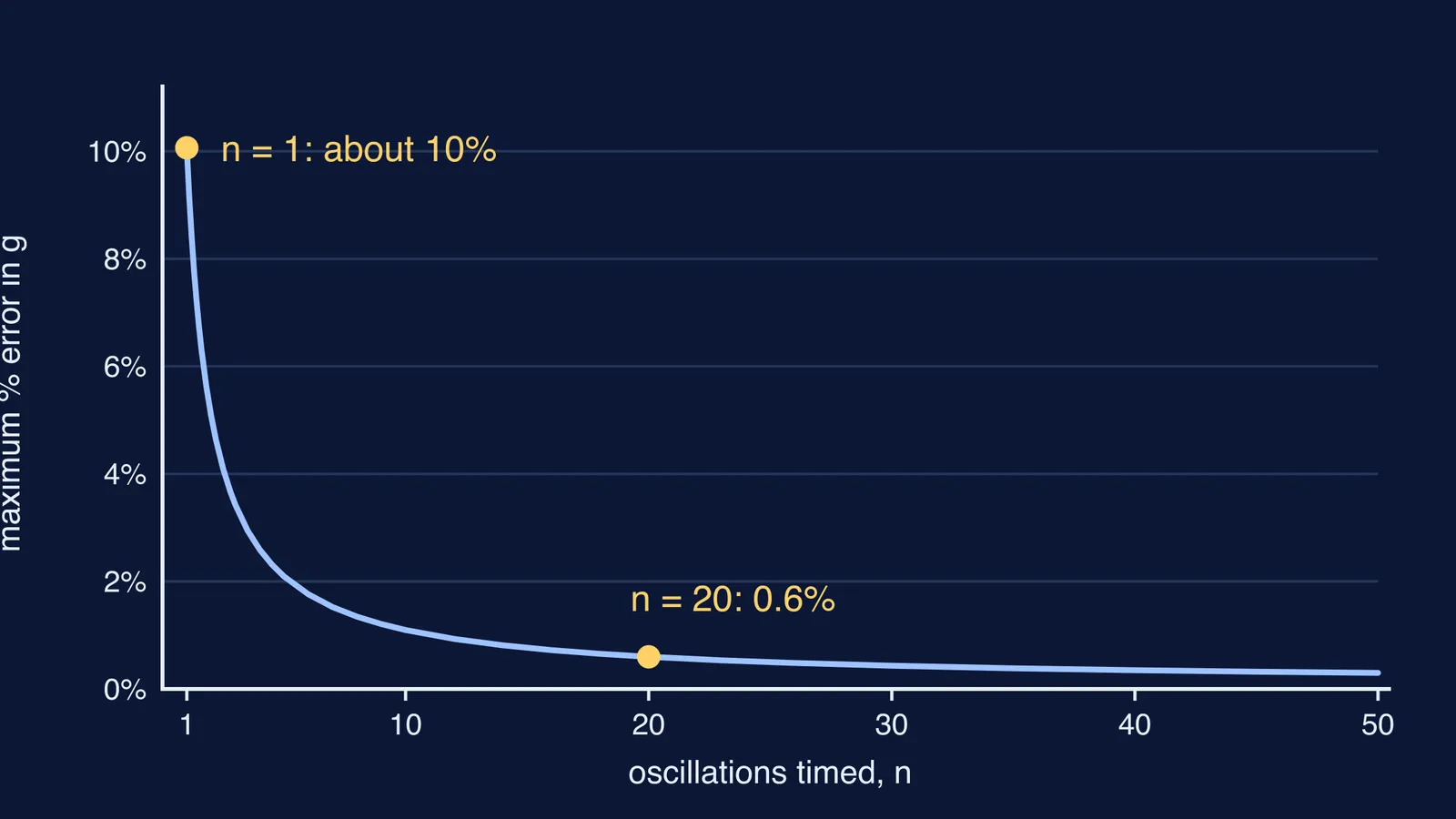
You start and stop the watch once whether you time one swing or twenty, so the 0.1 s error stays fixed. Because T = t/n, the error in T is Δt/n (NCERT Example 2.12, 2022-23 edition). Spread over 20 periods, it becomes 20 times smaller.
Timing one swing: T = 2.0 ± 0.1 s, so the time term is 2 × 5% = 10%, and g is uncertain by about 10%.
Timing 20 swings: 40.2 ± 0.1 s, so the time term is 2 × 0.25% = 0.5%, and g is uncertain by about 0.6%.
Timing 50 swings: the time term drops to about 0.2%, and the 0.1% from length starts to matter.
The NCERT lab manual asks you to count n oscillations (say, 20 or 25), choosing n so that the total time is 50 s or more. Past that, the length term dominates and extra swings gain little.
What else creeps into your value of g?
The formula only covers reading errors. The NCERT lab manual lists other sources to control:
Keep the swing small, not more than 15 degrees, because T = 2π√(L/g) holds only for small amplitude.
Start and stop the watch as the bob passes the mean position, always in the same direction.
Measure L to the centre of the bob: L = string length + hook length + bob radius.
Use a thin cotton thread, not a stretchy nylon string, and a small, dense bob to reduce air drag.
Release the bob gently so it swings in a vertical plane rather than in a cone.
For a refresher on simple harmonic motion itself, see the Fermi Concept Library.
Next time you are in the lab, write the error line before your first reading. It tells you which measurement deserves your care.