On this page
JEE (Advanced) 2027 will be held on 23 May 2027 (Sunday), organised by IIT Delhi, according to the official JEE (Advanced) website. To sit it, you need to be among the top 2,50,000 candidates in the B.E./B.Tech paper of JEE (Main) 2027, as the eligibility page states. JEE (Advanced) 2026 had two compulsory papers of three hours each, according to the 2026 Information Brochure. Question types have changed from year to year; see JEE Advanced question types.
What does the JEE Advanced syllabus say about units, dimensions and errors?
The official JEE (Advanced) 2026 syllabus opens its Physics list with a section called General: "Units and dimensions, dimensional analysis; least count, significant figures; Methods of measurement and error analysis for physical quantities pertaining to the following experiments". The experiments it names are:
Vernier callipers and screw gauge (micrometre)
Determination of g using a simple pendulum
Young's modulus, elasticity of the material
Surface tension of water by capillary rise and effect of detergents
Specific heat of a liquid using a calorimeter
Focal length of a concave mirror and a convex lens using the u-v method
Speed of sound using a resonance column
Verification of Ohm's law using voltmeter and ammeter
Specific resistance of the material of a wire using a meter bridge and post office box
The document says it is unchanged from 2025. As of 19 November 2026, the 2027 syllabus has not been published.
NTA's JEE (Main) 2027 syllabus covers the same theory in Unit 1 and experiments in Unit 20. Three differences stand out: the post office box does not appear, the simple pendulum is listed for energy dissipation rather than finding g, and focal length is found by the parallax method rather than u-v. JEE Main also lists several extra experiments. If the basics feel shaky, start with our Units and Measurements guide for JEE Main.
How do zero error and error analysis combine in one problem?
A wire measures 50.0 cm on a metre scale (least count 1 mm). A screw gauge with pitch 0.5 mm and 50 circular divisions (least count 0.01 mm) reads +0.03 mm with the jaws closed. On the wire, the main scale shows 0.5 mm and the circular scale 22 divisions. A voltmeter reads 0.60 V ± 0.01 V and an ammeter 0.40 A ± 0.01 A. Find the resistivity and its maximum error.
Reading = 0.5 + 22 × 0.01 = 0.72 mm. Corrected diameter d = 0.72 − 0.03 = 0.69 mm.
R = V/I = 0.60/0.40 = 1.50 Ω.
ρ = πd²R/(4L) = π × (0.69 × 10⁻³)² × 1.50/(4 × 0.500) ≈ 1.12 × 10⁻⁶ Ω m.
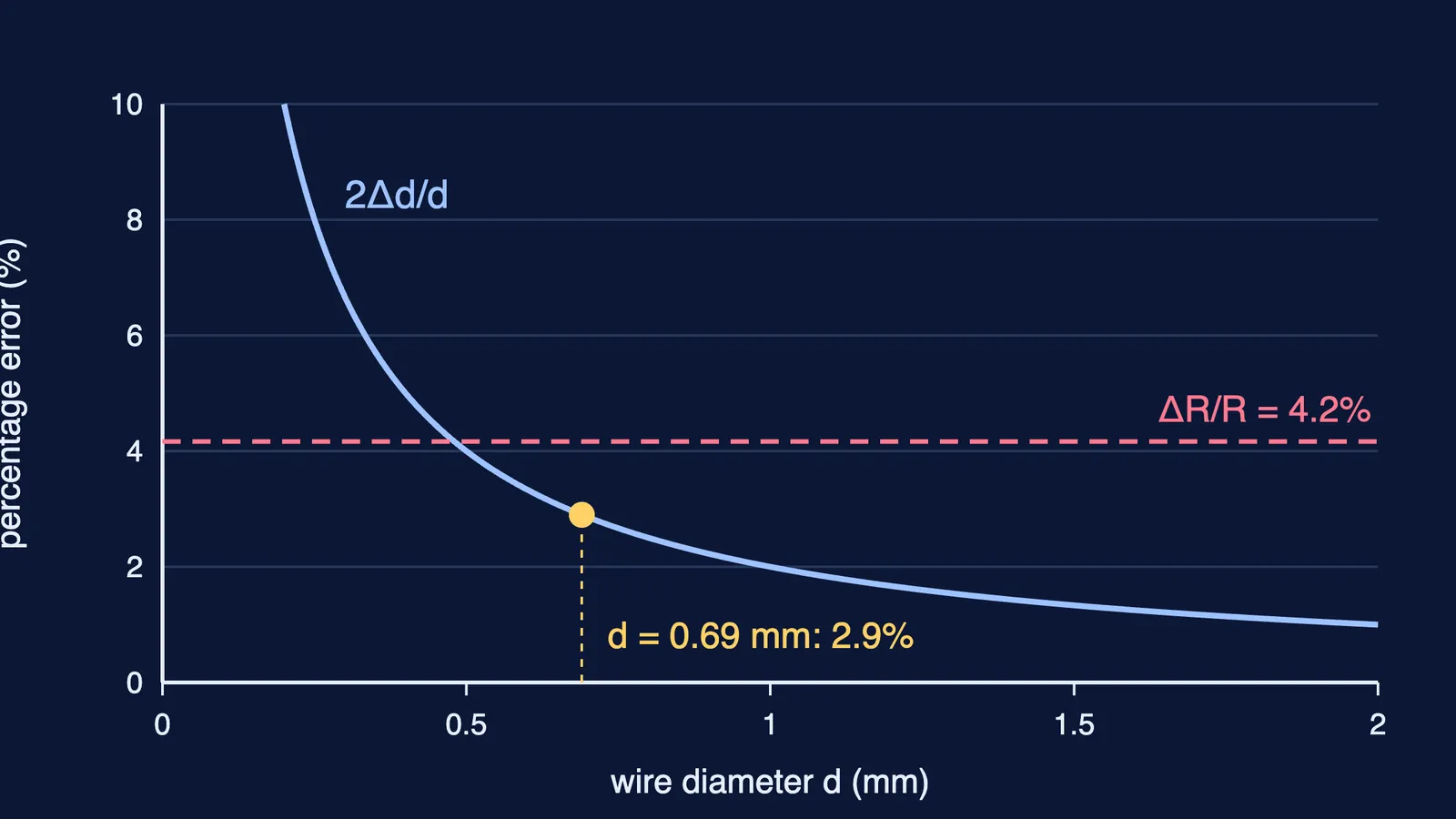
Fractional errors add: ΔR/R = 0.01/0.60 + 0.01/0.40 ≈ 4.17%; 2Δd/d = 2 × 0.01/0.69 ≈ 2.90%; ΔL/L = 0.1/50.0 = 0.20%. Total ≈ 7.27%.
Answer: ρ = (1.12 ± 0.08) × 10⁻⁶ Ω m, to three significant figures.
The trap: skip the zero correction and ρ comes out about 8.9% high, more than the whole error budget.
How do you use dimensions to judge multiple-correct options?
Which have the dimensions of speed? B is magnetic field, E electric field, ρ density, γ surface tension and r a radius.
B/√(μ₀ρ): true. B²/μ₀ is an energy density, ML⁻¹T⁻², so dividing by ρ gives L²T⁻², and the square root is LT⁻¹.
√(γ/(ρr)): true. γ is MT⁻², so γ/(ρr) is L²T⁻², and the square root is LT⁻¹.
ε₀E²/ρ: false. ε₀E² is also an energy density, so this is L²T⁻², a speed squared.
B²/μ₀ itself: false, it is a pressure.
Dimensions catch wrong powers, not a missing 2π or ½, so test a limiting case too.
Unsure why energy density and pressure share units? The Fermi Concept Library covers every concept in physics, chemistry, biology, mathematics and computing, each with its own lesson and its place in the map.
How should you practise this unit for JEE Advanced?
Week 1: dimensions of every constant you meet (G, h, μ₀, ε₀, viscosity); derive formulas by dimensional analysis.
Week 2: Vernier and screw gauge readings with positive and negative zero errors.
Week 3: one listed experiment a day; write its formula, find the highest power and compute the maximum error.
Week 4: mixed problems; judge each multiple-correct option on its own and round only at the end.
Try these, then check:
A pendulum of effective length 80.0 cm ± 0.1 cm makes 20 oscillations in 36.0 s ± 0.2 s. Find g and its maximum error.
In a resonance column with a 500 Hz fork, the first two resonances occur at 16.4 cm and 50.8 cm, each ± 0.1 cm. Find the speed of sound, its maximum error and the end correction.
Answers: g ≈ 9.75 ± 0.12 m/s². Speed of sound = 2 × 500 × 0.344 = 344 ± 2 m/s; end correction = (50.8 − 3 × 16.4)/2 = 0.8 cm.
For Class 11 foundations, see our Units and Measurements Class 11 guide.