

On this page
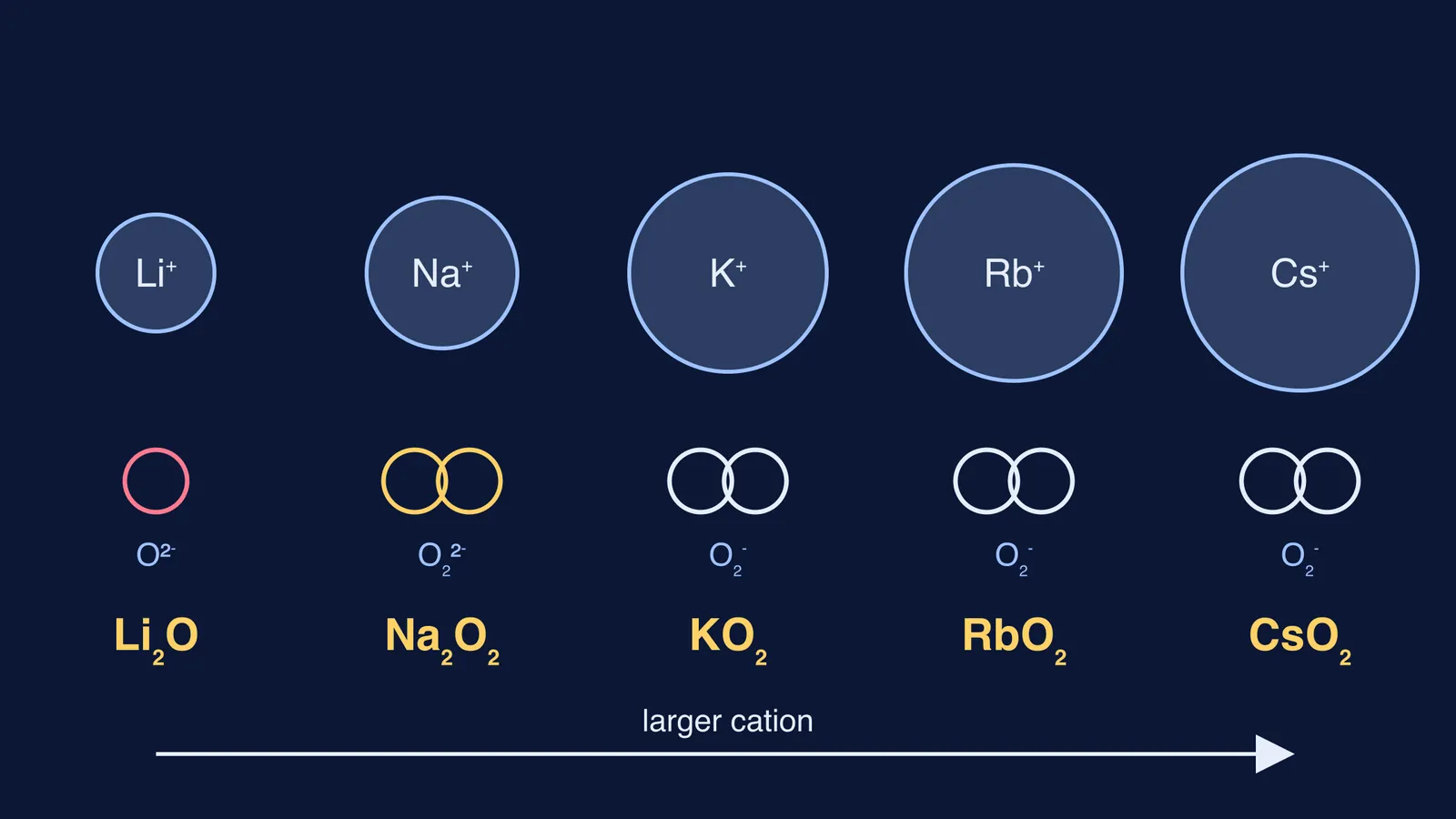
Burn the alkali metals in plenty of oxygen and they do not all give the same kind of product. Lithium gives the simple oxide Li₂O, sodium gives a mixture of oxide and the peroxide Na₂O₂, and potassium, rubidium and caesium give superoxides, as the LibreTexts page on Group 1 reactions with oxygen/Descriptive_Chemistry/Elements_Organized_by_Block/1_s-Block_Elements/Group__1%3A_The_Alkali_Metals/2Reactions_of_the_Group_1_Elements/Reactions_of_Group_I_Elements_with_Oxygen) sets out with equations. Behind the list is one idea: how big the metal ion is.
What are oxide, peroxide and superoxide ions?
The three ions differ in how many oxygen atoms share the negative charge. The equations below are from the same LibreTexts page.
Oxide, O²⁻: one oxygen atom at −2, as in 4Li + O₂ → 2Li₂O.
Peroxide, O₂²⁻: two singly bonded oxygen atoms, each at −1, as in 2Na + O₂ → Na₂O₂.
Superoxide, O₂⁻: two oxygen atoms sharing one negative charge, each at −½, as in K + O₂ → KO₂ (and RbO₂, CsO₂).
Potassium superoxide is a yellow paramagnetic solid, according to the Wikipedia entry on potassium superoxide. The paramagnetism comes from the unpaired electron on O₂⁻.
Why does lithium form an oxide but potassium a superoxide?
Start with size. In R. D. Shannon's table of crystal radii, as reproduced on LibreTexts' radius appendix/06%3A_Appendix/6.04%3A_Radius), Li⁺ has a radius of 90 pm and Cs⁺ has a radius of 181 pm, about twice as large. Other radius scales differ, but the order is the same.
Now put a small positive ion next to a peroxide ion. Chemguide's page on Group 1 and oxygen explains that electrons in the peroxide ion are pulled strongly towards a small positive ion, which is "well on the way" to breaking off one oxygen and leaving a simple oxide ion. This pull, called polarisation, is strongest when a lot of charge is packed into a small ion. Li⁺ is exactly that, so only the compact O²⁻ ion survives beside it.
Down the group the cations grow and their pull weakens. Na⁺ can sit beside O₂²⁻ without breaking it, and K⁺, Rb⁺ and Cs⁺ can hold even the bulkier O₂⁻ ion. In exam language: larger cations stabilise larger anions.
Chemguide gives the heat released per mole of rubidium as 169.5 kJ for Rb₂O, 236 kJ for Rb₂O₂ and 278.7 kJ for RbO₂, so for a big cation the superoxide is the most favourable product.
How does KO₂ work in breathing apparatus?
Potassium superoxide takes in the carbon dioxide you breathe out and gives back oxygen. The main reaction is 4KO₂ + 2CO₂ → 2K₂CO₃ + 3O₂, and moisture in breath also reacts by 4KO₂ + 2H₂O → 4KOH + 3O₂, both listed in the Wikipedia entry on potassium superoxide. The same entry notes its use in canisters for rebreathers in firefighting and mine rescue, and in spacecraft and submarines.
A 1985 NASA report by Peter Wood and Theodore Wydeven, Improved Oxygen Sources for Breathing Apparatus, describes how KO₂ "reacts with exhaled breath and releases oxygen (O2) while it absorbs CO2", making closed-circuit self-rescuers possible. It describes a prototype for coal miners that held 1.5 lb of KO₂, weighed 4.54 lb in all and gave one hour of protection.
Worked example: how much oxygen from that canister?
Use the molar masses K = 39.10 g/mol and O = 16.00 g/mol.
Molar mass of KO₂ = 39.10 + 32.00 = 71.10 g/mol.
1.5 lb is about 680 g, so moles of KO₂ = 680 ÷ 71.10 ≈ 9.57 mol.
From the equation, 4 mol KO₂ give 3 mol O₂, so O₂ = 9.57 × 3/4 ≈ 7.18 mol.
Mass of O₂ = 7.18 × 32.00 ≈ 230 g at most.
CO₂ absorbed = 9.57 × 2/4 ≈ 4.79 mol, about 211 g.
The water reaction also gives 3 mol O₂ per 4 mol KO₂, so the ceiling is the same either way. Real devices deliver less.
If mole ratios like these are where you lose marks, the Fermi Problem Library has worked problems with a step-by-step solver that explains the reasoning rather than printing an answer.
How do you write this answer in an exam?
Use this five-step frame for any "explain the trend" question:
Name the product for each metal: Li₂O, Na₂O₂, KO₂ (and RbO₂, CsO₂).
Name the anion and its oxidation state: O²⁻ (−2), O₂²⁻ (−1), O₂⁻ (−½).
State the size trend: cation radius increases from Li⁺ to Cs⁺.
Give the reason: a small cation polarises and breaks the larger anion; a large cation stabilises it.
Add one consequence: superoxides are paramagnetic, and KO₂ is used in breathing apparatus.
Two traps to check before you submit:
Writing KO₂ as a peroxide. Potassium is +1, so each oxygen is −½.
Balancing 4KO₂ + 2CO₂ with 2O₂ instead of 3O₂. Count oxygen atoms: 12 on each side.
To see how polarisation links this chapter to others, the Fermi Concept Library gives every concept in chemistry its own lesson and its place in the map.


