On this page
Drag an eccentricity slider from 0 towards 1 and a circle barely changes for a long time, then flattens fast into a straight line segment. Here is why, with numbers you can check on a calculator, and a way to use a slider so the picture sticks.
What is the eccentricity of an ellipse?
An ellipse is the set of points whose distances to two fixed points, the foci, add up to the same constant 2a, as Wolfram MathWorld's ellipse entry defines it.
Eccentricity is e = c/a, where c is the distance from the centre to each focus and a is the semi-major axis. The semi-minor axis then follows from b = a√(1 − e²), so e alone fixes the shape and a only sets the size (MathWorld).
For an ellipse, 0 ≤ e < 1. At e = 0 the two foci sit on top of each other at the centre, b equals a, and the ellipse is a circle.
What happens to an ellipse as eccentricity goes from 0 to 1?
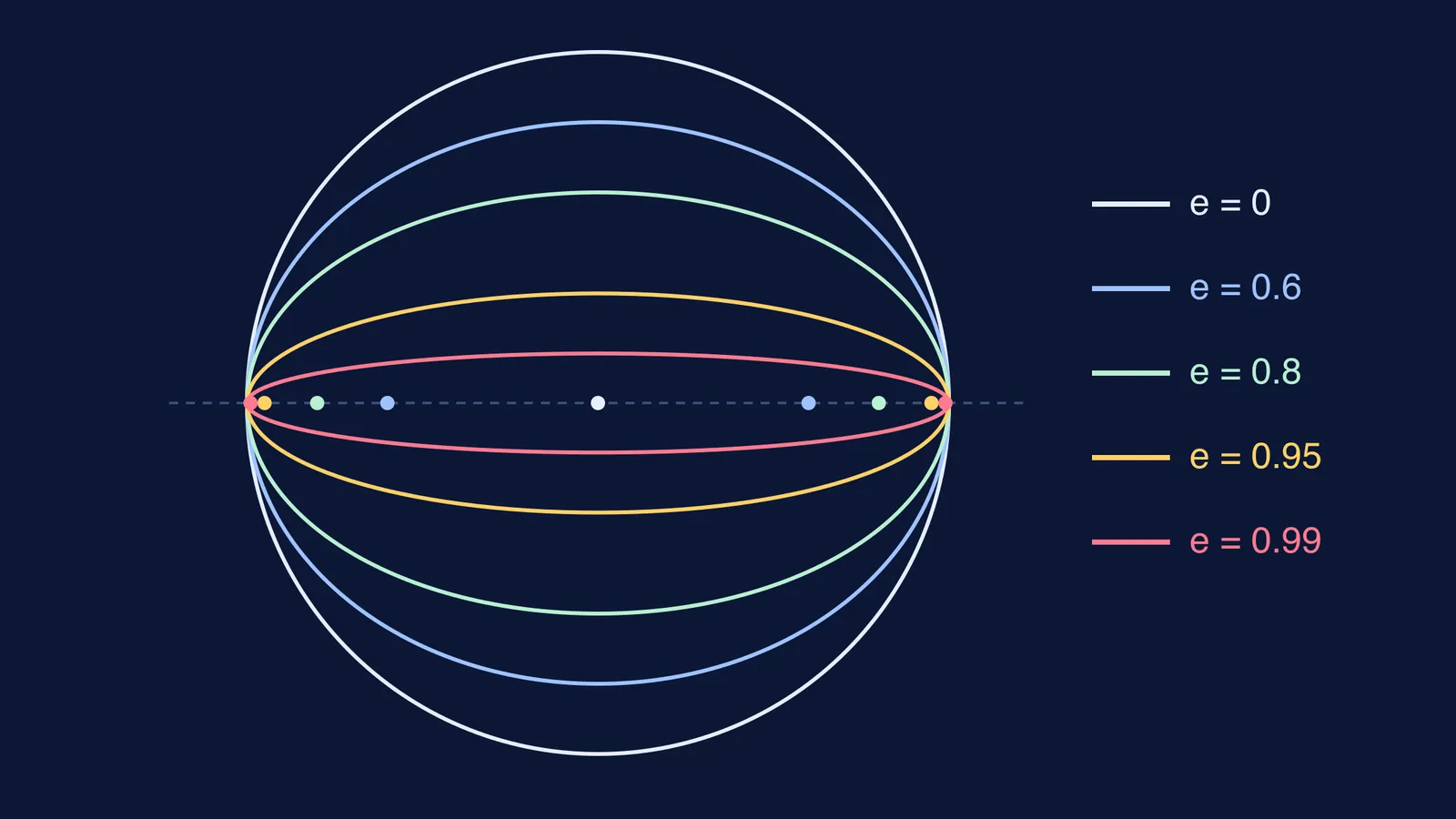
Hold a fixed at 5 cm and move only the slider. Using c = ae and b = a√(1 − e²) from the formulas above:
e = 0: c = 0 cm, b = 5 cm. A circle, both foci at the centre.
e = 0.3: c = 1.5 cm, b ≈ 4.77 cm.
e = 0.6: c = 3 cm, b = 4 cm.
e = 0.8: c = 4 cm, b = 3 cm.
e = 0.95: c = 4.75 cm, b ≈ 1.56 cm.
e = 0.99: c = 4.95 cm, b ≈ 0.71 cm.
As e rises, the foci walk outwards and the ellipse thins. Because a is fixed, the distances from any point on the curve to the two foci still add up to 2a = 10 cm the whole time.
Now push e towards 1. The foci close in on the ends of the major axis, nearly 10 cm apart. In the limit, a point P needs PF₁ + PF₂ = 10 cm, exactly the distance F₁F₂, and the triangle inequality allows that only when P lies on the segment between the foci. So the ellipse collapses into that segment and b becomes 0. That segment is a degenerate ellipse; a conic defined by a focus and directrix with e exactly 1 is a parabola instead.
Why does an ellipse with e = 0.6 still look round?
The height-to-width ratio is b/a = √(1 − e²), from the relation on MathWorld. Squaring e shrinks small values: at e = 0.3, b/a is about 0.95, and at e = 0.6 it is exactly 0.8. Over the first 60% of the slider the ellipse loses only a fifth of its height. From e = 0.6 to 0.95, b/a falls from 0.8 to about 0.31, and the last stretch to e = 1 takes the rest.
Real orbits show the same thing. Earth's orbital eccentricity is 0.0167, according to NASA's Earth fact sheet. Put that in the formula and b/a is about 0.9999: drawn to scale, Earth's orbit looks like a circle. What gives it away is the Sun, which sits at a focus; on a drawing 20 cm across, that focus is about 1.7 mm from the centre.
Halley's comet is the other extreme. NASA JPL's Small-Body Database lists its eccentricity as 0.968, which gives b/a ≈ 0.25: an orbit about four times as long as it is wide.
How should you use an eccentricity slider to learn conics?
A slider teaches you most when you guess before you look:
Predict first. Sketch the ellipse at e = 0.5 and e = 0.9 and write down b/a for each.
Fix a. Change only e, so size and shape do not get mixed up.
Watch the foci, not just the outline. Say where each focus is as a fraction of a, since c = ae.
Check one value by hand. At e = 0.8, b = 0.6a and c = 0.8a, so b, c and a form a 3-4-5 right triangle.
Stop near 1. At e = 0.99 the foci almost touch the ends of the major axis; ask what PF₁ + PF₂ = 2a now forces.
Ellipses are easier to see than to read, which is what the Fermi Simulation Lab is for: interactive simulations you can test your predictions against. If a step is unclear, Fermi's AI tutor can draw the figure, run the simulation and check your understanding as it goes.
If eccentricity across all the conics is still hazy, read what eccentricity tells you about the shape of a conic. For the same shape in physics, see why the v–x graph in SHM is an ellipse. And when a question hands you a messy equation, use AI to convert the conic to standard form and check it before you read off a and e.
Next time you meet e in a question, picture the slider: small e, nearly a circle; e close to 1, nearly a line.