On this page
An equation like 4x² + 9y² − 16x + 18y − 11 = 0 hides an ellipse. An AI chatbot can do the algebra quickly, but the marks come from reading the focus, directrix and eccentricity correctly. Here is a prompt, a worked example and a five-point sketch check.
How do you convert a conic equation to standard form?
The method has four steps, as set out in OpenStax Precalculus, section 10.1: group the terms with the same variable, factor out the coefficients of x² and y², complete the square for each variable, then divide both sides by the constant.
Before you start, identify the conic. If there is no xy term, an ellipse has A and C (the coefficients of x² and y²) with the same sign and different values, a hyperbola has them with opposite signs, and a parabola has one of them equal to zero (OpenStax Precalculus, section 10.4). Here A = 4 and C = 9, so expect an ellipse.
Worked example: 4x² + 9y² − 16x + 18y − 11 = 0
Group: 4(x² − 4x) + 9(y² + 2y) = 11.
Complete the squares: 4(x − 2)² − 16 + 9(y + 1)² − 9 = 11.
Tidy: 4(x − 2)² + 9(y + 1)² = 36.
Divide by 36: (x − 2)²/9 + (y + 1)²/4 = 1.
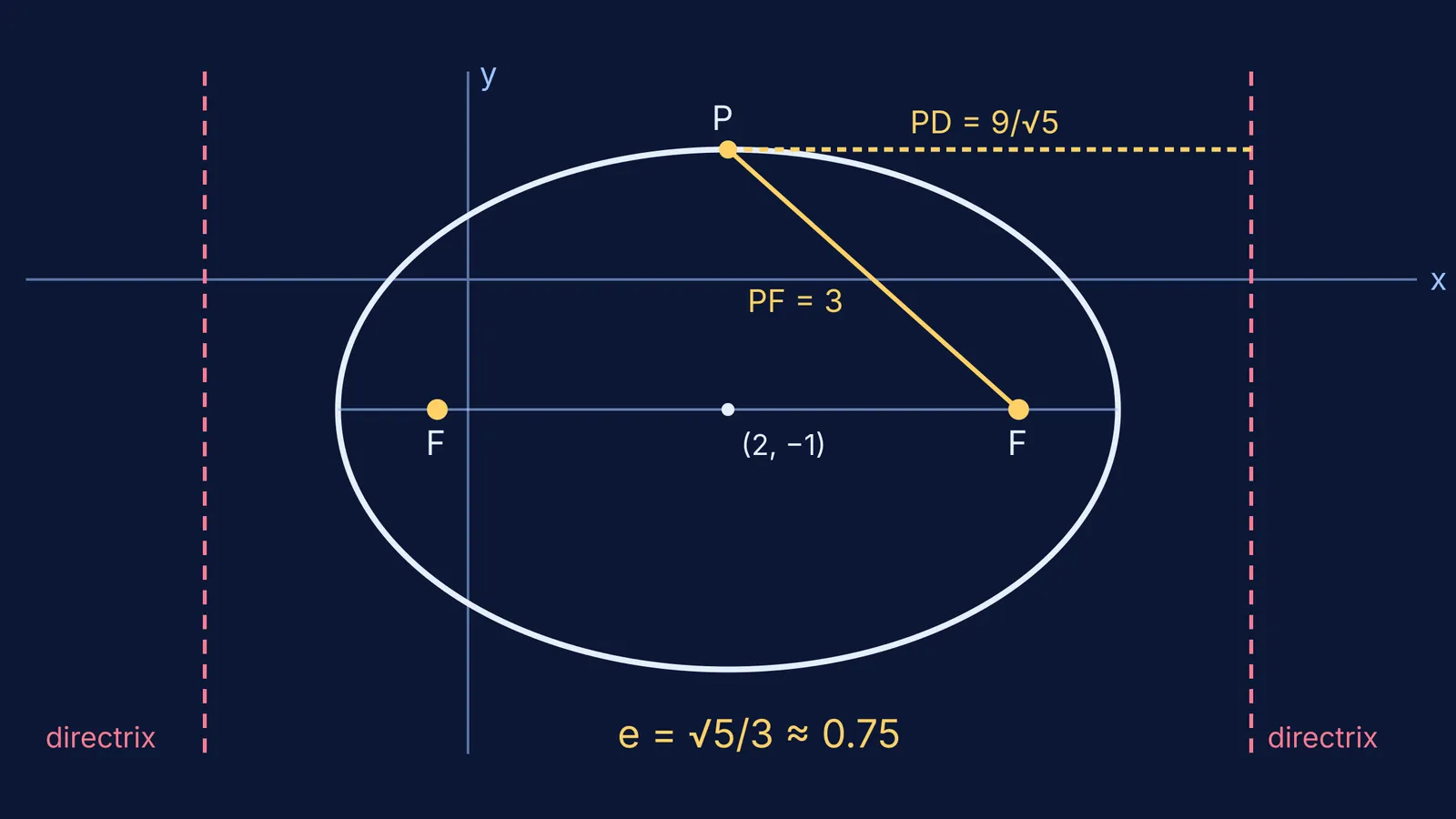
The centre is (2, −1), with a = 3 along x and b = 2 along y. The major axis is horizontal because the larger denominator sits under x.
How do you read the focus, directrix and eccentricity from standard form?
For an ellipse, c² = a² − b² and the foci are at (h ± c, k) when the major axis is horizontal (OpenStax Precalculus, section 10.1).
Eccentricity is e = c/a for both ellipses and hyperbolas, and the directrices of a horizontal ellipse centred at the origin are x = ±a²/c (OpenStax Calculus Volume 2, section 7.5). For a shifted centre, add h.
In our example, c² = 9 − 4 = 5, so c = √5 ≈ 2.24. The foci are (2 ± √5, −1). The eccentricity is e = √5/3 ≈ 0.75. The directrices are x = 2 ± 9/√5, about x = −2.02 and x = 6.02. Since a²/c equals a/e, our post on why the directrix of an ellipse sits at x = a/e covers the same line, and why c² = a² − b² for an ellipse explains the sign that flips for a hyperbola.
Eccentricity also names the curve: an ellipse has 0 ≤ e < 1, a parabola has e = 1 and a hyperbola has e > 1 (OpenStax Precalculus, section 10.5). So if an AI gives e = 1.3 for this ellipse, it is wrong, however confident it sounds.
What should you ask the AI, and what should you check yourself?
Ask for the steps; keep the readings for yourself. A prompt that works:
"Convert 4x² + 9y² − 16x + 18y − 11 = 0 to standard form. Show each completing-the-square step on its own line. Do not give the foci, directrix or eccentricity; I will find those and you can check them."
In a field experiment with nearly 1,000 high-school maths students, those who practised with a GPT-4 tutor that mimicked a standard ChatGPT interface scored 17% lower than students who never had access once it was removed, while a version with learning safeguards largely mitigated this harm (Bastani et al., PNAS, 2025).
How does a quick sketch catch the AI's mistakes?
Draw axes, mark the centre and run these checks.
Plug in a vertex. The vertex (5, −1) gives 100 + 9 − 80 − 18 − 11 = 0, so the standard form matches the original.
The foci lie inside the ellipse, on the long axis. c = 2.24 is less than a = 3, as it must be.
The directrices lie outside the ellipse. 9/√5 ≈ 4.02 is more than a = 3.
e falls in the right range. 0.75 is between 0 and 1 for an ellipse.
Test the focus–directrix ratio. Take the top point P = (2, 1). Its distance to the focus (2 + √5, −1) is √(5 + 4) = 3. Its distance to the directrix x = 2 + 9/√5 is 9/√5. The ratio is 3√5/9 = √5/3, which equals e.
If a check fails, go back to the step that produced that number; usually a constant went missing while completing the square. For parabolas, our guide to finding the focus and directrix of a shifted parabola uses the vertex in the same way.
Where Fermi fits
If you get stuck midway, Fermi's AI tutor notices where you are stuck, decides whether to explain, ask or show, and can draw the figure on a board. For ideas easier to see than to read, the Fermi Simulation Lab has interactive simulations.
Next time, let the AI complete the square on one conic and do all five checks before you look at its readings.