

On this page
NCERT's Class 11 chapter on conic sections gives four standard equations for a parabola with its vertex at the origin: y² = 4ax, y² = −4ax, x² = 4ay and x² = −4ay (NCERT Class 11 Mathematics, Conic Sections). It calls parabolas with the focus at any point and any line as directrix "beyond the scope here". Practice questions often go further, handing you y² + 8x − 6y + 25 = 0 and asking for the focus. One rewrite handles them all; the minus signs are where marks go.
What does (y − k)² = 4a(x − h) tell you?
A parabola is the set of all points that are the same distance from a fixed point, the focus, and a fixed line, the directrix (OpenStax Precalculus 2e, section 10.3). Shifting the curve moves every feature by the same amount. For (y − k)² = 4a(x − h):
Vertex: (h, k)
Axis of symmetry: y = k
Focus: (h + a, k)
Directrix: x = h − a
OpenStax writes p in place of a: the curve opens right when p > 0 and left when p < 0. For (x − h)² = 4a(y − k), the axis is x = h, the focus is (h, k + a), the directrix is y = k − a, and the curve opens up for positive a and down for negative a.
How do you find the focus and directrix of a shifted parabola, step by step?
Take y² + 8x − 6y + 25 = 0.
Keep the y terms on the left: y² − 6y = −8x − 25.
Add 9 to both sides: (y − 3)² = −8x − 16.
Factor the right side: (y − 3)² = −8(x + 2).
Match with (y − k)² = 4a(x − h): k = 3, h = −2, 4a = −8, so a = −2. It opens left.
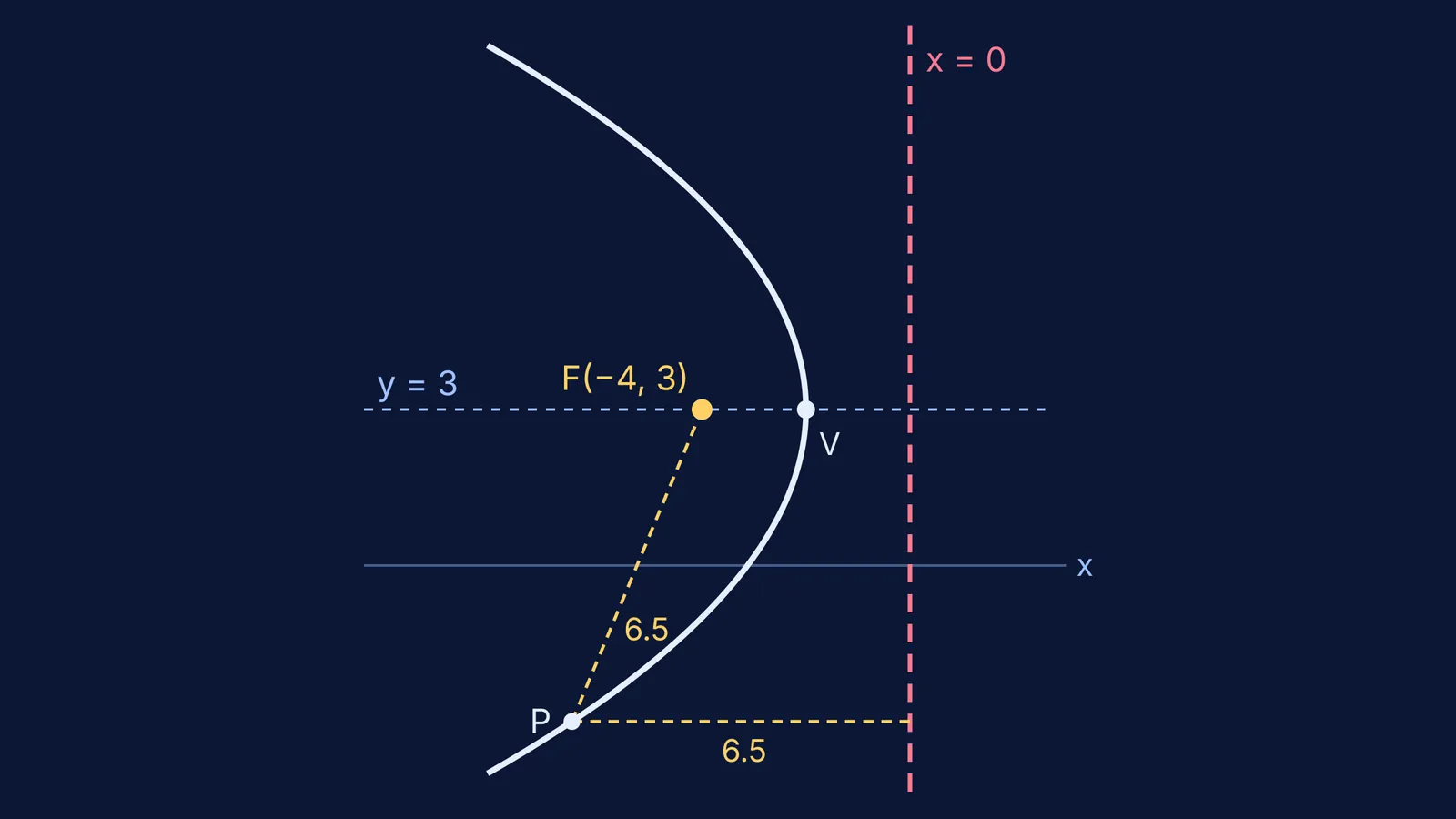
Read off: vertex (−2, 3); axis y = 3; focus (h + a, k) = (−4, 3); directrix x = h − a = 0.
Check a point. At x = −4, (y − 3)² = 16, so y = 7 or −1. The point (−4, 7) is 4 units from the focus and 4 units from x = 0.
The diagram at the top shows this parabola and the point P(−6.5, −3), which is 6.5 units from both the focus and the directrix.
Where do sign errors creep in when a parabola opens left or down?
Reading h and k with the wrong sign. (x + 2) means h = −2, not 2.
Stopping before you factor. From (y − 3)² = −8x − 16 you cannot read the vertex. Only −8(x + 2) gives h.
Using both conventions at once. Treat a = 2 as an NCERT-style length for a leftward curve, put it into the signed formula (h + a, k), and you get (0, 3), a point on the directrix itself.
Swapping focus and directrix on a downward curve. x² − 4x + 4y + 8 = 0 becomes (x − 2)² = −4(y + 1), so a = −1, the focus is (2, −2) and the directrix is y = 0.
How can you tell which way a parabola opens before calculating?
For the origin forms, NCERT says a parabola with its axis along the x-axis opens right if the coefficient of x is positive and left if it is negative; along the y-axis, it opens up or down with the sign of the coefficient of y (NCERT Class 11 Mathematics, Conic Sections). After you factor, apply the same test to 4a. Our guide on how to identify the direction a parabola opens covers all four cases, and the focal distance rule for a point on a parabola follows once the focus is in place. Starting from y = ax² + bx + c? See how to sketch a parabola from a quadratic equation.
What should you practise next?
These three open right, down and up.
(y + 1)² = 12(x − 3). Answer: vertex (3, −1), focus (6, −1), directrix x = 0.
x² + 6x + 8y + 1 = 0. Answer: vertex (−3, 1), focus (−3, −1), directrix y = 3.
x² − 4x − 8y + 12 = 0. Answer: vertex (2, 1), focus (2, 3), directrix y = −1.
If yours differ, the Fermi Problem Library has worked problems with a step-by-step solver that explains the reasoning rather than printing an answer, so you can find where the sign flipped. If completing the square is the weak step, the Fermi Concept Library gives each concept in mathematics its own lesson.
Work one equation of each type tonight, and run the halfway check on every answer.


