

On this page
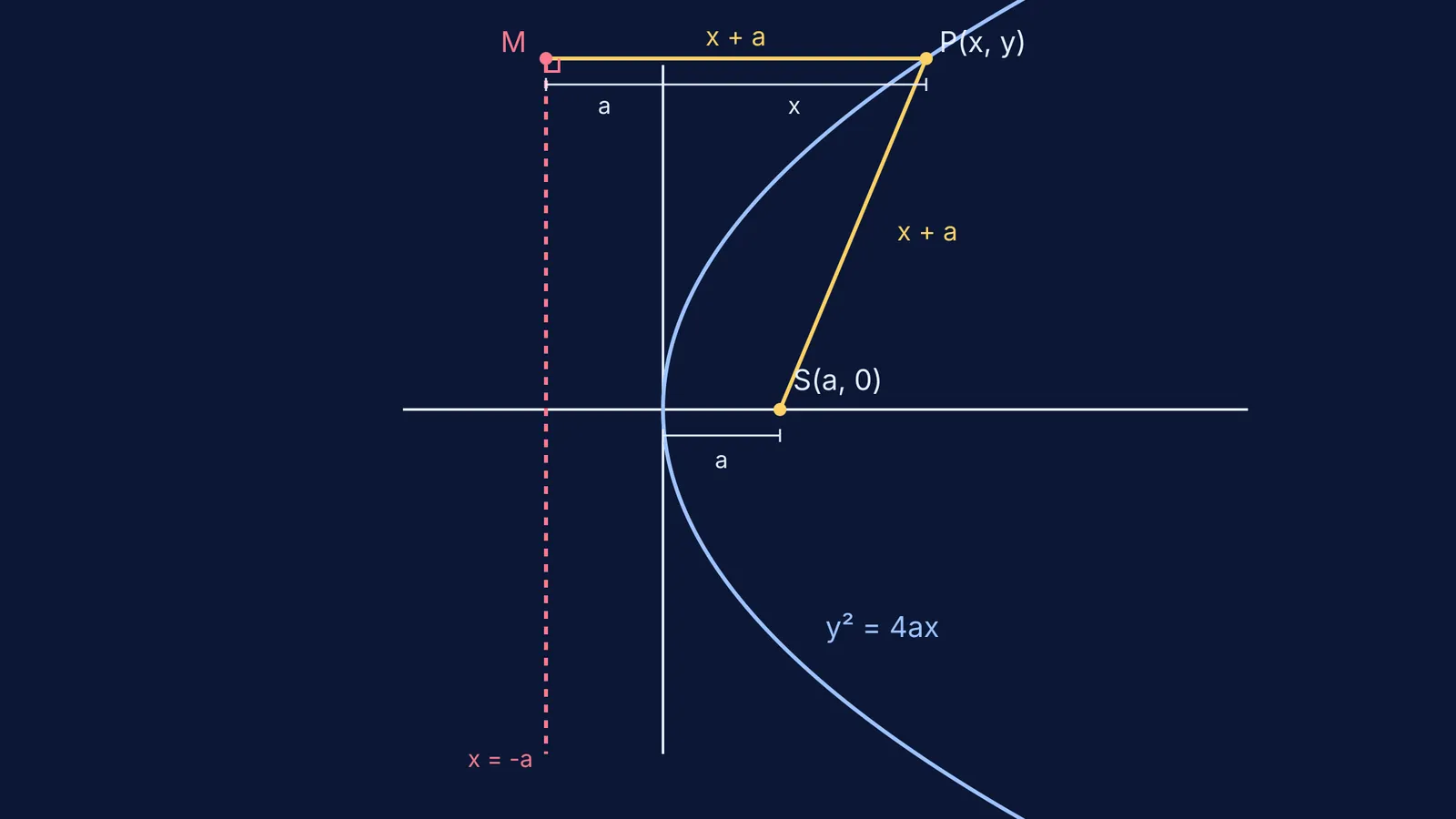
In coordinate geometry, the focal distance of a point on a parabola is the distance from that point to the focus. For the standard parabola y² = 4ax, finding this distance does not require the complex distance formula—it simplifies directly to x + a.
This elegant result comes straight from the core definition of a parabola: a curve where every point is equidistant from a fixed point (the focus) and a fixed straight line (the directrix).
What is the focal distance of a point on a parabola?
If you pick any point P(x, y) on a parabola, its focal distance is simply the length of the line segment connecting P to the focus S.
For the standard right-opening parabola y² = 4ax, the focus is located at (a, 0). According to the distance formula, the distance from P(x, y) to S(a, 0) would be √( (x − a)² + y² ).
However, because P lies on the parabola, we know that y² = 4ax. Substituting this into the square root gives: √( (x − a)² + 4ax ) = √( x² − 2ax + a² + 4ax ) = √( x² + 2ax + a² ) = √( (x + a)² )
Since x is always positive or zero for this standard parabola, the square root simplifies to exactly x + a. This means the focal distance of a point on the parabola y² = 4ax is always x + a.
Why is the focal distance x + a?
There is a faster, geometric way to see why this is true without doing any algebra. By definition, every point on a parabola is exactly the same distance from the focus as it is from the directrix.
For y² = 4ax, the directrix is the vertical line x = -a. If you drop a perpendicular line from P(x, y) to this directrix, the horizontal distance is simply the x-coordinate of the point plus the distance a to the y-axis.
Because the distance to the directrix is x + a, the distance to the focus must also be x + a. If drawing the directrix or visualizing x = -a feels tricky, the Fermi Concept Library contains every concept in physics, chemistry, biology, mathematics and computing, each with its own lesson and its place in the map.
How do you find the length of a focal chord?
A focal chord is any line segment that passes through the focus and intersects the parabola at two points. You can find its length by adding the focal distances of its two endpoints.
Points on a parabola are often written in parametric form as (at², 2at). Using the x + a rule, the focal distance of a point in parametric form is at² + a, which factors to a(1 + t²).
If a focal chord intersects the parabola at points with parameters t₁ and t₂, a key property of parabolas states that t₁t₂ = -1. Because of this relationship, the total length of the focal chord simplifies to: Length = a(t + 1/t)²
The shortest possible focal chord occurs when t = 1, which makes the chord perpendicular to the axis of symmetry. This specific chord is the latus rectum of a parabola, and its length is exactly 4a.
When you are stuck setting up parametric equations for these chords, the Fermi Problem Library offers worked problems with a step-by-step solver that explains the reasoning rather than printing an answer.
The harmonic mean of focal segments
Focal chords have another remarkable mathematical property. If a focal chord passing through the focus S intersects the parabola at points P and Q, it divides the chord into two segments: SP and SQ.
The semi-latus rectum of the parabola (which has length 2a) is always the harmonic mean of these two segment lengths. Mathematically, this means: 1/SP + 1/SQ = 1/a
This property is universally true for all parabolas and is often the fastest way to find the length of a segment if the other segment's length is known. Similar elegant rules apply to other conic sections, such as the rule that the sum of the focal distances on an ellipse is always 2a.
Worked example: Finding a missing segment
The harmonic mean property makes it easy to find a missing segment length without calculating coordinates.
Problem: A focal chord of the parabola y² = 16x is divided by the focus S into two segments, SP and SQ. If the length of SP is 6 units, what is the length of SQ?
Solution:
Identify a: From the equation y² = 16x, we compare it to y² = 4ax to find 4a = 16, so a = 4.
Use the harmonic mean formula: The formula is 1/SP + 1/SQ = 1/a.
Substitute the known values: 1/6 + 1/SQ = 1/4.
Solve for SQ:
1/SQ = 1/4 - 1/6 1/SQ = 3/12 - 2/12 = 1/12
Therefore, SQ = 12 units. The length of the remaining segment is 12 units, making the total length of this focal chord 18 units.


