

On this page
When studying conic sections, one of the first tasks is figuring out which way a parabola opens just by looking at its equation. Parabolas describe everything from satellite dishes to the trajectory of a projectile.
A parabola centered at the origin takes one of four standard forms depending on the axis it opens along, according to OpenStax Precalculus. Once you know the form, finding the focus, directrix, and length of the latus rectum is straightforward.
What are the four standard forms of a parabola?
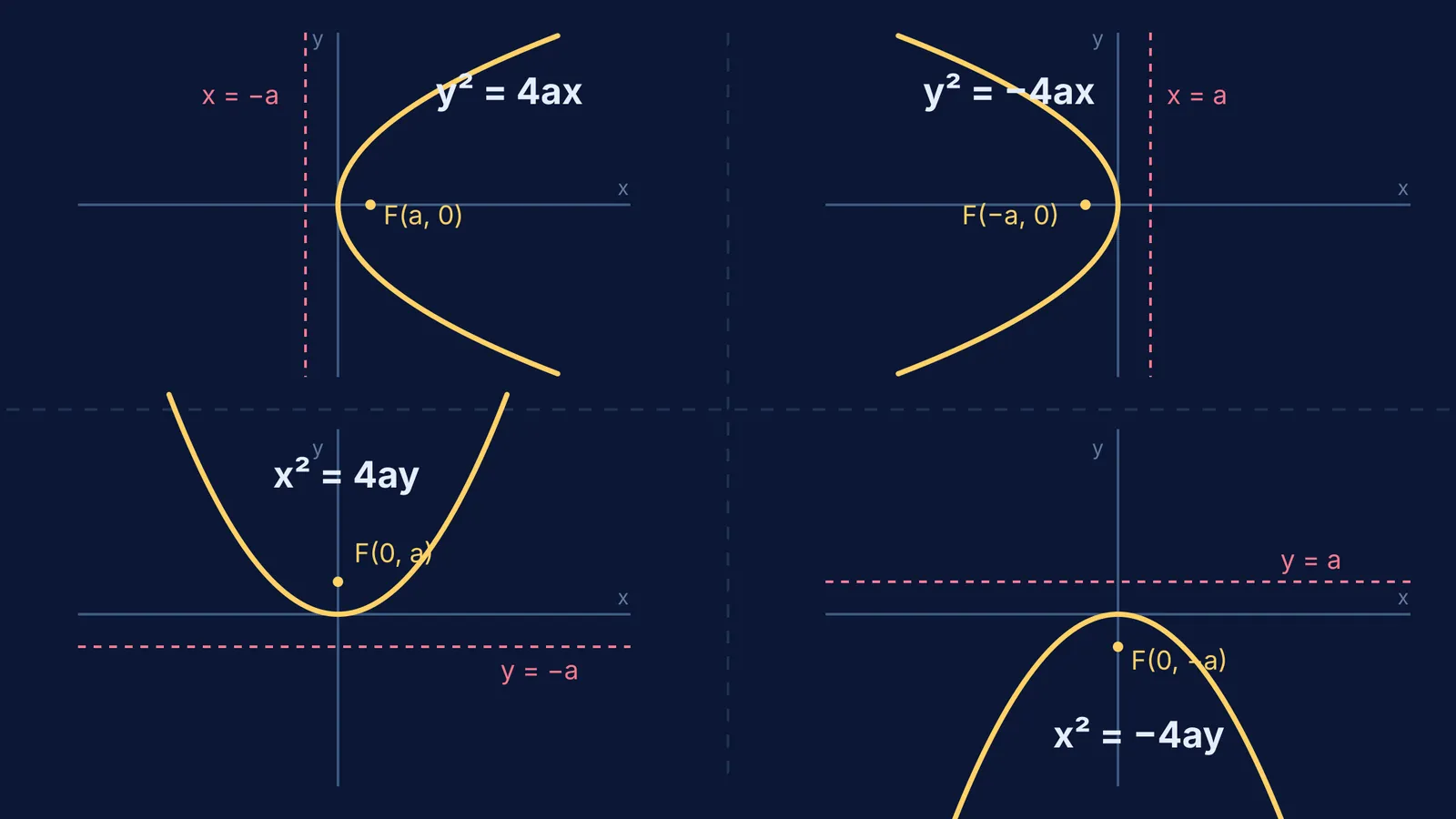
The standard forms of a parabola with its vertex at the origin (0, 0) are written as either y² = 4ax, y² = −4ax, x² = 4ay, or x² = −4ay (some textbooks use p instead of a). The variable that is *not* squared tells you the axis of symmetry:
If the equation has x (not squared) on one side, the parabola opens along the x-axis (left or right).
If the equation has y (not squared) on one side, the parabola opens along the y-axis (up or down).
From there, the sign of the coefficient tells you the exact direction. A positive coefficient means it opens toward the positive numbers (right or up), while a negative coefficient means it opens toward the negative numbers (left or down).
What are the focus and directrix?
The standard forms are built on a fundamental mathematical definition of a parabola: it is the set of all points in a plane that are the same distance from a fixed point and a fixed line. The fixed point is called the focus, and the fixed line is called the directrix.
In the standard forms, the distance from the vertex (the tip or turning point of the parabola) to the focus is represented by the constant a. The distance from the vertex to the directrix is also a. Because the vertex sits exactly halfway between the focus and the directrix, the focus is always tucked inside the curving arms of the parabola, while the directrix runs outside it, entirely perpendicular to the axis of symmetry.
What are the properties of the four standard forms?
Here are the key properties of the four standard forms read off at a glance.
Opens Right (y² = 4ax): The focus is at (a, 0), the directrix is the line x = −a, and the axis of symmetry is the x-axis (y = 0).
Opens Left (y² = −4ax): The focus is at (−a, 0), the directrix is the line x = a, and the axis of symmetry is the x-axis (y = 0).
Opens Up (x² = 4ay): The focus is at (0, a), the directrix is the line y = −a, and the axis of symmetry is the y-axis (x = 0).
Opens Down (x² = −4ay): The focus is at (0, −a), the directrix is the line y = a, and the axis of symmetry is the y-axis (x = 0).
How does the latus rectum define the width?
While the direction tells you where the parabola points, you also need to know how wide it opens. This is determined by the latus rectum, which is the line segment that passes through the focus, runs parallel to the directrix, and has its endpoints on the parabola itself.
For all four standard forms, the length of the latus rectum is exactly 4a. Because the parabola is perfectly symmetric, this segment extends a distance of 2a on either side of the focus. This property is incredibly useful for sketching: if a is large, the focus is far from the vertex, and the parabola opens widely. If a is small, the focus is close to the vertex, and the parabola forms a narrow, tight curve.
How can you check which way a parabola opens?
If you ever forget the rules, you can use a quick mental test by plugging in numbers. Take the equation y² = 4x (where a = 1). Since y² must always be positive (or zero) for real numbers, the right side of the equation, 4x, must also be positive. This means x cannot be negative. Therefore, the parabola must exist only on the positive x side of the graph—meaning it opens to the right.
Conversely, for x² = −4y, the left side (x²) is always positive, so the right side (−4y) must be positive. This only happens when y is negative, so the parabola opens downward. This logical check will quickly save you from a sign error during an exam, especially when finding roots by curve intersections.
How do you visualise a parabola's direction?
Memorising formulas is easier when you can picture the geometry behind them. When you need a refresher on these equations or other mathematical shapes, the Fermi Concept Library covers every concept in physics, chemistry, biology, mathematics and computing, each with its own lesson and its place in the map.
If you are practicing for an exam like JEE and want to see how these standard forms appear in harder coordinate geometry questions, the Fermi Problem Library has worked problems with a step-by-step solver that explains the reasoning rather than printing an answer.


