

On this page
When you think about jumping on the Moon, the maths seems straightforward at first glance. We know that lunar gravity is 1.62 m/s², which is roughly one-sixth of Earth's 9.80 m/s² (NASA Moon Fact Sheet). If you can jump 0.5 metres high in your backyard, it is tempting to multiply that by six and assume you would jump 3 metres high on the lunar surface.
However, this simple multiplication misses a crucial part of how humans actually jump. The physics of your center of mass means you would go significantly higher than 3 metres. Let us break down the work-energy theorem to see why the "times six" rule underestimates your lunar leap, and how you can predict the true height.
How does your center of mass define a jump?
In physics, a jump is not just about where your feet end up; it is measured by the vertical displacement of your center of mass. When you stand flat on the ground, your center of mass is typically around your waist. To jump, you do not just launch from a straight leg. You first crouch down, lowering your center of mass, and then push upward with your leg muscles until your feet leave the ground. The distance your center of mass moves from the lowest point of the crouch to the moment of takeoff is your push-off distance (*d*).
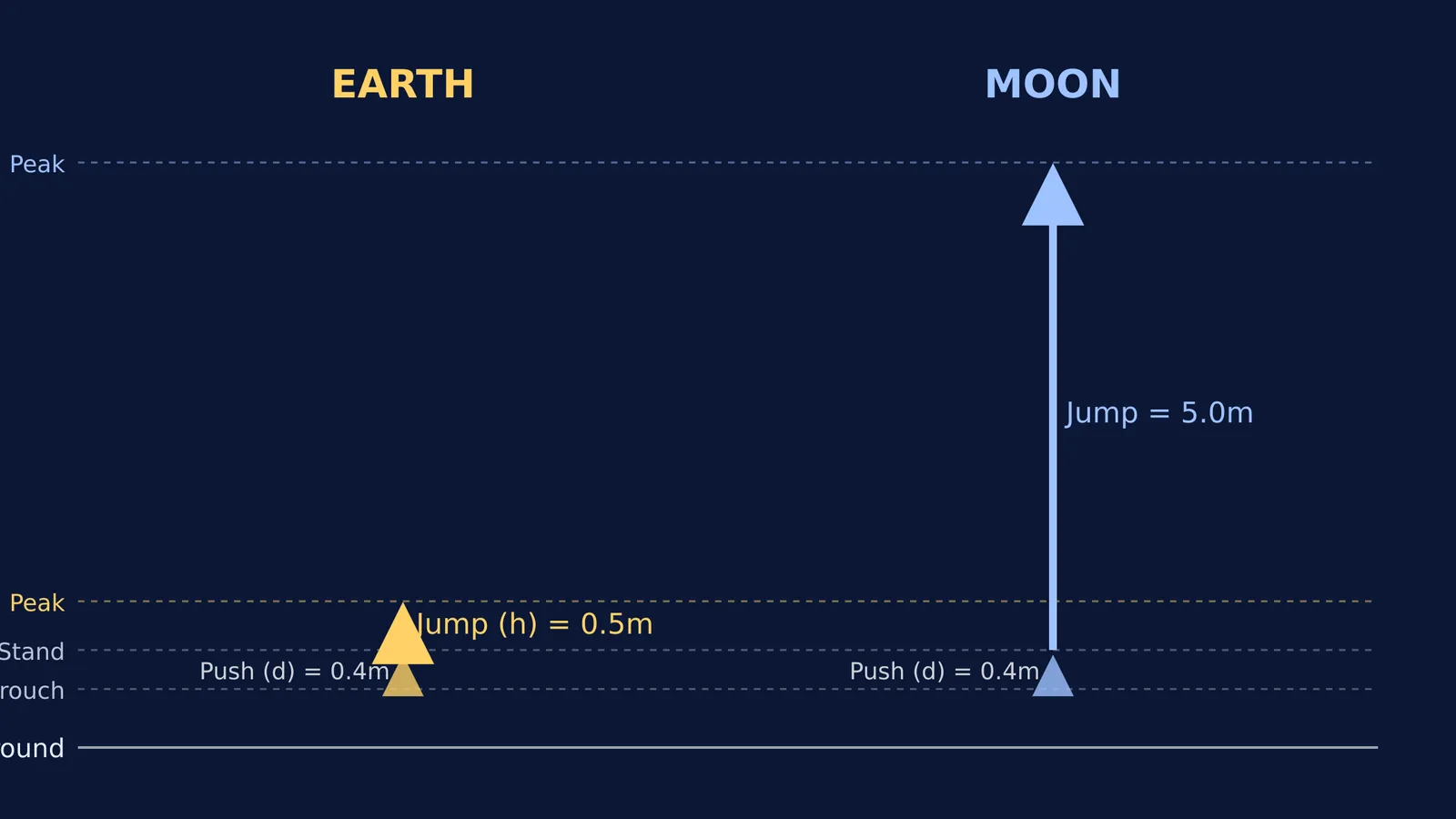
According to normative data, a typical young adult has an average vertical jump height (*h*) of roughly 0.5 metres, or about 20 inches (Patterson and Peterson, 2004). To achieve this height, suppose you drop into a crouch that gives you a push-off distance (*d*) of 0.4 metres. During that 0.4-metre push, your legs are doing mechanical work.
Why do you jump higher on the Moon?
On Earth, your leg muscles have to perform two distinct tasks simultaneously during the push-off phase. First, they must support your entire body weight against Earth's strong gravity. Second, they must provide the extra upward force needed to accelerate you into the air. A large portion of the energy your legs generate is "wasted" simply fighting gravity before you even leave the ground.
On the Moon, the environment is different. Because gravity is one-sixth as strong (NASA Moon Fact Sheet), your legs spend far less energy supporting your weight during that same 0.4-metre push-off. Assuming your muscles push with the exact same average force as they do on Earth, that leftover energy is entirely converted into kinetic energy. This "push-off advantage" translates into a much higher takeoff speed.
Let us plug in the numbers for our average jumper to see the difference:
**Earth jump height (*h*):** 0.5 m
**Push-off distance (*d*):** 0.4 m
Lunar jump height: 6(0.5) + 5(0.4) = 3.0 + 2.0 = 5.0 metres.
Instead of a 3-metre jump, you achieve a 5-metre (16.4-foot) vertical leap. The extra 2 metres come entirely from the energy you saved during the push-off phase. If you find it hard to picture how forces and kinetic energy change across different gravitational environments, running the scenario in the Fermi Simulation Lab can help you visualise exactly where that extra energy goes.
What about the Apollo astronaut suits?
If you have watched archival footage of the Apollo astronauts on the Moon, they certainly did not look like they were jumping 5 metres into the air. They usually performed small, bounding hops.
Why the discrepancy? The Apollo A7L spacesuit was heavy and rigid. If you double your total mass by wearing a bulky life-support suit (Apollo spacesuit specifications), Newton's second law (*F = ma*) tells us that your acceleration during push-off is severely reduced. Combined with the suit's stiff joints that prevent a deep crouch—thereby reducing your push-off distance *d*—an astronaut's vertical jump is brought back down to around 2 metres or less.
Still, if you were standing inside a pressurised lunar habitat in normal gym clothes, a single jump could comfortably take you to the ceiling of a two-storey building.
If you are studying mechanics and keep getting stuck on work-energy equations like these, the Fermi Problem Library has worked problems with a step-by-step solver that explains the reasoning rather than printing an answer, helping you master the underlying concepts.
For more practice with motion, you might also want to read our guides on how to find the equation of trajectory of a projectile or how to test if two projectiles will collide midair.


