On this page
Strike a cue ball softly so it is rolling when it reaches the object ball, and cut the object ball off to one side. Textbook collision theory says the two balls should leave at 90° to each other. On a real table the cue ball sets off along the 90° line, then bends forward onto a path about 30° from where it was heading. Players call this the 30° rule. Here is where it comes from, using only rolling-with-slipping equations, and why a half-ball hit gives 33.7°.
Why should the balls leave at 90° in the first place?
For equal, smooth, non-spinning balls colliding elastically, momentum and energy force the final velocities to be at right angles. The proof is in why equal masses leave at 90° in an oblique elastic collision, and it states its own assumption: friction and rotation are ignored.
The push between the balls acts along the line of centres, so the object ball leaves along that line with speed u cos φ, where φ is the cut angle. The cue ball keeps only its velocity across the line of centres, u sin φ, at 90° to the object ball's path.
What the collision does not touch is the cue ball's spin. The contact force passes through its centre, so it exerts no torque about the centre. A rolling ball arrives with Rω = u, spinning about a horizontal axis that makes it roll along its old line. Just after impact it still has all of that topspin.
What happens to the cue ball after the collision?
Just after impact the cue ball moves one way but spins as if to roll another, so its contact point slides and kinetic friction acts. This is the same situation as in which way friction acts when a rolling body slips, but in two dimensions.
Friction opposes the slip and keeps a fixed direction while the slip shrinks, so the path is a parabola. When the slip reaches zero the ball rolls again and runs straight.
How do you find the final direction without solving the motion?
Use angular momentum about the point of contact with the cloth. Friction acts at that point, and gravity and the normal force cancel each other, so neither has a torque about it. Angular momentum about the contact point is therefore conserved, as a vector, even though friction is acting.
For a solid ball of mass m and radius R, I = (2/5)mR².
Just after impact. The translational part is mR v₁, from the velocity v₁ = u sin φ along the tangent line. The spin part is Iω = (2/5)mR²(u/R) = (2/5)mRu, pointing along the old line.
When it rolls again. A rolling ball with velocity v_f has angular momentum about the contact point of mRv_f + (2/5)mRv_f = (7/5)mRv_f, along v_f.
Equate the vectors. (7/5)mRv_f = mRv₁ + (2/5)mRu, so v_f = (5/7)v₁ + (2/7)u.
The cloth's friction coefficient has cancelled out. It decides how long and how far the cue ball curves, not where it ends up.
Resolve along and across the old line. v₁ has components u sin²φ forward and u sin φ cos φ sideways. The deflection θ from the old line then satisfies
tan θ = 5 sin φ cos φ / (5 sin²φ + 2)
This is the formula in David Alciatore's technical proof TP 3.3 on the 30° rule, written there as tan θ = sin φ cos φ / (sin²φ + 2/5).
Worked example: a half-ball hit at 2.0 m/s
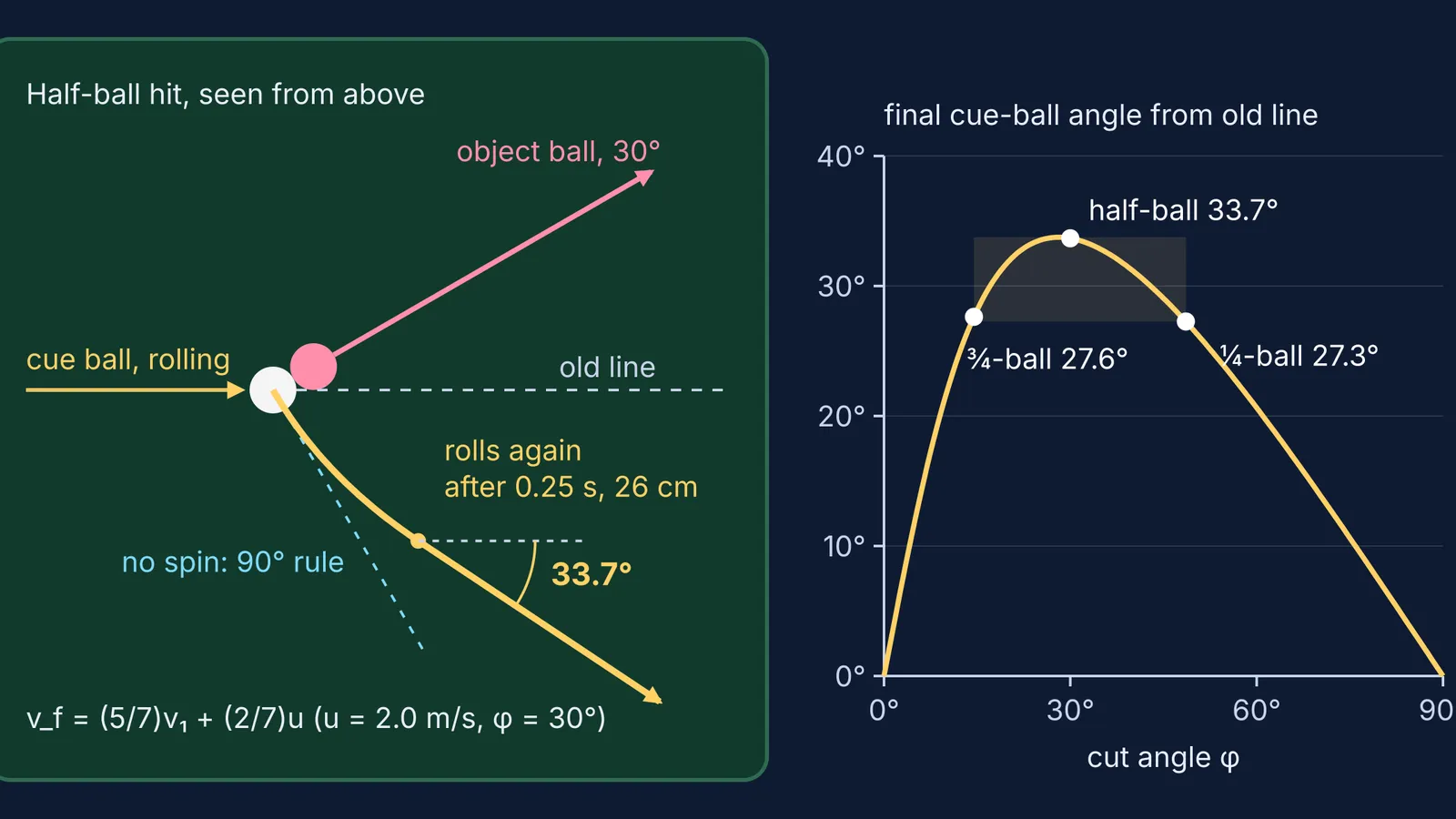
In a half-ball hit the cue ball's centre is aimed at the object ball's edge, so sin φ = 1/2 and φ = 30°. Take u = 2.0 m/s and a sliding friction coefficient μ = 0.2 on the cloth (an illustrative round value).
Object ball. Speed u cos φ = 2.0 × 0.866 = 1.73 m/s, at 30° to one side of the old line.
Cue ball just after impact. Speed u sin φ = 1.00 m/s, at 60° to the other side. Spin unchanged, Rω = 2.0 m/s.
Final velocity. v_f = (5/7)(1.00 m/s along the tangent line) + (2/7)(2.0 m/s along the old line). Along the old line: (5/7)(0.50) + 0.571 = 0.929 m/s. Across: (5/7)(0.866) = 0.619 m/s. So v_f = 1.12 m/s.
Direction. tan θ = 0.619/0.929 = 0.666, so θ = 33.7° from the old line.
How long it curves. The contact point first slips at 1.73 m/s. Friction μmg slows the centre at μg and changes Rω at (5/2)μg, so the slip falls at (7/2)μg = 6.87 m/s². Time t = 1.73/6.87 = 0.25 s.
How far. In that time the centre moves 0.26 m, about 26 cm, along a gentle curve. After that it rolls straight at 1.12 m/s.
Is it really 30° for every cut?
No, but it is close for a wide range. Running the formula over all cut angles gives:
The largest deflection is 33.7°, at a cut angle of about 28°, very close to a half-ball hit.
The deflection is at least 30° for every cut angle from 17° to 43°.
A three-quarter-ball hit (φ = 14.5°) gives 27.6°. A quarter-ball hit (φ = 48.6°) gives 27.3°.
So for every cut between the three-quarter-ball and quarter-ball hits, the cue ball ends between about 27° and 34° from its old line.
Thin cuts break the rule: at φ = 70° the deflection is only 14°.
TP 3.3 gives the same 33.67°, 27.63° and 27.27° values. For a full hit (φ = 0) the formula gives θ = 0: the cue ball stops for an instant, then its topspin drives it forward again at (2/7)u = 0.57 m/s. That is the follow shot.
What do real tables add?
Two effects shift the answer by a degree or two: friction between the balls (throw) and a slightly inelastic collision. A ball with backspin at impact gets dragged the other way and ends up more than 90° from its old line, which is how players draw the cue ball back.
The same angular momentum trick works whenever a ball must change from sliding to rolling, as in where to strike a ball so it rolls at once.
How does this appear in JEE problems?
JEE Advanced likes problems where friction acts but angular momentum about the contact point is still conserved; this is a two-dimensional version. For more like it, the Fermi Problem Library has a step-by-step solver that explains the reasoning. If you are preparing for JEE Main & Advanced, Fermi Test Prep offers personalised preparation with an AI tutor, live classes, adaptive mocks, mentorship and a study plan that updates based on mastery.
Quick checklist
At impact the cue ball keeps u sin φ along the tangent line and all of its topspin.
Friction from the cloth bends its path into a parabola until it rolls again.
Angular momentum about the contact point is kept: v_f = (5/7)v₁ + (2/7)u.
tan θ = 5 sin φ cos φ / (5 sin²φ + 2); half-ball hit gives 33.7°.
Between three-quarter-ball and quarter-ball hits, θ stays between about 27° and 34°.
μ sets how long the curve lasts, not the final direction.