On this page
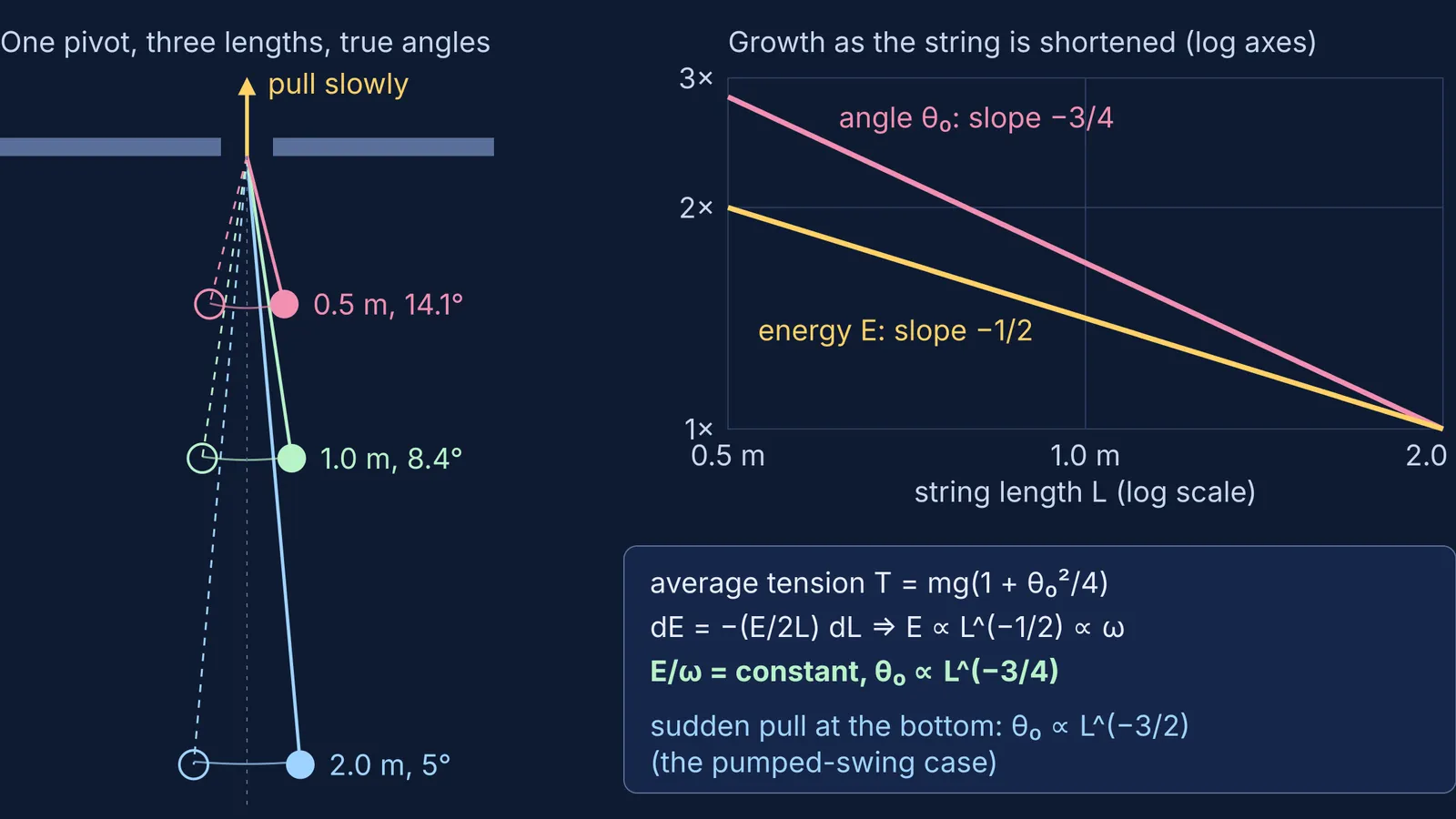
Tie a bob to a string, pass the string up through a small hole in the ceiling, and set it swinging through 5° on 2.0 m of string. Now pull the string up through the hole, slowly and steadily, until only 0.50 m hangs below. The swing does not stay at 5°. It grows to about 14°, and the energy of the swing doubles. The rule behind this is short: when the length changes slowly, the swing energy divided by the angular frequency, E/ω, stays fixed. You can derive it with Class 11 work-energy and string tension; treat it as a JEE Advanced extension.
Where does the extra swing energy come from?
From you. To shorten the string you pull against its tension, and the tension is not constant during a swing. As shown in how the tension in a pendulum string changes with angle, T = mg cos θ + mv²/L, so it is largest at the bottom, where the bob moves fastest.
If you pull steadily over many swings, what counts is the tension averaged over one swing. For small angles:
Energy conservation gives v² = gL(θ₀² − θ²), where θ₀ is the amplitude.
With cos θ ≈ 1 − θ²/2, the tension becomes T ≈ mg(1 + θ₀² − 3θ²/2).
In SHM the average of θ² over a cycle is θ₀²/2.
So the average tension is mg(1 + θ₀²/4).
Pull the string up by a small length. The mg part of the tension does the work of lifting the bob's resting position. The extra mgθ₀²/4 per metre pulled goes into the swing.
Why does energy divided by frequency stay constant?
For small angles the swing energy is E = ½mgLθ₀², because the bob rises L(1 − cos θ₀) ≈ Lθ₀²/2 at the ends. So the extra term is mgθ₀²/4 = E/2L.
Shortening means dL is negative, and the work you put into the swing is
dE = −(E/2L) dL
Separate the variables: dE/E = −½ dL/L. Integrate and you get E ∝ L^(−1/2).
The angular frequency of a pendulum is ω = √(g/L), which also goes as L^(−1/2). So E/ω does not change while the length changes slowly. Two more results follow:
Since E ∝ Lθ₀², θ₀² ∝ L^(−3/2), so θ₀ ∝ L^(−3/4).
The bob's sideways reach is about Lθ₀, which goes as L^(1/4). The angle grows, but the sideways swing shrinks a little.
This pendulum has a place in the history of quantum theory. At the first Solvay Conference in 1911, Lorentz asked what happens to a pendulum whose length is slowly altered, and Einstein replied that if the length is changed infinitely slowly, its energy stays equal to hν if it starts at hν. Rayleigh had already found E/ν constant in 1902. The history and a careful analysis are in Sánchez-Soto and Zoido, American Journal of Physics 81, 57 (2013). Landau and Lifshitz's Mechanics (section 49) gives the general rule: under slow changes, the quantity I = (1/2π)∮p dq is conserved, and for a harmonic oscillator I = E/ω.
Worked example: from 2.0 m to 0.50 m
A 200 g bob swings through 5° on 2.0 m of string. You pull the string up through the hole until 0.50 m is left. Take g = 9.81 m/s².
Periods. T = 2π√(L/g) gives 2.84 s at 2.0 m and 1.42 s at 0.50 m. The period halves, so ω doubles, from 2.21 to 4.43 rad/s.
Energy. E/ω is fixed, so E doubles. At the start, E = ½ × 0.200 × 9.81 × 2.0 × (0.0873)² = 0.0149 J. At the end, E = 0.0299 J.
Angle. θ₀ = 5° × (2.0/0.50)^(3/4) = 5° × 2.83 = 14.1°. Halfway, at 1.0 m, it is 5° × 2^(3/4) = 8.4°.
Sideways reach. Lθ₀ = 2.0 × 0.0873 = 17.5 cm at the start, and 0.50 × 0.247 = 12.3 cm at the end.
Your work. Lifting the bob by 1.5 m takes mg × 1.5 = 2.94 J. Only about 0.015 J, half a percent, goes into the swing.
Units. In E = ½mgLθ₀², kg × m/s² × m gives joules, and θ₀ is in radians.
We checked this by integrating the full equation of motion step by step, with the length falling at a steady rate. Pulled in over 60 s (about 28 oscillations), the final amplitude is 14.1° to 14.2°, depending on where in the swing you start. Over 10 s (about 5 oscillations) it is 13.7° to 14.6°. Over 2 s, less than one oscillation, it ranges from 12.8° to 15.7°, and the rule no longer holds.
How slow is "slowly"?
The length should change by only a small fraction of itself during one period. In the 60 s pull, the string moves 2.5 cm per second, about 5 cm per oscillation. That is 2.5% of the length at the start and 10% at the end, small enough for the rule to work to about 0.1°.
A fast pull breaks the rule because the average tension no longer applies. What you get then depends on the phase: pulling while the bob is near the bottom, where the tension is largest, puts in more energy than pulling near the ends.
How is this different from pumping a swing?
When you pump a swing by standing up at the bottom, you shorten the pendulum suddenly, exactly when the tension is greatest. Angular momentum about the pivot is conserved across that instant, and for small angles the amplitude grows as θ ∝ L^(−3/2), twice the power for a slow pull.
Shorten the same 2.0 m pendulum to 0.50 m in one sudden pull at the bottom and the 5° swing becomes about 41°, not 14°. A well-timed pull puts in much more swing energy than a steady one.
Does E/ω stay exactly constant at large angles?
No. At large amplitudes the pendulum is no longer simple harmonic, and its period depends on the amplitude. The quantity that stays fixed is the area enclosed by the motion's loop in a graph of momentum against position, ∮p dq. For small swings that area equals 2πE/ω, which is the E/ω rule.
Friction and air drag also slowly drain the swing, so a real pull gives a little less.
To practise work-energy and oscillation problems like this one, the Fermi Problem Library has a step-by-step solver that explains the reasoning. For a full plan, Fermi Test Prep offers personalised preparation for JEE Main & Advanced with an AI tutor, live classes, adaptive mocks, mentorship and a study plan that updates based on mastery. For the fixed-length case, see how the period of a seconds pendulum changes with length and g.
Quick checklist
Average tension over a small swing: mg(1 + θ₀²/4).
Slow shortening: dE = −(E/2L) dL, so E ∝ L^(−1/2).
E/ω stays fixed; θ₀ ∝ L^(−3/4); sideways reach ∝ L^(1/4).
2.0 m to 0.50 m: 5° becomes 14.1°, E doubles, period halves.
"Slowly" means over many oscillations; a quick pull depends on phase.
Sudden pull at the bottom: angular momentum, θ ∝ L^(−3/2).
At large angles the invariant is ∮p dq, not E/ω exactly.