On this page
A mass on a spring takes the same time for every swing, whether you pull it 1 cm or 5 cm. That is the special property of SHM, and it is easy to start believing every oscillation works this way. Most do not. Lay a bead at the middle of a slack wire on a smooth table, pull it sideways and let go: the further you pull, the faster it oscillates. A ball bouncing on a floor does the opposite: drop it from higher and each bounce takes longer. One line of dimensional analysis tells you which way the period goes for any potential of the form U = c|x|ⁿ.
Why is a spring's period independent of amplitude?
For a spring, U = ½kx², so n = 2. If you double the amplitude, the distance to cover doubles, but the restoring force at each point of the path doubles too, so the speeds double. The two effects cancel and the time stays the same.
For any other power they do not cancel. The harmonic case is the one treated in finding the period of small oscillations from a potential curve, where every smooth well looks like a parabola near the bottom. Here we look at wells that are not parabolas even at the bottom.
How does dimensional analysis give the period for U = c|x|ⁿ?
The period can depend only on the mass m, the constant c and the amplitude A. The unit of c is J/mⁿ, that is kg m^(2−n) s⁻². Write T = m^α c^β A^γ and match units:
Seconds: −2β = 1, so β = −½.
Kilograms: α + β = 0, so α = ½.
Metres: (2 − n)β + γ = 0, so γ = 1 − n/2.
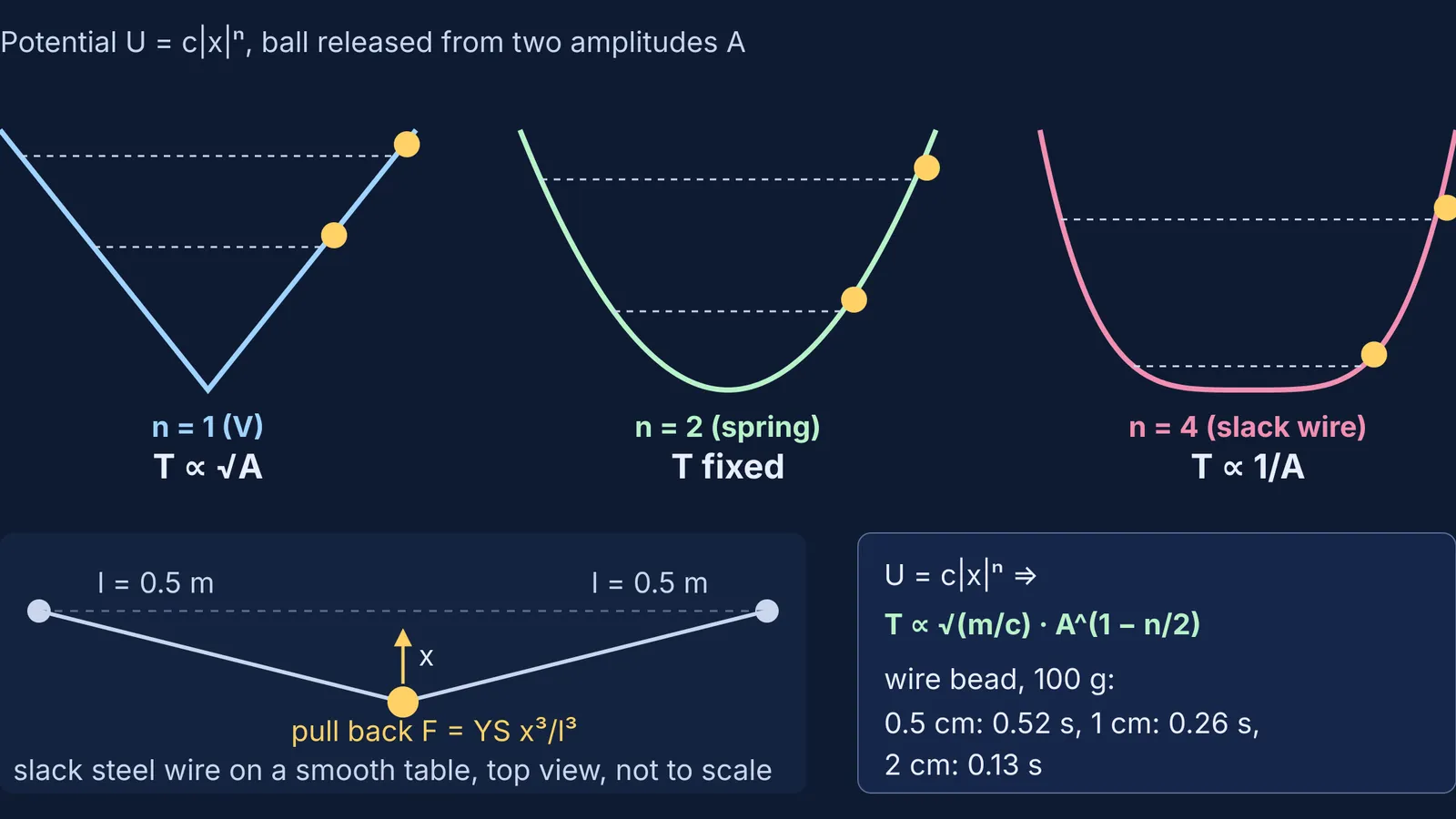
So T ∝ √(m/c) × A^(1 − n/2).
n = 2 (spring): A⁰, the period is fixed.
n = 1 (constant force towards the centre, a V-shaped well): T ∝ √A.
n = 4 (force ∝ x³): T ∝ 1/A, so bigger swings are faster.
Landau and Lifshitz derive the same rule from mechanical similarity in section 10 of their Mechanics: for a potential of degree n, times scale as (length)^(1 − n/2). Dimensional analysis gives the power but not the number in front. That comes from energy conservation, ½mv² + c|x|ⁿ = cAⁿ, integrated over a quarter of the cycle:
T = 4√(m/2c) × A^(1 − n/2) × I, where I = ∫₀¹ du/√(1 − uⁿ)
The integral is 2 for n = 1, π/2 for n = 2 and 1.311 for n = 4. The closed form, with a Beta function, is in Santos, Santos and Lima, Brazilian Journal of Physics (2006). For n = 2 it gives T = 2π√(m/k), as it should.
Why does a bead on a slack wire oscillate faster when pulled further?
Take a steel wire with no initial tension, fixed at both ends, and a bead at its middle. As worked out in the sag of a mass at the middle of a taut wire, pulling the middle sideways by x stretches each half and creates a tension that grows as x². Its sideways component grows as x² × x, so the restoring force is
F = YS x³/l³
where Y is Young's modulus, S the cross-sectional area and l the length of each half. That is n = 4, with U = YS x⁴/4l³. Near the centre the force is tiny, so a small swing crawls; a large swing meets a force that grows very fast and is thrown back quickly. Lay the wire on a smooth horizontal table so that gravity plays no part.
Worked example: the slack-wire bead
Data: steel wire 1.0 m long (l = 0.50 m each half), S = 0.50 mm² = 5.0 × 10⁻⁷ m², Y = 2 × 10¹¹ Pa, no initial tension, a 100 g bead at the middle.
Stiffness. YS = 2 × 10¹¹ × 5.0 × 10⁻⁷ = 1.0 × 10⁵ N. So c = YS/4l³ = 1.0 × 10⁵ / (4 × 0.125) = 2.0 × 10⁵ J/m⁴.
Prefactor. √(m/2c) = √(0.100 / 4.0 × 10⁵) = 5.0 × 10⁻⁴ s·m.
Period. T = 4 × 5.0 × 10⁻⁴ × 1.311 / A = 2.62 × 10⁻³ / A, with A in metres.
Pulled 0.5 cm: T = 2.62 × 10⁻³ / 0.005 = 0.524 s.
Pulled 1 cm: 0.262 s. Pulled 2 cm: 0.131 s. Double the pull, halve the period.
Check the assumptions at 2 cm. The wire's angle is tan⁻¹(2/50) = 2.3°, small. The strain is x²/2l² = 8 × 10⁻⁴, giving a stress of 1.6 × 10⁸ Pa, below the roughly 2.5 × 10⁸ Pa at which mild steel yields.
If the wire starts with any tension T₀, there is an extra linear force 2T₀x/l. For small swings that term wins, and the period becomes fixed again.
Why does a bouncing ball take longer from higher up?
A ball above a floor has U = mgx, which is n = 1 on one side, with the floor as a hard wall. It falls for √(2h/g) and rises for the same time, so T = 2√(2h/g). Ignoring the energy a real ball loses at each bounce:
From 10 cm: T = 0.29 s.
From 40 cm: 0.57 s.
From 1.6 m: 1.14 s.
Four times the height doubles the period, the √A rule.
A small block sliding in a smooth V-shaped trough with 30° slopes is the two-sided version. The acceleration along each slope is g sin 30° = 4.9 m/s², and T = 4√(2s/g sin 30°), with s the starting distance along the slope. From 10 cm along the slope, T = 0.81 s; from 40 cm, 1.62 s.
Where else does the period depend on amplitude?
A simple pendulum is harmonic only for small angles; at large angles the restoring torque grows more slowly than the angle, and the period lengthens. You can see this in a simulation of a pendulum at large amplitudes. A periodic motion that is not SHM is also discussed in why every SHM is periodic but not the converse.
For more oscillation and dimensional-analysis problems in the JEE style, Fermi Test Prep offers personalised preparation for JEE Main & Advanced with an AI tutor, live classes, adaptive mocks, mentorship and a study plan that updates based on mastery. The Fermi Problem Library has a step-by-step solver that explains the reasoning.
Quick checklist
For U = c|x|ⁿ, T ∝ √(m/c) × A^(1 − n/2).
n = 2: fixed period; n = 1: T ∝ √A; n = 4: T ∝ 1/A.
The number in front needs energy conservation, not dimensions.
Slack wire, 100 g bead: 0.524 s at 0.5 cm, 0.131 s at 2 cm.
Bouncing ball: T = 2√(2h/g), so four times the height doubles the period.
Any pre-tension in the wire brings back a fixed period for small swings.