

On this page
A steel wire 1.0 m long is stretched between two pillars until it is just taut. You hang a 100 g mass from its midpoint. How far down does the midpoint move? This NCERT Class 11 exercise from Mechanical Properties of Solids looks like a statics question, but you cannot solve it with statics alone. The wire has no tension to begin with. The tension appears only because the mass stretches the wire, so the sag and the tension have to be found together, using Young's modulus.
Why can't you find the sag from the forces alone?
In a clothesline problem you are usually given the angle or the tension. Then T = W/(2 sin θ) finishes the job, as shown in why a tight clothesline has huge tension with small sag. Here you are given neither. You know only the load, the wire's material and its size.
The wire also cannot stay straight. A horizontal wire has no vertical component of tension to hold anything up, which is the point made in why a taut horizontal string cannot be perfectly straight. So the midpoint drops. As it drops, each half becomes slightly longer, and that stretch is what creates the tension. The wire settles where the tension produced by the stretch is exactly enough to hold the weight.
So you need two equations: one from elasticity (how much tension a given sag produces) and one from equilibrium (how much tension the weight needs at that sag).
How do you set up the equations?
Let l be the length of each half, so l = 0.5 m. Let x be the depression of the midpoint and θ the angle each half makes with the horizontal.
Geometry. Each half becomes the hypotenuse of a right triangle with sides l and x. Its new length is √(l² + x²).
Strain. For x much smaller than l, √(l² + x²) ≈ l + x²/2l. The extension of each half is x²/2l, so the strain is x²/2l².
Tension from Hooke's law. T = Y × A × strain = YA·x²/2l².
Vertical equilibrium. The two halves pull up with 2T sin θ. For a small angle, sin θ ≈ tan θ ≈ x/l. So 2T(x/l) = mg.
Combine. Substitute T: 2 × (YA·x²/2l²) × (x/l) = mg, which simplifies to YA·x³/l³ = mg.
Solve. x = l(mg/YA)^(1/3).
Check the dimensions: mg and YA are both forces (Y in N m⁻² times A in m²), so mg/YA is a pure number and x comes out in the units of l.
Two approximations went in, and you should state both in an answer: the small-angle approximation, and a wire with zero initial tension.
Worked example: NCERT's steel wire with 100 g
Data: length 1.0 m, cross-section 0.50 × 10⁻² cm², Y = 2 × 10¹¹ Pa for mild steel, m = 100 g, g = 9.8 m s⁻².
Convert the area. 1 cm² = 10⁻⁴ m², so A = 0.50 × 10⁻² × 10⁻⁴ = 5.0 × 10⁻⁷ m².
Find YA. YA = 2 × 10¹¹ × 5.0 × 10⁻⁷ = 1.0 × 10⁵ N.
Find mg/YA. mg = 0.100 × 9.8 = 0.98 N, so mg/YA = 0.98/(1.0 × 10⁵) = 9.8 × 10⁻⁶.
Take the cube root. (9.8 × 10⁻⁶)^(1/3) ≈ 0.0214.
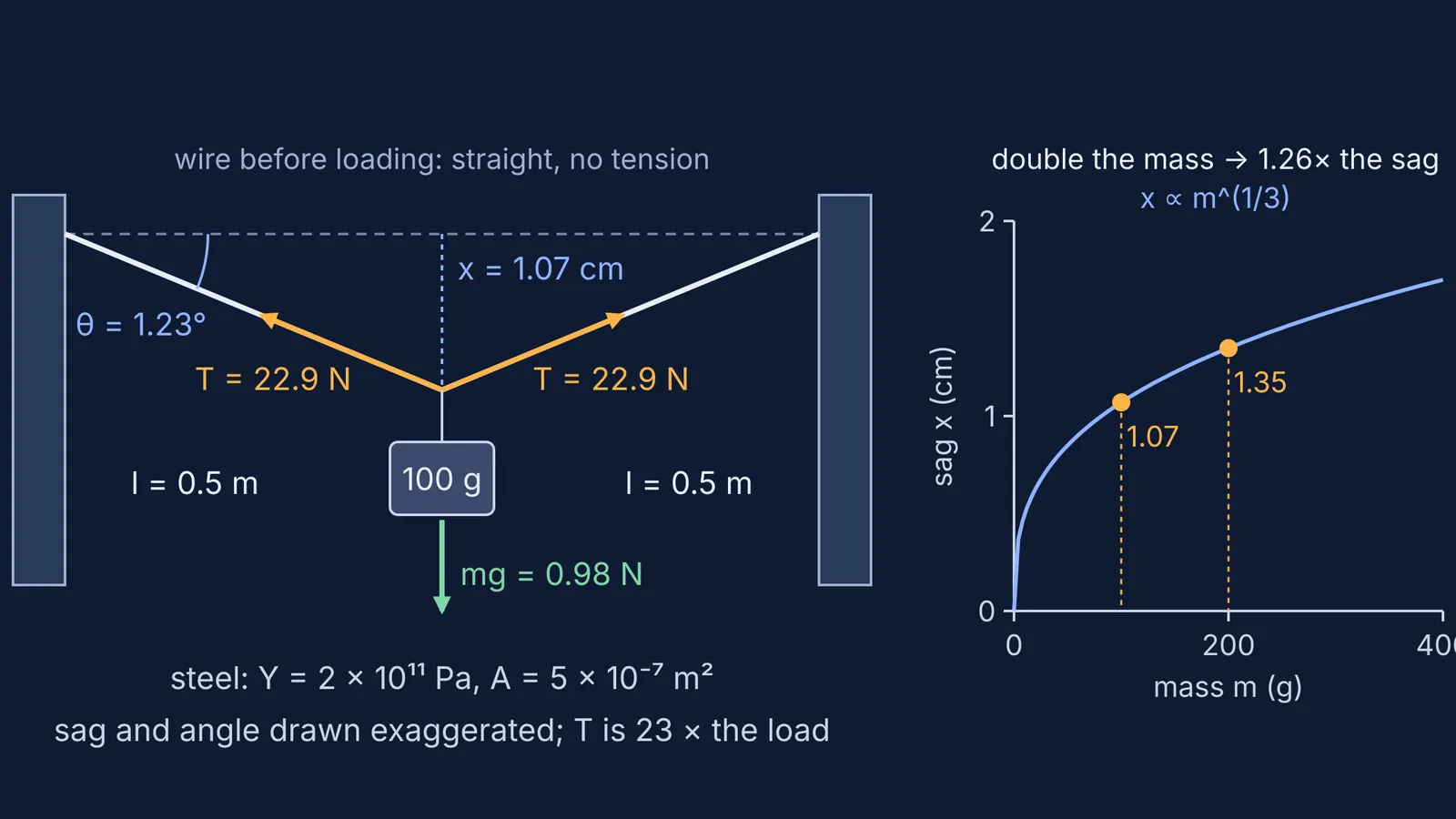
Multiply by l. x = 0.5 × 0.0214 = 0.0107 m ≈ 1.07 cm, which matches NCERT's answer.
Now check the result against the assumptions.
Angle: tan θ = 0.0107/0.5, so θ ≈ 1.23°. The small-angle approximation is excellent. Solving the exact equations numerically, without any approximation, changes the answer only in the fourth significant figure.
Tension: T = mg·l/(2x) = 0.98 × 0.5/(2 × 0.0107) ≈ 22.9 N. That is about 23 times the 0.98 N load.
Strain: x²/2l² ≈ 2.3 × 10⁻⁴. The total stretch of the whole wire is only about 0.23 mm.
Stress: Y × strain ≈ 4.6 × 10⁷ Pa. Mild steel yields at roughly 2.5 × 10⁸ Pa, so the wire stays well inside its elastic limit and Hooke's law is valid. If you need a refresher on that region, see how to read the stress-strain curve of a wire.
A 0.23 mm stretch, hidden in a 1.07 cm sag, is what holds the mass up. The geometry turns a tiny change in length into a visible drop.
Why is the sag proportional to the cube root of the mass?
From x = l(mg/YA)^(1/3), the sag grows as m^(1/3). This is not the linear response you might expect from Hooke's law, even though Hooke's law was used. The reason is that two effects work together as the wire drops:
the stretch, and so the tension, grows as x²;
the upward share of that tension grows as x (through sin θ ≈ x/l).
Their product grows as x³, and it must equal mg. So:
doubling the mass increases the sag by 2^(1/3) ≈ 1.26 times (100 g gives 1.07 cm, 200 g gives 1.35 cm);
you need 8 times the mass to double the sag;
a stiffer or thicker wire (larger YA) sags less, but only as the cube root.
This stiffening response is why a wire can carry a small load with a surprisingly small sag: the more it drops, the faster its supporting force rises.
What changes if the wire already has tension?
Real wires, such as guitar strings and power lines, are rarely just taut. Suppose the wire starts with a tension T₀ that is much larger than the extra tension the mass adds. Then T stays close to T₀, and vertical balance gives 2T₀(x/l) = mg, so x ≈ mgl/(2T₀).
Now the sag is linear in the mass, and Young's modulus drops out. For the same 100 g on a 0.5 m half with T₀ = 50 N, x ≈ 0.98 × 0.5/(2 × 50) ≈ 0.49 cm.
So there are two models, and you must say which one you are using:
zero initial tension (NCERT's "just taut"): x = l(mg/YA)^(1/3), cube-root in m;
large pretension: x ≈ mgl/(2T₀), linear in m.
Between the two, both effects matter, and you would solve a cubic numerically. JEE and NEET questions use one of the two limits.
If you want to practise more elasticity problems where the method matters as much as the number, the Fermi Problem Library has a step-by-step solver that explains the reasoning at each stage.
Quick checklist
Just taut means zero initial tension: the stretch creates the tension.
Use l = half the wire's length.
Strain of each half ≈ x²/2l²; tension T = YA·x²/2l².
Vertical balance with sin θ ≈ x/l gives YA·x³/l³ = mg.
x = l(mg/YA)^(1/3) = 1.07 cm for NCERT's data.
Convert cm² to m² with 10⁻⁴.
Check the angle (1.23°) and the stress (4.6 × 10⁷ Pa) to confirm your approximations.
With a large pretension T₀, switch to x ≈ mgl/(2T₀).


