On this page
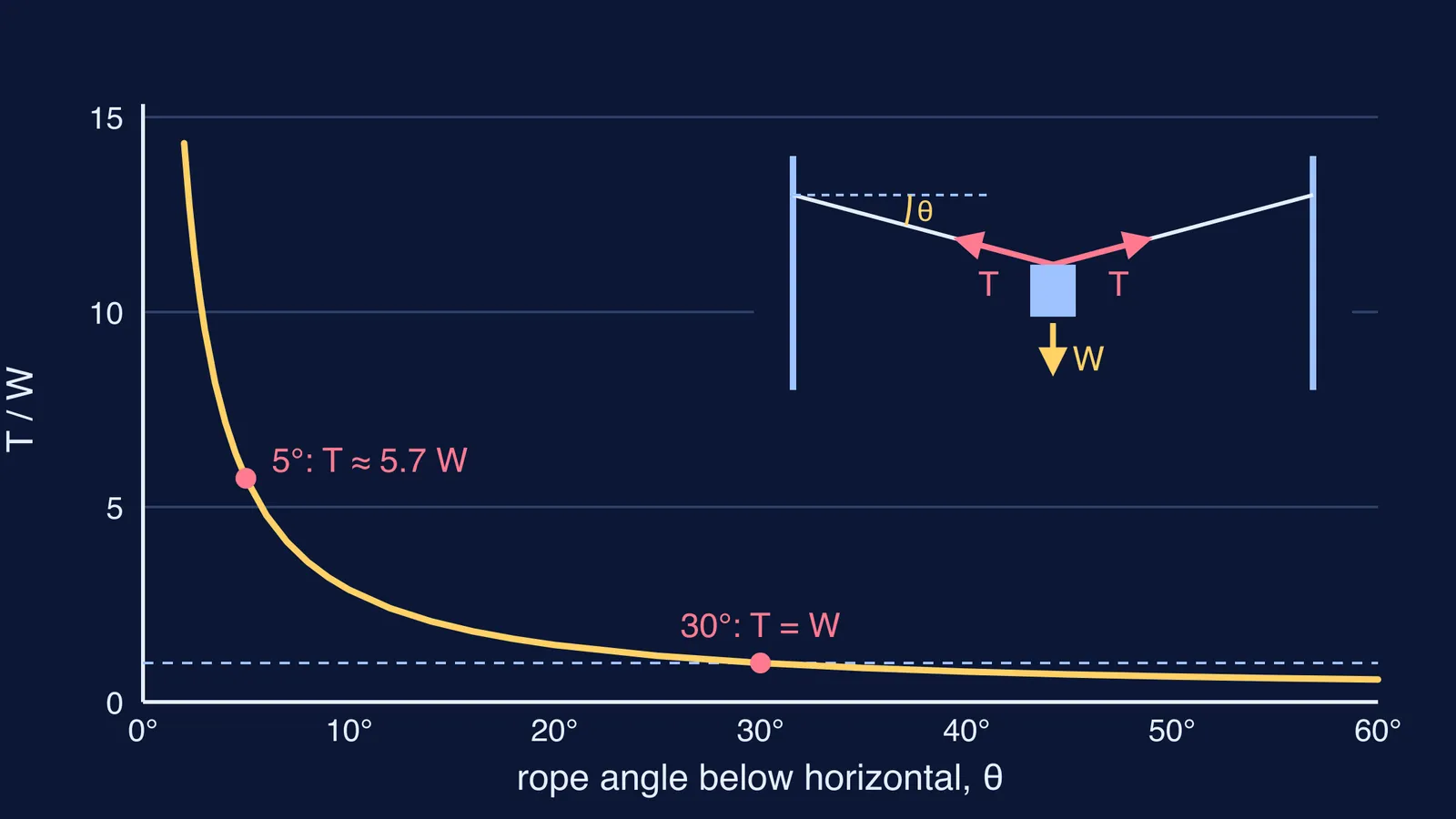
You peg a wet towel on a clothesline, then pull the line tighter so it stops drooping. A tighter line feels stronger, but the less a line sags, the harder it has to pull. Guess first: if each side of the line sits 5° below the horizontal, is the tension less than the towel's weight, equal to it, or more?
Why does a nearly flat rope have such high tension?
OpenStax College Physics defines tension as "a force along the length of a medium, especially a force carried by a flexible medium, such as a rope or cable." A rope can only pull along its own length, so each half of the line pulls up and sideways at the same angle θ below the horizontal.
The sideways pulls cancel. Only the two vertical parts hold the towel up, so 2T sin θ = W, which gives T = W/(2 sin θ), the relation OpenStax uses for a tightrope walker. When θ is small, sin θ is small, and dividing by a small number gives a big answer. In OpenStax's words, "an infinite tension would result if it were horizontal."
Predict first: what happens at 30°, 10°, 5°, 2° and 1°?
Write down your guess for T/W at each angle, then check it against T = W/(2 sin θ) from OpenStax:
30°: sin 30° = 0.5, so T = W exactly.
10°: T is about 2.9 W.
5°: T is about 5.7 W.
2°: T is about 14.3 W.
1°: T is about 28.6 W.
From 30° to 5° the tension grows nearly six times, and each time you halve a small angle it roughly doubles. That is the curve in the diagram above.
OpenStax's worked example lands on the same row: a 70.0 kg tightrope walker on a wire sagging 5.0° creates a tension of 3900 N, "almost six times the 686-N weight of the tightrope walker" (OpenStax).
How much tension is in a real clothesline? A worked example
Take a 4 m line with a 2 kg wet towel pegged at the middle (example numbers; use your own). Its weight is W = 2 × 9.8 = 19.6 N. Each half spans 2 m, so tan θ = sag ÷ 2 m, and T = W/(2 sin θ) from OpenStax:
Sag 50 cm: θ is about 14°, so T is about 2.1 W, or 40 N.
Sag 20 cm: θ is about 5.7°, so T is about 5.0 W, or 99 N.
Sag 10 cm: θ is about 2.9°, so T is about 10 W, or 196 N, the weight of a 20 kg mass.
Sag 5 cm: θ is about 1.4°, so T is about 20 W, or 392 N, the weight of a 40 kg mass.
For small sags, a shortcut works: T ≈ W × span ÷ (4 × sag). With a 4 m span and a 10 cm sag, 19.6 × 4 ÷ 0.4 = 196 N, matching step 3. Halve the sag and you double the tension. That is how pulling a loaded line "just a bit tighter" can snap a cord or pull a hook out of the wall.
How can you test the angle effect at home?
You need two chairs, strong string, a small water bottle, a luggage scale and a protractor app.
Weigh the bottle on the scale, so you know W in the scale's units.
Tie the string to one chair and to the scale's hook at the other end, and hold the scale.
Hang the bottle from a loose loop so it slides to the middle.
With a big sag, read the angle and the scale. Pull flatter and read again near 30°, 15° and 5°.
Compare each reading with W/(2 sin θ). Knots and stretch mean close, not exact.
Stop before the string or knots strain, and keep your face clear of the line.
To slide the angle on a screen first, the Fermi Simulation Lab has interactive simulations for ideas that are easier to see than to read. Our vector addition simulation where you predict the resultant first uses the same predict-then-test habit.
How do you avoid mistakes in string tension problems?
JEE-style problems dress this up as a lamp on two wires. Check:
Draw the free-body diagram at the point where the weight hangs. See how to check a free-body diagram an AI has drawn.
If the angle α is measured from the vertical, use T = W/(2 cos α).
A smaller sag must give a bigger tension. If yours shrinks as the rope flattens, you have swapped sin and cos.
Unequal angles mean unequal tensions, so write separate horizontal and vertical equations, as in tension in a hanging rod when one string is cut.
If your working still goes wrong, the Fermi Problem Library has worked problems with a step-by-step solver that explains the reasoning rather than printing an answer.
Next time you hang the washing, estimate the tension from the sag before you pull the line any tighter.