

On this page
This is a standard problem in introductory physics. When you first look at a horizontal uniform rod supported by two vertical strings, the system is in equilibrium. The tension in each string is simply half the weight of the rod, or mg/2.
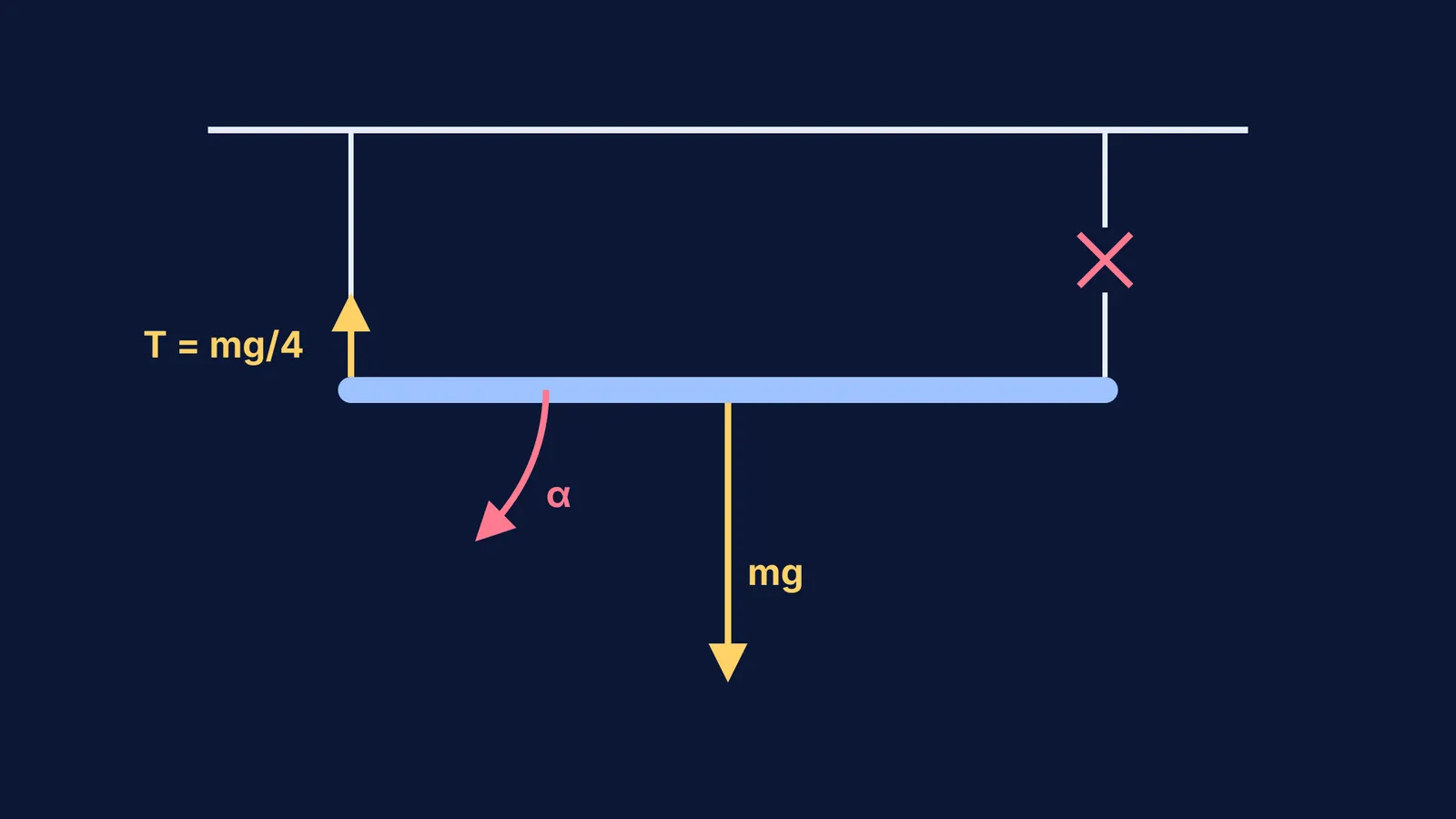
When one string is suddenly cut, that equilibrium is destroyed. A common mistake is to assume the tension in the remaining string stays at mg/2, or that it suddenly jumps to support the full weight, mg. In reality, the tension immediately drops to mg/4. Understanding exactly how and why this happens is a part of rotational dynamics.
Why does the tension drop immediately?
Right after the cut, the rod starts to fall, but it does not fall straight down. Because the remaining string is inextensible and still holds one end of the rod, that end cannot accelerate downwards. Instead, the rod begins to swing, rotating about the point attached to the intact string.
This rotation means the center of mass of the rod is accelerating downwards. According to Newton's second law, if the center of mass is accelerating downwards, there must be a net downward force. The downward force of gravity (mg) must be strictly greater than the upward tension force from the string. Therefore, the tension cannot be equal to mg. It must be less. The moment the string is cut, the rod transitions from static equilibrium to rotational acceleration, causing an instant drop in the tension force holding it up.
How to calculate the tension after one string is cut?
You can solve this by calculating the torque about the remaining string. Let us call the length of the uniform rod L and its mass m.
Identify the pivot: The end of the rod attached to the uncut string acts as the instantaneous axis of rotation. Because its initial velocity is zero and the string limits its downward movement, its vertical acceleration at the exact moment of the cut is zero.
Calculate the torque: Gravity acts downwards at the rod's center of mass, which is a distance of L/2 from the pivot. The torque (τ) is the force multiplied by the perpendicular distance, so τ = mg(L/2).
Find the moment of inertia: For a uniform rod rotating about its end, the moment of inertia (I) is mL²/3.
Solve for angular acceleration: Using the rotational equation of motion τ = Iα, we get mg(L/2) = (mL²/3)α. Solving this for the angular acceleration (α) gives α = 3g/2L.
Find the acceleration of the center of mass: The center of mass is at a distance of L/2 from the pivot. Its downward linear acceleration (a) is the angular acceleration multiplied by this radius, giving a = (3g/2L) × (L/2) = 3g/4.
Use Newton's second law: The net downward force on the center of mass is mg - T, where T is the new tension in the remaining string. Setting this equal to mass times acceleration gives mg - T = m(3g/4). Solving for T, you find that the tension drops to mg/4.
This step-by-step mathematical approach is a structured way to solve rigid body constraint problems. If you need to trace how accelerations change the moment a constraint breaks, we have a detailed breakdown on cutting a string in a spring system.
What is a practical framework for instantaneous cuts?
When a constraint like a string or a spring is suddenly removed in a physics problem, you can avoid guesswork by using this checklist:
Check which points can still move. A taut string prevents motion along its length, so the acceleration along that axis is zero. A spring, however, maintains its force instantaneously and does not act as a rigid constraint.
Choose your pivot wisely. Taking the torque about the remaining support eliminates the unknown tension force from your initial torque equation, giving you a direct path to the angular acceleration.
Relate rotational and linear acceleration. Always connect the angular acceleration of the rigid body to the linear acceleration of its center of mass.
Apply Newton's laws. Use the center of mass acceleration to find the final tension forces.
If you want to test this framework on more complex rigid bodies, the Fermi hub provides practice problems.
For related problems involving systems that have not yet been cut, review torque and equilibrium for ladders and beams.


