

On this page
In physics courses from CBSE Class 11 to university mechanics, students often confuse periodic, oscillatory, and simple harmonic motion (SHM). The distinction lies in their dynamical requirements.
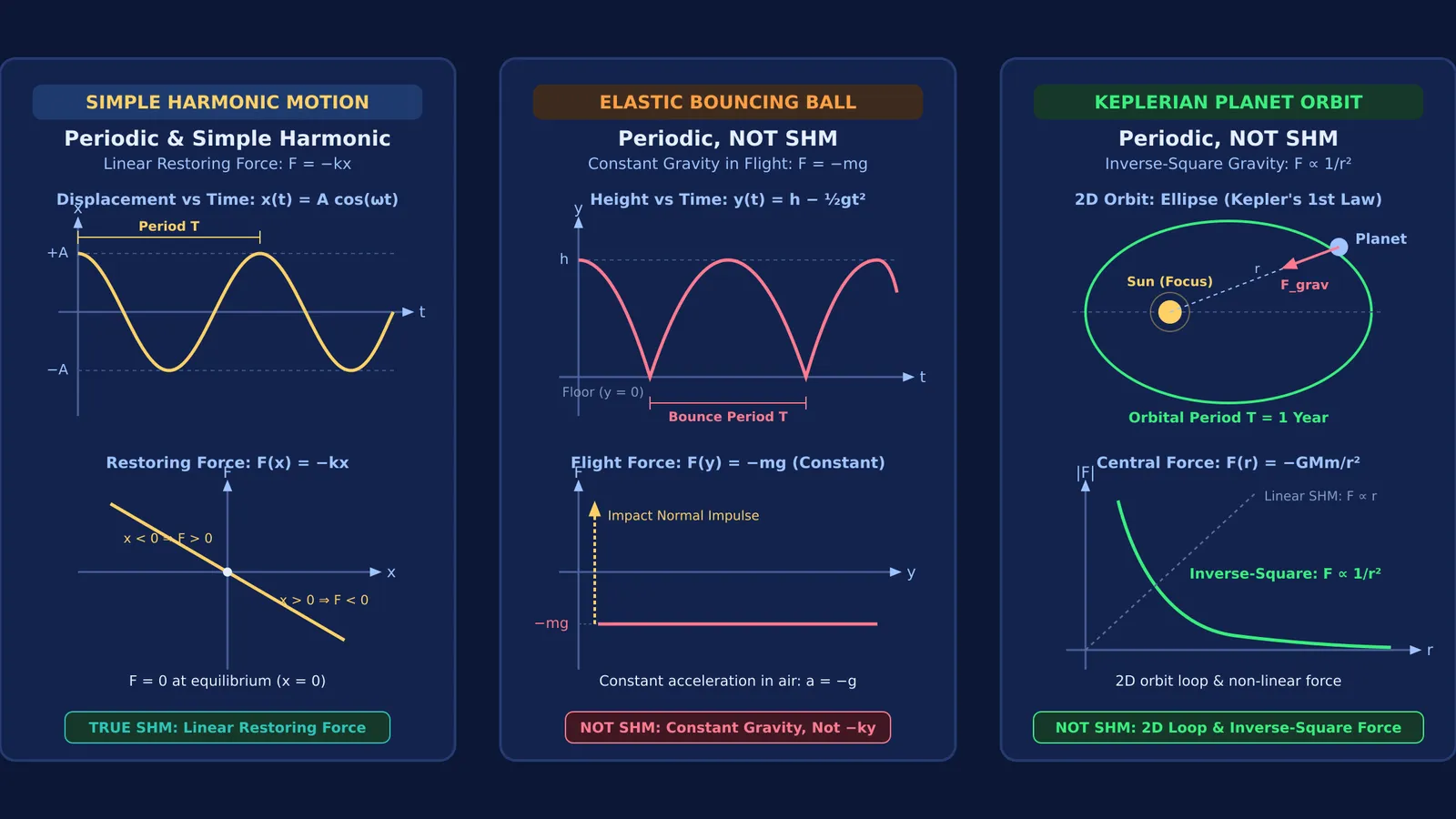
According to OpenStax University Physics, periodic motion repeats itself at regular intervals of time T. Oscillatory motion adds a spatial constraint: the object moves back and forth along the same path about a fixed mean position.
Simple harmonic motion is a specialized subset of oscillatory motion requiring two strict conditions:
The restoring force F is directly proportional to displacement x from equilibrium.
The force always points toward equilibrium, opposing displacement.
Hooke's law expresses this as F = −k x. Dividing by mass m gives acceleration a = −(k/m) x = −ω² x, yielding a sinusoidal trajectory x(t) = A cos(ωt + φ) with period T = 2π/ω independent of amplitude A.
Because every simple harmonic oscillator repeats its cycle after period T, every SHM is periodic. However, the converse fails whenever a repeating motion violates the linear force law F = −k x, an essential distinction when proving whether a motion is simple harmonic.
Why is an ideal bouncing ball periodic but not SHM?
An elastic bouncing ball on a rigid floor provides a clear counterexample. Dropped from height h without energy loss, the ball rebounds to height h and repeats its vertical journey indefinitely.
While periodic and oscillatory, this motion is not SHM. Throughout its flight, the only acting force is downward gravity, F = −mg. As detailed in the OpenStax University Physics free fall analysis, gravitational acceleration has a standard value of 9.8 m/s² downward. A drop from 1.225 metres yields a one-way fall time of √(2h/g) = 0.50 seconds and a bounce period of 1.0 second.
In SHM, acceleration changes continuously with displacement, vanishing at equilibrium. For a bouncing ball, acceleration stays constant during flight and spikes abruptly at the floor, as analysed in classical impact dynamics by Julio Gea-Banacloche in the American Journal of Physics. The position-time graph consists of repeated quadratic parabolas, y(t) = h − (1/2) g t², rather than a cosine curve. Lacking a linear restoring force, the bouncing ball is periodic but not simple harmonic.
Why are planetary orbits periodic without being SHM?
Planetary orbits provide another major counterexample. As detailed under Kepler's laws in OpenStax University Physics, planets move in closed elliptical orbits with regular orbital periods, such as Earth's 365-day annual cycle around the Sun, returning to the same position with dependable regularity.
Yet planetary motion violates the core requirements of SHM. Under Newton's law of gravitation, planetary attraction follows an inverse-square relation, F = −G M m / r².
This fails the definition of SHM on two fronts:
The trajectory is a two-dimensional orbital loop rather than a one-dimensional to-and-fro oscillation about equilibrium.
The gravitational force is proportional to 1/r² instead of displacement r¹.
Similarly, a simple pendulum has restoring force F = −mg sin θ. As noted in OpenStax University Physics pendulum dynamics, it approximates SHM only for small angles below 15 degrees (0.26 radians), where sin θ ≈ θ. At larger angles, period T depends on amplitude, departing from pure SHM. You can examine how potential wells shape these motions in our guide on potential energy curves and equilibrium.
How can you test whether an oscillation is true SHM?
When solving mechanics questions in CBSE Class 11, JEE Main, or NEET-UG, determine whether a periodic motion is SHM using a four-step framework:
Identify the equilibrium position: Find the coordinate x₀ where net force is zero.
Apply a small displacement: Shift the body by distance x and resolve all acting forces.
Test the restoring force: If the net force does not reduce to F = −k x (or torque τ = −C θ), the motion is not simple harmonic.
Check amplitude independence: Ensure period T does not depend on amplitude, consistent with the parabolas of energy variations in simple harmonic motion.
When evaluating unfamiliar physical systems, the Fermi Concept Library maps every concept in physics, each with its own lesson and its place in the map. If you struggle to visualise how restoring forces change across an oscillation, the Fermi Simulation Lab provides interactive simulations for ideas that are easier to see than to read. For problems where you must derive equations of motion from first principles, the Fermi Problem Library offers worked problems with a step-by-step solver that explains the reasoning rather than printing an answer.


