

On this page
When a particle rests at a stable minimum of a potential energy function, small disturbances make it oscillate. You can find the effective spring constant by taking the second derivative of the potential at that minimum (k = U''(x₀)), giving a time period of T = 2π√(m/U''(x₀)).
How do you find the time period of small oscillations from potential energy?
Simple harmonic motion occurs when a restoring force is directly proportional to the displacement from an equilibrium position 1. For any conservative system with a potential energy function U(x), you can find this restoring force and the time period by focusing on the minimum of the potential well.
The steps are standard across classical mechanics:
Find the equilibrium position (x₀): Set the first derivative U'(x) = 0 and solve for x. To ensure it is a stable equilibrium (a minimum), confirm that U''(x) > 0.
Find the effective spring constant (k): Calculate the second derivative U''(x) and evaluate it exactly at x = x₀. This value is your effective k.
Calculate the period (T): Plug the effective spring constant into the standard formula for a mass on a spring, T = 2π√(m/k), to get T = 2π√(m/U''(x₀)).
If you are dealing with a physical pendulum instead of a particle in a well, you might also want to review Simple pendulum string tension at any angle or see how gravity affects the Seconds pendulum: how its period changes with length and g.
Why is the effective spring constant U''(x₀)?
The relationship k = U''(x₀) comes from the Taylor series expansion. When a particle is slightly displaced from its stable equilibrium x₀, the potential energy can be written as an infinite sum of derivatives.
For a displacement x, the Taylor expansion of U(x) around x₀ is: U(x) ≈ U(x₀) + U'(x₀)(x - x₀) + ½ U''(x₀)(x - x₀)²
Because x₀ is a minimum, the slope U'(x₀) is exactly zero. We can also define our zero of energy such that U(x₀) = 0. The equation then simplifies beautifully: U(x) ≈ ½ U''(x₀)(x - x₀)²
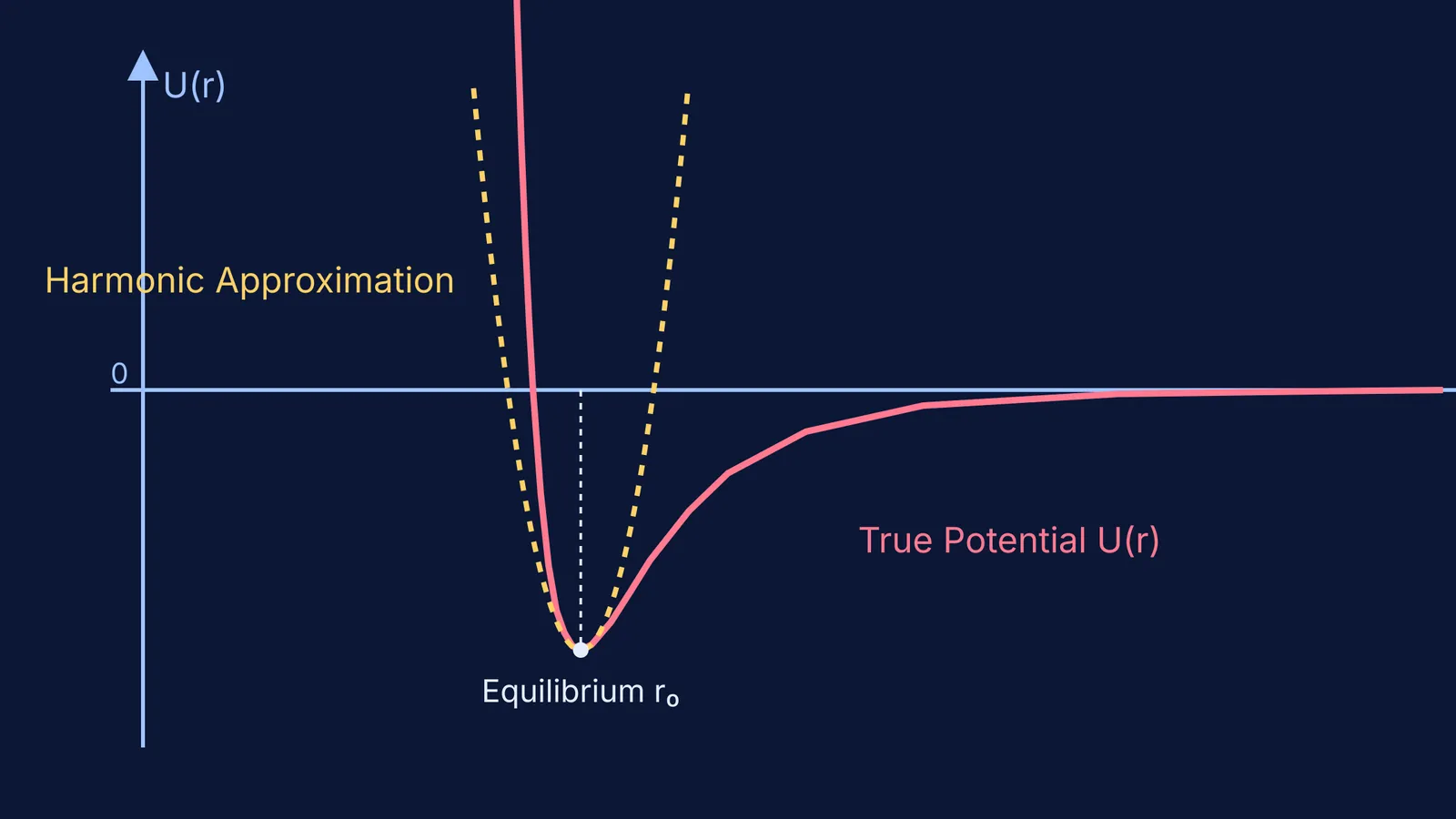
This quadratic form is identical to the potential energy of an ideal spring, U = ½ kx² 1. By matching the terms, the effective spring constant k is exactly U''(x₀). The motion is simple harmonic as long as the displacement (x - x₀) remains small enough that the higher-order terms in the Taylor series stay negligible.
Whenever you encounter a new potential energy function in your physics syllabus, you can find its lesson and its place in the map in the Fermi Concept Library.
What is the time period for a Lennard-Jones potential?
The Lennard-Jones potential describes the interaction energy between two non-bonding atoms. The standard equation is V(r) = 4ε [ (σ/r)¹² - (σ/r)⁶ ], where r is the distance between particles, ε is the depth of the potential well, and σ is the distance at which the potential is zero 2.
To find the frequency of small atomic vibrations, we apply our three-step framework.
First, we find the equilibrium distance r₀ by setting the first derivative to zero: V'(r) = 4ε [ -12(σ¹² / r¹³) + 6(σ⁶ / r⁷) ] = 0 Solving for r gives r₀ = 2^(1/6) σ.
Second, we find the effective spring constant by taking the second derivative: V''(r) = 4ε [ 156(σ¹² / r¹⁴) - 42(σ⁶ / r⁸) ] When we evaluate this at r = r₀, the terms simplify neatly. Because (σ/r₀)⁶ = 1/2, we get an effective spring constant of k = 72ε / (2^(1/3) σ²).
Finally, we substitute this k into the time period formula: T = 2π√(m/k) = 2π√[ (m × 2^(1/3) σ²) / 72ε ] Simplifying the constants yields T = (πσ / (3 × 2^(1/3))) √(m/ε).
Calculations like this can easily get bogged down in messy algebra. If you drop a sign or lose a power in a textbook problem, the Fermi Problem Library offers worked problems with a step-by-step solver that explains the reasoning rather than printing an answer, helping you spot exactly where the derivative went wrong.
When does the small oscillation approximation break down?
For the T = 2π√(m/U''(x₀)) formula to work, the oscillation must be genuinely "small." The entire derivation relies on cutting off the Taylor series after the quadratic term. If the displacement (x - x₀) is large, the higher-order terms—like the cubic 1/6 U'''(x₀)(x - x₀)³—become significant.
When these cubic and quartic terms are included, the restoring force is no longer linear (F is not equal to -kx), and the motion ceases to be simple harmonic. The system becomes an anharmonic oscillator. In a Lennard-Jones potential, for instance, pulling the atoms too far apart moves them into the flatter region of the curve where the restoring force weakens, causing the time period to increase before the bond eventually breaks.
Before applying the time period formula, check three practical requirements:
The point must be a true minimum: The second derivative U''(x₀) must be strictly positive. If it is negative, the equilibrium is unstable (like a ball on a hill), and the system will simply fall away instead of oscillating.
The potential must be smooth: The function U(x) must be twice differentiable at x₀. A sharp V-shaped potential well (like U(x) = |x|) does not have a defined second derivative at the minimum.
The total energy must remain constant: The system must be conservative, meaning there is no friction or damping to drain the kinetic energy 1.


