On this page
How hard is the squeeze at the centre of the Earth? You can get a good first answer with two Class 11 ideas: how g changes inside a sphere, and how pressure builds up with depth in a fluid. Put together, they give about 172 GPa, or 1.7 million atmospheres. The real figure is about 364 GPa. The gap between the two tells you something about what the Earth is made of.
Fermi News has covered how g changes with depth inside the Earth and how a diamond anvil cell reaches centre-of-the-Earth pressures in a lab. This post does the sum that connects them: adding up the weight of every layer from the surface to the centre.
How does g change inside a uniform Earth?
Inside a uniform sphere, only the mass closer to the centre than you pulls on you overall. That mass is (4/3)πr³ρ, so:
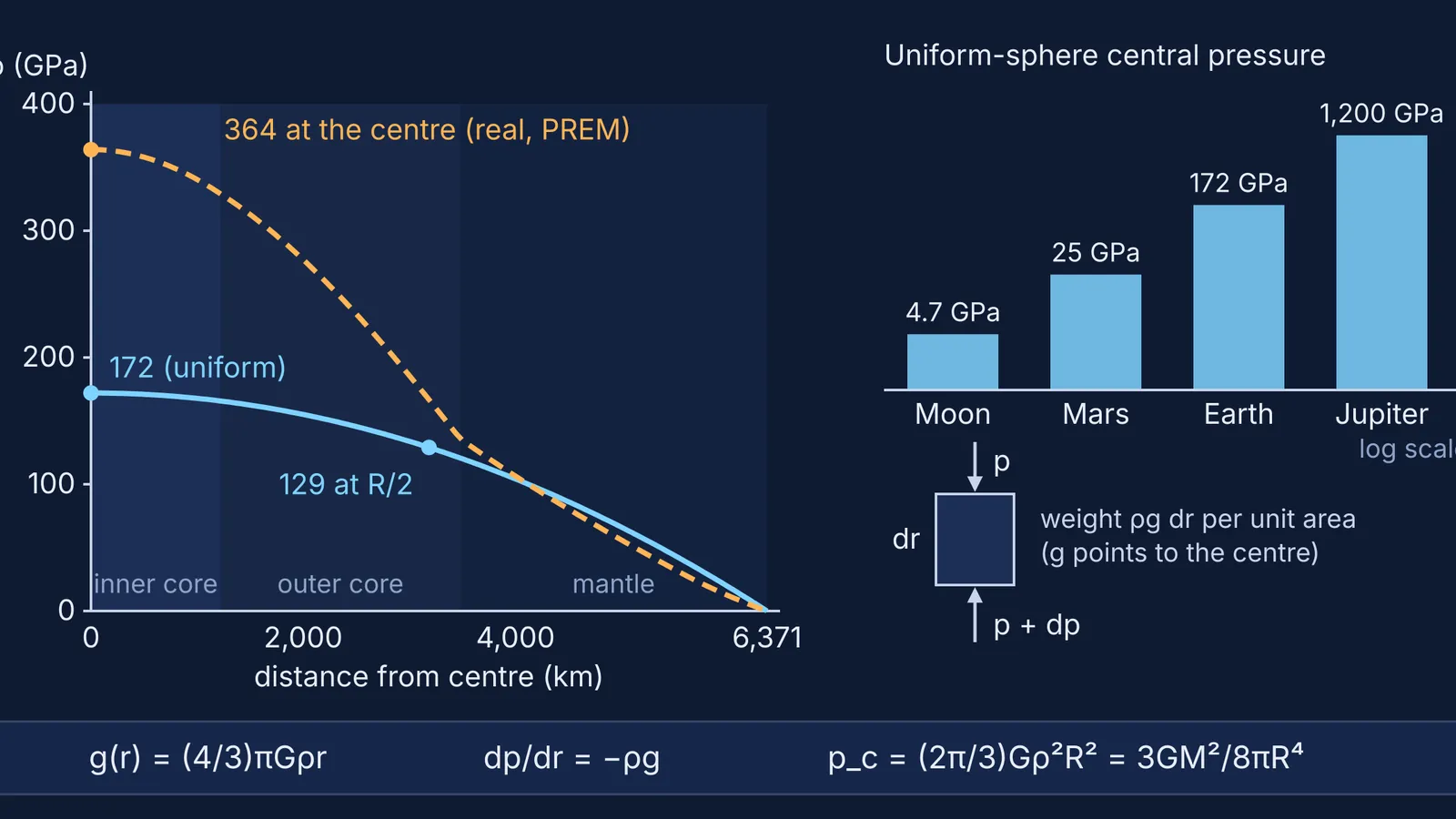
g(r) = G × (4/3)πr³ρ / r² = (4/3)πGρr
At the surface this is g_s, and at the centre it is zero. In between, g = g_s × r/R, a straight line.
How do you find the pressure at the centre of a planet?
Take a thin shell of thickness dr at radius r. Gravity pulls it towards the centre with a force per unit area of ρg dr. The layer below has to hold it up, so the pressure just below the shell is larger by that amount. This is the same balance that gives p = ρgh in a tank of water, as in our hydrostatics problems, except that g now changes with depth:
dp/dr = −ρg(r) = −(4/3)πGρ²r
Integrate from radius r out to the surface R, where p = 0:
p(r) = (2π/3)Gρ²(R² − r²)
At the centre, r = 0:
p_c = (2π/3)Gρ²R²
Put ρ = 3M/(4πR³) to write it with mass and radius, which are easier to look up:
p_c = 3GM²/(8πR⁴)
Using g_s = (4/3)πGρR, this is also p_c = ½ρg_sR. The half is there because g falls from g_s at the surface to zero at the centre, so its average along the way is g_s/2.
Worked example: the central pressure of a uniform Earth
Take G = 6.674 × 10⁻¹¹ N m²/kg². NASA's Earth fact sheet gives M = 5.9722 × 10²⁴ kg, a volumetric mean radius R = 6,371 km and a mean density of 5,513 kg/m³.
Mean density: ρ = M/((4/3)πR³) = 5.9722 × 10²⁴/(1.0832 × 10²¹ m³) = 5,513 kg/m³, matching NASA.
Central pressure: p_c = (2π/3) × 6.674 × 10⁻¹¹ × 5,513² × (6.371 × 10⁶)² = 1.72 × 10¹¹ Pa = 172 GPa.
In atmospheres: 1.72 × 10¹¹/1.013 × 10⁵ = 1.7 million atm.
Halfway down (r = R/2): p = p_c × (1 − ¼) = 129 GPa. Three quarters of the central pressure is already reached halfway down.
Check with the other form: ½ρg_sR = ½ × 5,513 × 9.82 × 6.371 × 10⁶ = 172 GPa. Same answer.
The same formula, with masses and radii from NASA's planetary fact sheet, gives:
Moon (7.35 × 10²² kg, 1,737 km): 4.7 GPa
Mars (6.42 × 10²³ kg, 3,390 km): 25 GPa
Jupiter (1.90 × 10²⁷ kg, 69,911 km): 1,200 GPa
Because p_c goes as M²/R⁴, a planet twice as wide with the same density has four times the central pressure.
What is the real pressure at the centre of the Earth?
Seismologists work out the density inside the Earth from how earthquake waves travel. The standard result is the Preliminary Reference Earth Model (PREM) of Dziewonski and Anderson, published in Physics of the Earth and Planetary Interiors (1981)90046-7). PREM gives a pressure of about 364 GPa at the centre, 2.1 times the uniform estimate.
Why so much more? PREM's density is about 13,100 kg/m³ at the centre, more than twice the mean, and only about 3,400 kg/m³ near the top of the mantle. Two things follow:
Gravity stays strong deep down. So much mass is packed into the iron core that g actually rises as you go down through the mantle, instead of falling as the uniform model says.
The deep layers are heavy. The dense core material is exactly where g is still large, so ρg is big over a long stretch.
Integrating PREM's density gives about 136 GPa at the boundary between mantle and core, 2,891 km down, and about 329 GPa at the top of the inner core. The uniform model gives 121 GPa at that first boundary, not far off. Almost all the difference builds up inside the core.
The model also ignores compression. Rock and iron at these pressures are squeezed noticeably, which is one reason the centre is so dense. A uniform Earth is a lower limit, not a forecast.
Does the same trick work for the Sun?
Partly. The Sun's mean density is 1,410 kg/m³, and the uniform formula gives about 1.3 × 10¹⁴ Pa at its centre. NASA's Sun fact sheet lists 2.477 × 10¹⁶ Pa from solar models, about 180 times larger, because the Sun is far more centrally concentrated than the Earth.
If you treat the core as an ideal gas, p = (ρ/m̄)kT, with a mean particle mass m̄ of 0.6 hydrogen atoms, the uniform pressure gives T ≈ 6.9 million K. NASA lists about 15.7 million K. The order of magnitude is right, which is impressive for a two-line estimate.
How does this sum turn up in JEE problems?
This sum is a standard JEE pattern: g inside a sphere plus dp = ρg dr. Variants ask for the pressure at r = R/2, or the depth at which pressure reaches half its central value (R/√2 from the centre, about 1,870 km down for the Earth). For step-by-step solutions to gravitation and fluid problems, try the Fermi Problem Library, whose solver explains the reasoning. For a full plan, Fermi Test Prep offers personalised preparation for JEE Main & Advanced with an AI tutor, adaptive mocks and a study plan that updates based on mastery.
Quick checklist
Inside a uniform sphere: g(r) = (4/3)πGρr, zero at the centre.
Balance on a thin shell: dp/dr = −ρg.
Pressure profile: p(r) = (2π/3)Gρ²(R² − r²).
Centre: p_c = (2π/3)Gρ²R² = 3GM²/(8πR⁴) = ½ρg_sR.
Uniform Earth: 172 GPa at the centre, 129 GPa halfway down.
Real Earth (PREM): about 364 GPa, because the core is so dense.
Using surface g all the way down doubles the answer to 345 GPa.