

On this page
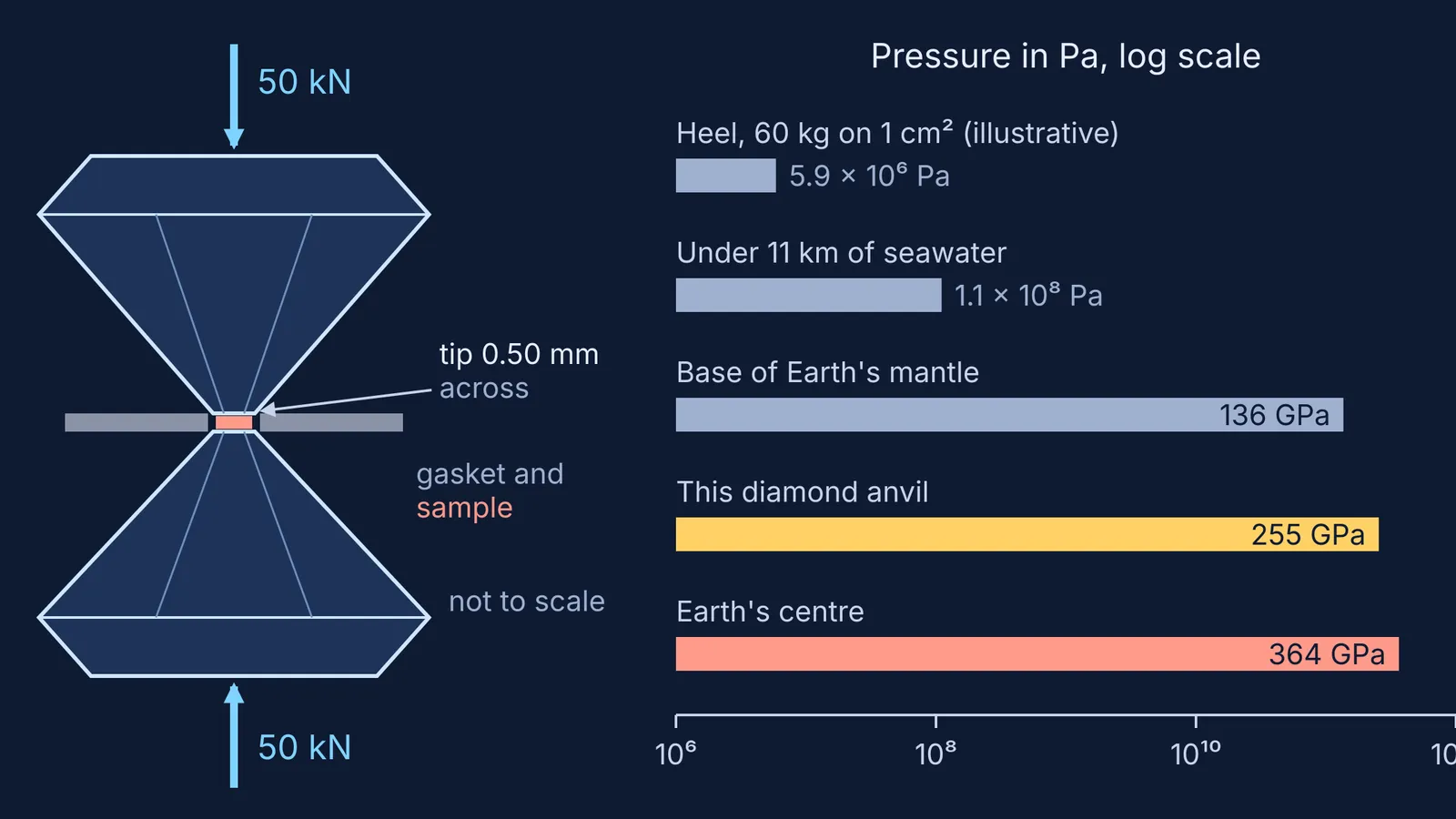
Two diamonds, cut into cones, are pressed tip to tip with a sample squeezed between them. Each flat tip is 0.50 mm across, and the wide ends are pushed together with a force of 50,000 N. What pressure does the sample feel? This classic textbook exercise is a one-line use of P = F/A, but the answer is enormous: about 2.5 × 10¹¹ Pa, or 2.5 million atmospheres. Here is how to get it, where students lose marks, and how this tool, the diamond anvil cell, lets scientists reach the pressure at the centre of the Earth in a lab.
What is a diamond anvil cell?
An anvil is a hard block that something is hammered or pressed against. In a diamond anvil cell, two gem diamonds face each other. Each is cut with a wide flat end and a small flat tip, called the culet. The sample sits in a tiny hole in a thin metal sheet, the gasket, between the two tips. When a screw or lever pushes the wide ends together, the whole force is carried down through each diamond to its tiny tip.
The key idea is the one behind a nail or a knife: the same force spread over a smaller area gives a larger pressure. The everyday versions of this, from knife edges to heels, are covered in why a sharp knife cuts better and why stiletto heels press harder than elephant feet. The diamond anvil takes the same idea to its limit.
How do you calculate the pressure at the diamond tip?
The data: force F = 50,000 N = 5.0 × 10⁴ N, and tip diameter d = 0.50 mm.
Radius. The 0.50 mm is the diameter, so r = 0.25 mm = 2.5 × 10⁻⁴ m.
Area of the tip. A = πr² = π × (2.5 × 10⁻⁴)² = 1.96 × 10⁻⁷ m².
Pressure. P = F/A = 5.0 × 10⁴ / 1.96 × 10⁻⁷ = 2.55 × 10¹¹ Pa.
In gigapascals. 1 GPa = 10⁹ Pa, so P = 255 GPa.
In atmospheres. 1 atm = 1.013 × 10⁵ Pa, so P = 2.55 × 10¹¹ / 1.013 × 10⁵ = 2.5 × 10⁶ atm, about 2.5 million atmospheres.
Check the units: newtons divided by square metres gives pascals. To two significant figures, which is all the data supports, the answer is 2.5 × 10¹¹ Pa.
Why does the same 50 kN not crush the wide end? Because the wide end has a much larger area. The force is the same at every cross-section of the diamond, so the pressure scales as 1/d². A tip ten times narrower than the wide end has a pressure a hundred times higher.
How does 255 GPa compare with other pressures?
Pressures this large are easier to feel on a ladder of examples:
Standing on a heel (illustrative). A 60 kg person on a heel tip of 1 cm²: 60 × 9.8 / 10⁻⁴ = 5.9 × 10⁶ Pa, about 58 atmospheres.
Under 11 km of seawater. With ρ ≈ 1025 kg/m³, the extra pressure is ρgh ≈ 1025 × 9.8 × 11,000 ≈ 1.1 × 10⁸ Pa, about 1100 atmospheres.
Base of Earth's mantle. At a depth of about 2900 km, roughly 136 GPa, according to a 2010 press release from JAMSTEC, Japan's marine-earth science agency.
This anvil. 255 GPa.
Earth's centre. About 364 GPa, from the same JAMSTEC release.
So the textbook anvil reaches about 70% of the pressure at the centre of the Earth. The ladder spans about five powers of ten, which is why the chart in the image uses a log scale.
The scientist who first pushed lab pressures far beyond anything earlier is the subject of what Percy Bridgman discovered about high pressure. The JAMSTEC release describes the diamond anvil cell as able to reach a higher static pressure than any other high-pressure apparatus.
Has anyone reached the pressure at the centre of the Earth?
Yes. According to the JAMSTEC release, a team from JAMSTEC, Tokyo Institute of Technology and the Japan Synchrotron Radiation Research Institute reached 364 GPa and 5500 °C in a laser-heated diamond anvil cell in 2010. They squeezed an iron particle 20 microns across between two diamond tips, each 40 microns in diameter, and heated it with near-infrared laser beams shone through the diamonds.
Those tips are far smaller than the textbook's 0.50 mm. Here is a rough estimate of the force needed, assuming the pressure were uniform over a 40 micron tip:
A = π × (20 × 10⁻⁶)² = 1.26 × 10⁻⁹ m².
F = P × A = 364 × 10⁹ × 1.26 × 10⁻⁹ ≈ 460 N.
That is about the weight of a 47 kg mass. The tip area is 156 times smaller than the textbook's, so a modest force produces a bigger pressure. Real tips are bevelled and the pressure is highest at the centre, so treat this as an order-of-magnitude figure, not a design value.
Why are the anvils made of diamond?
It is the hardest known natural material, so the tip does not flatten out under the load. A softer anvil would spread out and its tip area would grow, which would lower the pressure.
It is strongest in compression. In the cell, the diamond is squeezed, not pulled. If the two faces are not exactly parallel, part of the tip is loaded unevenly and the diamond can crack. The JAMSTEC release says the team spent ten years improving the shape of the diamond tips and the machining accuracy of the parts.
It is transparent. Light and X-rays pass through it, so scientists can heat the sample with lasers and study it with X-ray beams while it is still under pressure.
If you want to see how pressure, force and area trade off, the Simulation Lab has interactive simulations for ideas that are easier to see than to read.
What should you remember for JEE and NEET?
Questions like this test unit handling more than physics. Expect P = F/A with a circular area, a diameter given in mm, and an answer in Pa or atmospheres. A follow-up may ask what force gives a target pressure, or how the pressure changes if the tip diameter is halved (it rises four times).
Quick checklist
P = F/A, with A = π(d/2)² for a circular tip.
d = 0.50 mm means r = 2.5 × 10⁻⁴ m and A = 1.96 × 10⁻⁷ m².
50,000 N on that tip gives 2.55 × 10¹¹ Pa, about 2.5 million atmospheres.
Halving the tip diameter makes the pressure four times larger.
255 GPa is about 70% of the roughly 364 GPa at Earth's centre.
The answer is an average; real anvil tips have uneven pressure.


