On this page
In 1905 a young Harvard graduate student began squeezing liquids and solids to see what would happen. Percy Bridgman kept at it for the rest of his career, and in 1946 he won the Nobel Prize in Physics “for the invention of an apparatus to produce extremely high pressures, and for the discoveries he made therewith in the field of high pressure physics” (Nobel Prize summary). His measurements helped map the many solid forms of ice.
Who was Percy Bridgman?
Bridgman was born in Cambridge, Massachusetts, on 21 April 1882, earned his PhD at Harvard in 1908 and spent his working life there (Nobel biography). The same biography says he studied matter at pressures up to 100,000 atmospheres, measuring properties such as compressibility and conductivity for more than 100 compounds.
How did Bridgman's seals hold such high pressure?
In his Nobel lecture, Bridgman says leaks had limited earlier experiments, so his first step was a packing that “automatically becomes tighter the higher the pressure”. The liquid pushes on the head of a plug, and a narrow stem runs from the head through a ring of soft packing. The ring carries the whole force on the head over a smaller area, so the packing is always at higher pressure than the liquid, which cannot squeeze past.
Once the seal was solved, the limit became the strength of the vessel. The lecture traces the climb: steel vessels reached 12,000 kg/cm² as a routine matter; pushing a cone-shaped vessel into a heavy collar gave 30,000; smaller versions reached 50,000. No steel piston could take that, so he switched to carboloy (tungsten carbide powder cemented with cobalt). The last step to 100,000 kg/cm² needed carboloy pistons only 1.6 mm in diameter and the whole vessel immersed in fluid at up to 30,000 kg/cm².
One kilogram-force per square centimetre is 98.0665 kPa and one standard atmosphere is 101.325 kPa (NIST conversion factors). So 100,000 kg/cm² is about 9.8 GPa, or roughly 97,000 atmospheres.
What did Bridgman discover about ice and other solids under pressure?
His 1912 paper is titled “Water, in the Liquid and Five Solid Forms, under Pressure”. By his Nobel lecture he could list much more:
Water has seven phases, bismuth six and camphor eleven.
Water, bismuth and gallium were the only three substances he knew of whose melting point falls as pressure rises in the ordinary range.
That fall apparently cannot go on: above about 2,000 kg/cm² for water (12,000 for gallium, 25,000 for bismuth) the crystal collapses into a denser form, and from there the melting point rises as it does for other substances.
From room temperature to 200°C and up to 50,000 kg/cm², roughly one-third of the substances he examined changed crystal structure (polymorphism).
Yellow phosphorus held above 12,000 kg/cm² and 200°C turns permanently into a black, graphite-like solid that conducts electricity.
Caesium is 350 times more compressible than diamond.
Why is water odd? Ordinary ice is less dense than liquid water, the same fact behind the anomalous expansion of water. The lecture gives the rule: if a substance expands when it melts, its melting point rises with pressure; if it shrinks, the melting point falls. It is the same thermodynamics as the Clausius–Clapeyron equation for vapour pressure.
How do you read a phase diagram?
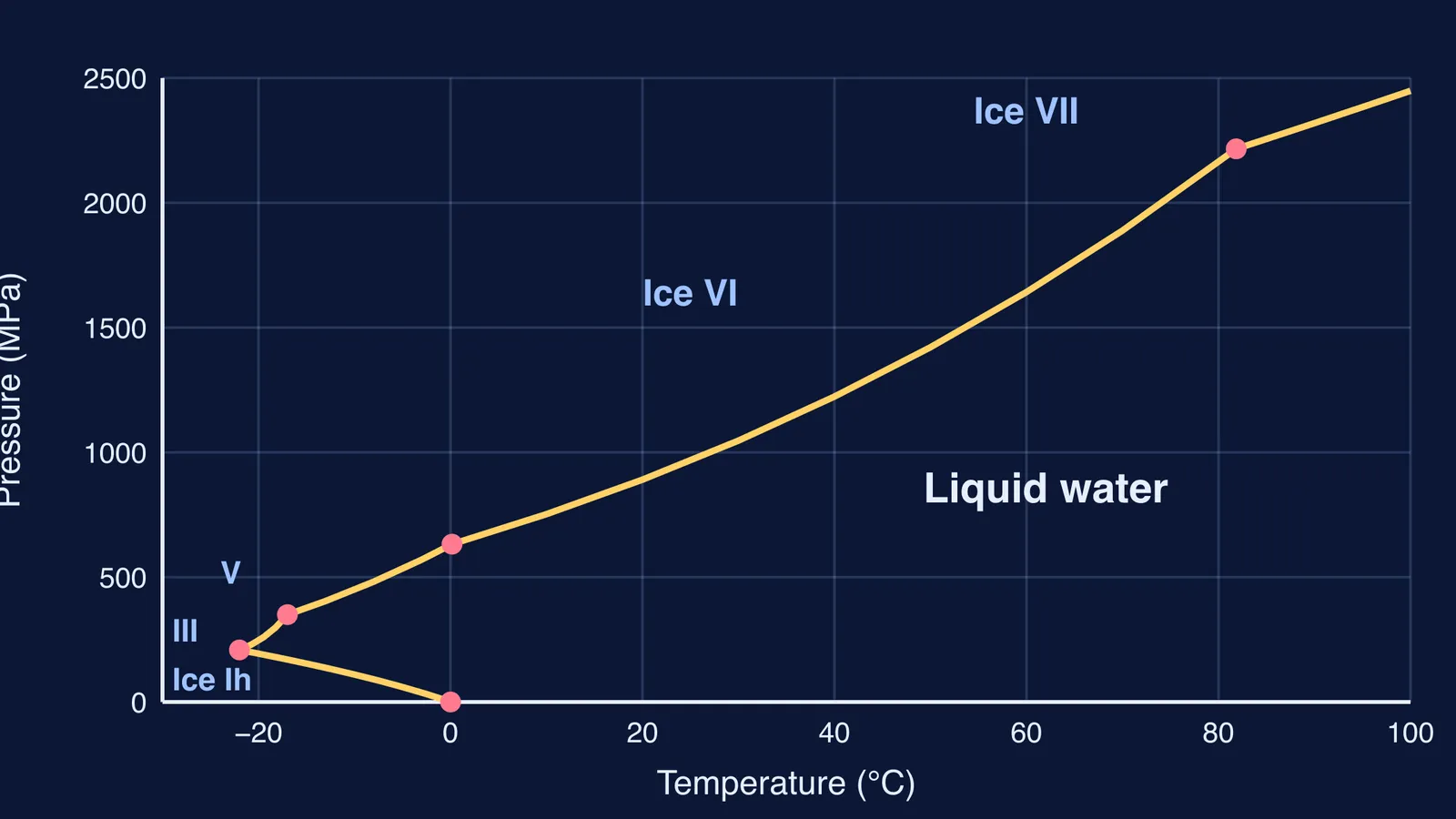
The image at the top is water's melting curve, drawn from the equations in IAPWS release R14-08. Practise these five steps on it:
Read the axes. Temperature runs across; pressure runs up on a straight scale in megapascals, and 1 MPa is about 10 atmospheres (NIST).
Name the regions. Each area is one phase, each line is where two phases coexist, and a point where three lines meet is a triple point.
Read the slope. If the melting line leans to colder temperatures as pressure rises (ordinary ice, Ih), the solid is less dense than the liquid; if it leans to hotter ones, the solid is denser.
Walk a straight path. Hold ice at −10°C and raise the pressure, so you move straight up. The IAPWS equations put the melting line at about 110 MPa, so squeezing melts it. Keep going and the liquid freezes again near 450 MPa, this time as ice V.
Find the triple points. Ice Ih, ice III and liquid meet at 251.165 K (about −22°C) and about 209 MPa; ice VI, ice VII and liquid meet at 355 K (about 82°C) and 2,216 MPa, so ice VII stays solid far above water's normal boiling point.
If the turns in that curve are hard to picture, the Fermi Simulation Lab is built for ideas that are easier to see than to read. If a word like polymorph or triple point is new, the Fermi Concept Library gives each concept its own lesson.
Carbon is the other famous case of one element, two solids: see how diamond and graphite differ in structure.