On this page
In 1905 two physicists in Sydney, J. A. Pollock and S. H. E. Barraclough, described something odd: a hollow copper lightning conductor crushed by the discharge it had carried. Nothing struck it from outside; the current squeezed the tube itself. This is the pinch effect, and you can work it out with Ampère's law and one idea from magnetic energy. Here is how hard a lightning current presses on a copper tube, and why a house wire feels nothing.
A safety note first. Currents of thousands of amperes kill, melt metal and start fires. This post describes the physics of a lightning stroke on paper. It is not an experiment to try, and nothing here should be copied with batteries, capacitors or mains electricity.
Why does a current squeeze its own conductor?
Two parallel wires carrying current in the same direction attract each other. That result is in the force between parallel currents.
Now think of the current in one thick conductor as many thin strands running side by side. Every strand carries current the same way, so every strand pulls every other strand towards it. Add up all those pulls and the result points inwards, towards the axis, everywhere around the conductor. The conductor is squeezed by its own current.
For everyday currents the squeeze is too small to notice. But it grows as the square of the current, and lightning carries a great deal of current.
What is the magnetic field inside and just outside a tube?
Take a thin-walled tube of radius r carrying current I along its length. Ampère's law with a circular loop gives:
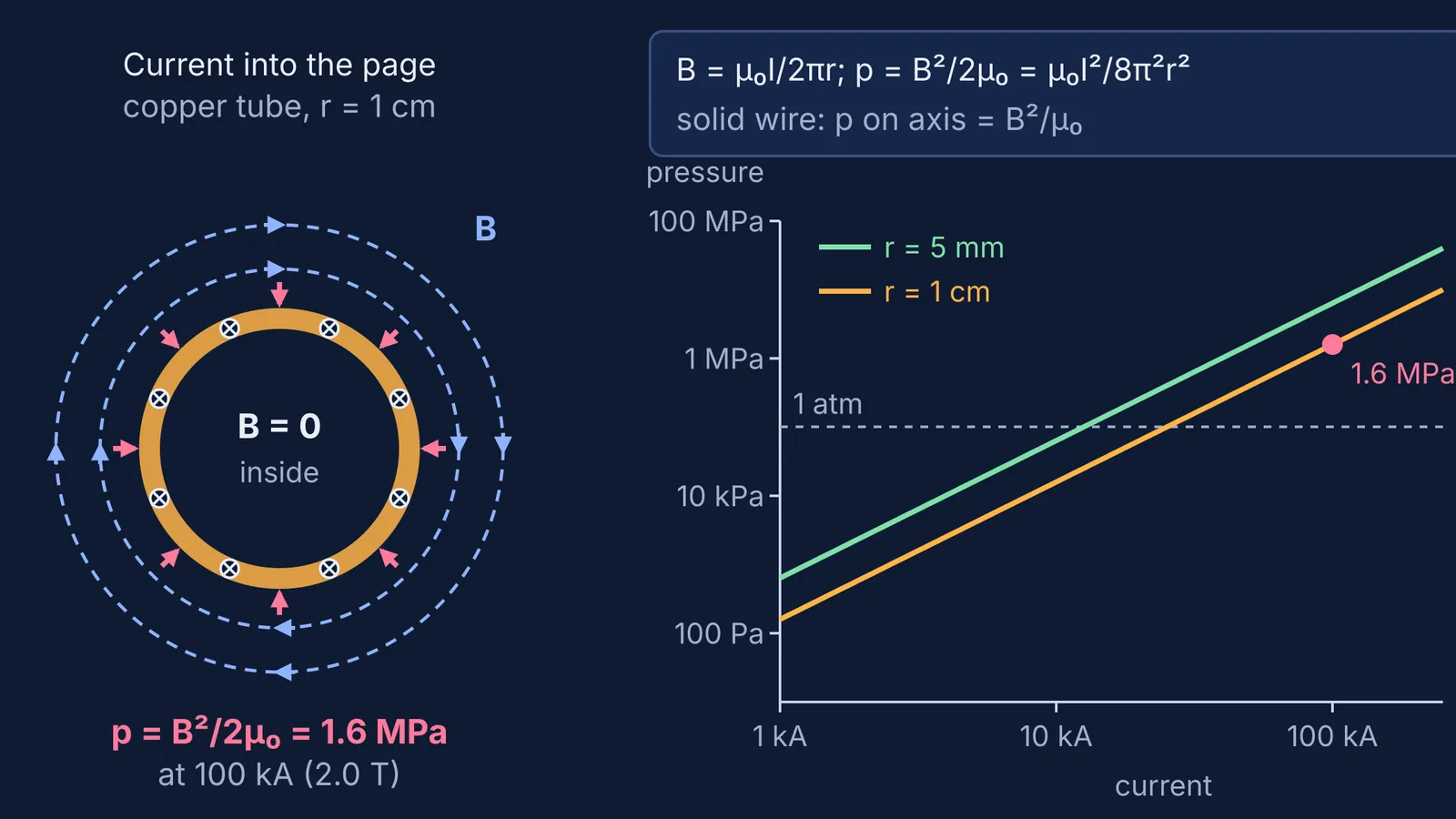
Outside the tube: B = μ₀I/2πr, as if all the current ran along the axis.
Inside the hollow: B = 0, because a loop drawn inside encloses no current.
Both are derived in the magnetic field inside a solid and a hollow wire. Across the wall the field jumps from zero on the inside face to μ₀I/2πr on the outside face. The current in the wall therefore sits in a field that is, on average, half the outside value.
How big is the pressure on the wall?
Spread the current around the circumference. The current per metre of circumference is K = I/2πr. A sheet carrying current K in a field B_avg feels a force per unit area K × B_avg. With B_avg = B/2:
p = K × B/2 = (I/2πr)(μ₀I/4πr) = μ₀I²/8π²r²
Since B = μ₀I/2πr, this is the same as p = B²/2μ₀. You have met it as the energy per cubic metre of field in energy density in a magnetic field; here it reads as a pressure. The field outside pushes on the wall like a gas at pressure B²/2μ₀, and there is no field inside to push back.
Since p ∝ I²/r², doubling the current or halving the radius makes the pressure four times larger.
A solid wire is different. If the current is spread evenly, each layer is pressed by all the layers outside it, so the pressure builds from zero at the surface to B²/μ₀ at the axis, twice the tube value, where B is the field at the surface.
Worked example: 100 kA in a 1 cm copper tube
Data: a lightning current I = 100 kA (an illustrative large stroke), a copper tube of radius r = 1.0 cm with a wall t = 1.0 mm thick, μ₀ = 4π × 10⁻⁷ T m/A.
Field at the surface. B = μ₀I/2πr = (4π × 10⁻⁷ × 1.0 × 10⁵)/(2π × 0.010) = 2.0 T.
Pressure on the wall. p = B²/2μ₀ = 2.0²/(2 × 4π × 10⁻⁷) = 1.59 × 10⁶ Pa, about 1.6 MPa. That is about 16 atmospheres (1 atm = 101,325 Pa).
Check with the other form. μ₀I²/8π²r² = (4π × 10⁻⁷ × 10¹⁰)/(8π² × 10⁻⁴) = 1.59 × 10⁶ Pa, the same.
Check the units. T²/(T m/A) = T A/m, and since 1 T = 1 N/(A m), that is N/m², a pressure.
Stress in the wall. A thin ring under outside pressure carries a compressive hoop stress σ = pr/t = 1.59 × 10⁶ × 0.010/0.0010 = 1.6 × 10⁷ Pa, about 16 MPa.
Now change the numbers:
30 kA in the same tube: B = 0.60 T, p = 0.14 MPa, about 1.4 atmospheres.
200 kA in the same tube: B = 4.0 T, p = 6.4 MPa, about 63 atmospheres.
10 A in a house wire of radius 0.5 mm: B = 4.0 mT, p = 6.4 Pa. Atmospheric pressure is about 16,000 times larger, so this is nothing at all.
How large are real lightning currents?
Lightning varies a lot. The engineering body CIGRÉ collected measured strokes in its Technical Bulletin 549 (2013). As summarised for engineers, the median peak current of the first stroke of ordinary (negative) cloud-to-ground lightning is about 30 kA, and the highest measured peaks are about 200 kA for negative and 300 kA for positive lightning. The same summary gives a median first-stroke front of about 5.5 µs and a fall to half the peak in about 75 µs.
So a typical stroke squeezes our 1 cm tube at about 1.4 atmospheres, and 100 kA is a large stroke rather than a typical one. The squeeze lasts only tens of microseconds: a sharp blow, not a steady load.
Does 16 MPa actually crush a copper tube?
Not by itself. A tube under outside pressure does not usually fail by the metal being squashed. It fails by buckling: the wall bends inwards at one place and then folds. The pressure at which that happens depends strongly on the ratio of wall thickness to radius, roughly as (t/r)³, and on any dent or flaw already in the tube. A thin wall can fold at a pressure far below what a solid copper wall could bear.
Our example tube, with a 1 mm wall at 1 cm radius, is fairly sturdy; a thinner wall, an old dent or a larger current makes folding far more likely. We do not quote the 1905 paper's own current estimate here. What matters is that the pinch effect gives the right kind of force, and Pollock and Barraclough used it to explain the crushed tube.
The same squeeze later became a tool. Willard Bennett worked out in 1934 how a stream of charged particles can be held together by its own magnetic field, and R. S. Pease's 1984 lecture traced the electromagnetic pinch from Pollock's tube to the Joint European Torus, a large fusion experiment.
If Ampère's law and the force on a current feel like separate chapters, the Fermi Concept Library covers every concept in physics and lets you go back to either one and see how they connect.
Quick checklist
Parallel currents attract, so a current squeezes its own conductor towards its axis.
For a thin tube, B = 0 inside and μ₀I/2πr just outside.
The wall feels the average field B/2, giving p = B²/2μ₀ = μ₀I²/8π²r².
For a solid wire, the pressure rises from zero at the surface to B²/μ₀ at the axis.
100 kA in a 1 cm tube: 2.0 T, 1.6 MPa, about 16 atmospheres; 10 A in a house wire: about 6 Pa.
Whether a tube crushes depends on buckling, wall thickness and flaws, not on the pressure alone.