On this page
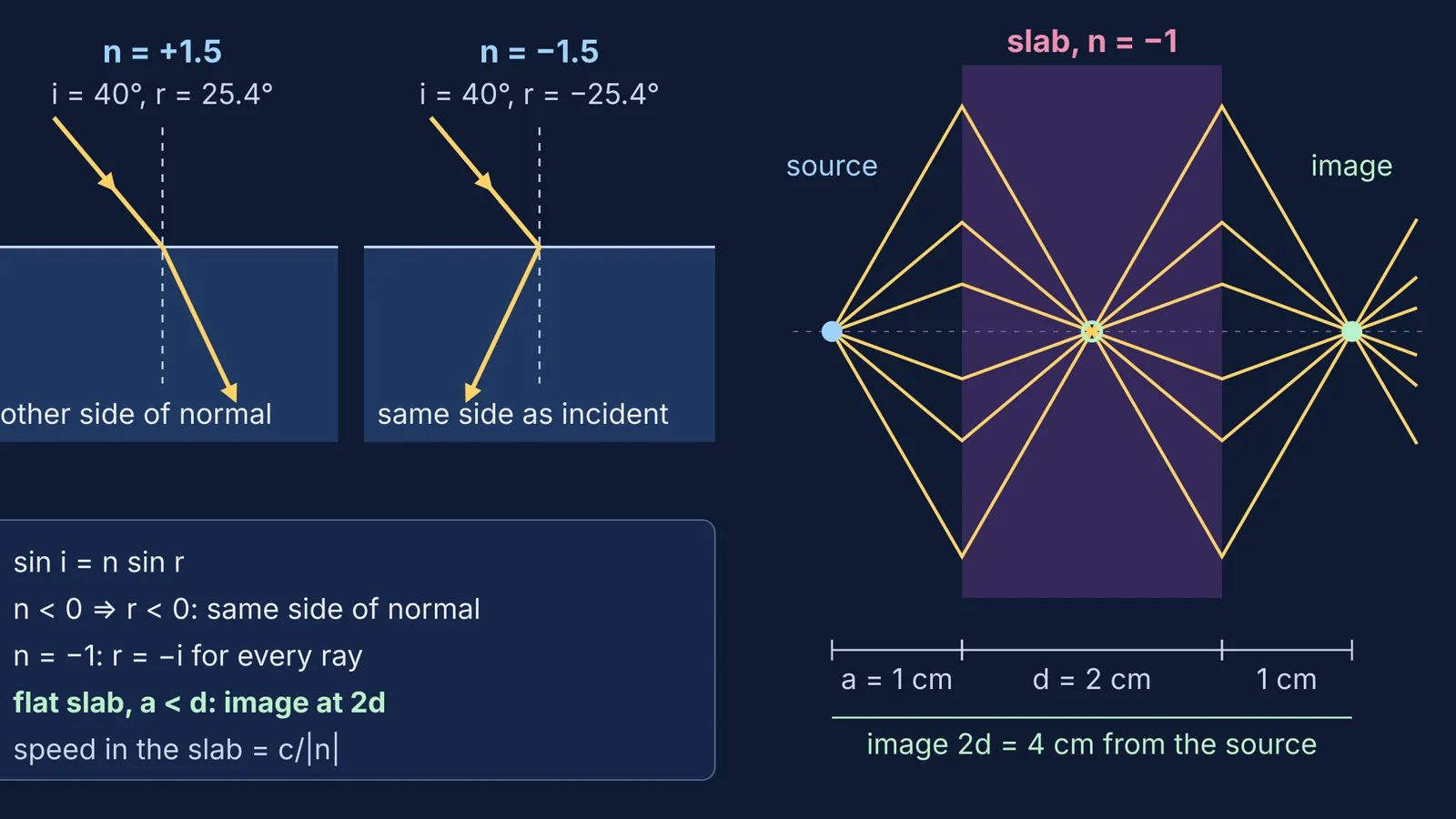
Every ray diagram you have drawn bends light either towards the normal or away from it, but always across it: the refracted ray comes out on the opposite side of the normal from the incident ray. Now suppose the refractive index were negative. Snell's law still works, but the refracted ray comes out on the same side as the incident ray. With n = −1, a flat slab with no curved surfaces at all brings rays from a point to a sharp focus. IIT-JEE 2012 set a paragraph on it, and it has been tested in the laboratory. Treat it as an extension of Snell's law beyond the NCERT syllabus.
What does Snell's law say when n is negative?
Snell's law for light going from air into a medium is sin i = n sin r. For ordinary glass, n = 1.5, and r is smaller than i, so the ray bends towards the normal on the far side. The basic case is worked through in when light bends towards the normal.
If n is negative, sin r = sin i / n is negative, so r is negative. That puts the refracted ray on the same side of the normal as the incident ray.
Take i = 30° and n = −1.5.
sin r = sin 30° / (−1.5) = 0.5 / (−1.5) = −0.333.
r = −19.5°.
The ray bends by the same amount as in glass with n = +1.5, but it folds back to the incident side. With n = −1, sin r = −sin i, so r = −i exactly: the refracted ray is the mirror image of the incident ray in the normal.
Do materials with negative refractive index exist?
Not naturally, and not for visible light. The idea comes from Victor Veselago's 1968 paper in Soviet Physics Uspekhi. He showed that if both the permittivity ε and the permeability μ of a material are negative, Maxwell's equations allow waves to travel, and the refractive index n = ±√(εμ) must be taken with the negative sign.
No known natural material has both negative at the same frequency. In 2001, Shelby, Smith and Schultz reported in Science a structured material made of copper strips and split-ring resonators on circuit board. The cells are much smaller than the wavelength. They cut a prism from it, measured the angle of the transmitted beam, and found a frequency band where the effective n in Snell's law is negative. Such engineered materials are called metamaterials. Most working ones are for microwaves and some longer wavelengths, and real ones absorb part of the wave, which limits how well they work.
How does a flat slab with n = −1 form an image?
Place a point source at distance a in front of a slab of thickness d, with a smaller than d.
Entering the slab. A ray leaving the source at angle i to the axis hits the front face at height a tan i. With r = −i, it bends back towards the axis at the same angle i.
First crossing. It travels a further distance a inside the slab before it reaches the axis again. Every ray does this, whatever its angle, so all rays meet at depth a: a real image inside the slab.
Leaving the slab. The rays spread again and reach the back face at height (d − a) tan i. Refraction there turns each one back towards the axis at angle i.
Second crossing. They meet on the axis a distance d − a behind the slab.
The source-to-image distance is a + d + (d − a) = 2d, independent of a and of the ray angle. No curved surface is needed, and there is no spherical aberration, because the condition r = −i holds for every angle.
Worked example: a 2.0 cm slab with n = −1
A point source sits 1.0 cm in front of a flat slab 2.0 cm thick, with n = −1.
A ray at i = 10° hits the front face at 1.0 × tan 10° = 0.18 cm from the axis. A 60° ray hits it at 1.0 × tan 60° = 1.73 cm.
Inside, each ray heads back at its own angle, so it covers 0.18 cm or 1.73 cm sideways in a forward distance of 1.0 cm. Both reach the axis at depth 1.0 cm.
The rays exit the back face at (2.0 − 1.0) × tan i, the same heights as on entry.
They meet again 2.0 − 1.0 = 1.0 cm behind the slab.
The final image is 1.0 + 2.0 + 1.0 = 4.0 cm = 2d from the source, for every ray from 10° to 80°.
Now change the slab to n = −1.5. The rays no longer share one crossing point. A 10° ray has r = −6.65° and crosses the axis at depth tan 10° / tan 6.65° = 1.51 cm. A 45° ray has r = −28.1° and crosses at 1.87 cm. A 60° ray would cross at 2.45 cm, past the back face. Only n = −1 gives a sharp image from a flat slab.
Why is the n = −1 slab called a perfect lens?
An ordinary lens cannot show detail much finer than the wavelength. Part of the information about fine detail travels in waves that die away within a short distance of the object, and a normal lens never collects them. In 2000, John Pendry argued in Physical Review Letters that a slab of negative-index material could restore these fading waves as well as focus the travelling ones. In principle it can focus all of them, which is why he called it a perfect lens. Absorption in real materials limits this, so working versions resolve finer detail than the wavelength but are far from perfect.
One more odd feature, for the curious: inside a negative-index material the wave crests move backwards, towards the source, while the energy still flows forwards.
How did IIT-JEE test this?
IIT-JEE 2012 Paper 2 had a paragraph on meta-materials (questions on ExamSIDE). It asked for the correct ray diagram and the speed and wavelength inside; both follow from sin i = n sin r and v = c/|n|. For curved surfaces with an ordinary index, see refraction at a single spherical surface.
To practise Snell's-law and ray-optics problems at this level, Fermi Test Prep offers personalised preparation for JEE Main & Advanced with an AI tutor, live classes, adaptive mocks, mentorship and a study plan that updates based on mastery. The Fermi Problem Library has a step-by-step solver that explains the reasoning.
Quick checklist
Snell's law still holds: sin i = n sin r.
n < 0 gives r < 0: the refracted ray stays on the incident side of the normal.
n = −1 gives r = −i for every ray.
A flat n = −1 slab of thickness d images a point at distance a < d to 2d from the source.
With n = −1.5 the crossing point depends on the ray angle, so there is no sharp image.
Speed is c/|n|; frequency is unchanged.
Negative n needs both ε and μ negative; it has been made only in engineered metamaterials.