On this page
Each order on this page is taken from the Reprint 2026-27 NCERT chapter on Cell Cycle and Cell Division (Class 11 Biology, Chapter 10), with its section number. Cell division sits in Unit 3, Cell Structure and Function, of the NEET (UG) 2026 syllabus. All 12 questions are original, not past-paper items.
Which sequences in this chapter does NCERT give in order?
The cell cycle (10.1.1): G1, S, G2, then M phase. M phase starts with karyokinesis and usually ends with cytokinesis. In animal cells the centriole duplicates in S, and the centrosomes begin moving to opposite poles in prophase (10.2.1).
Stages of karyokinesis (10.2): prophase, metaphase, anaphase, telophase.
Events of mitosis (10.2.1 to 10.2.4): condensation begins; the nuclear envelope fully disintegrates, which opens metaphase; fibres attach to kinetochores and chromosomes align on the metaphase plate; centromeres split and chromatids move to the poles, centromere first; chromosomes decondense and a nuclear envelope forms round each cluster.
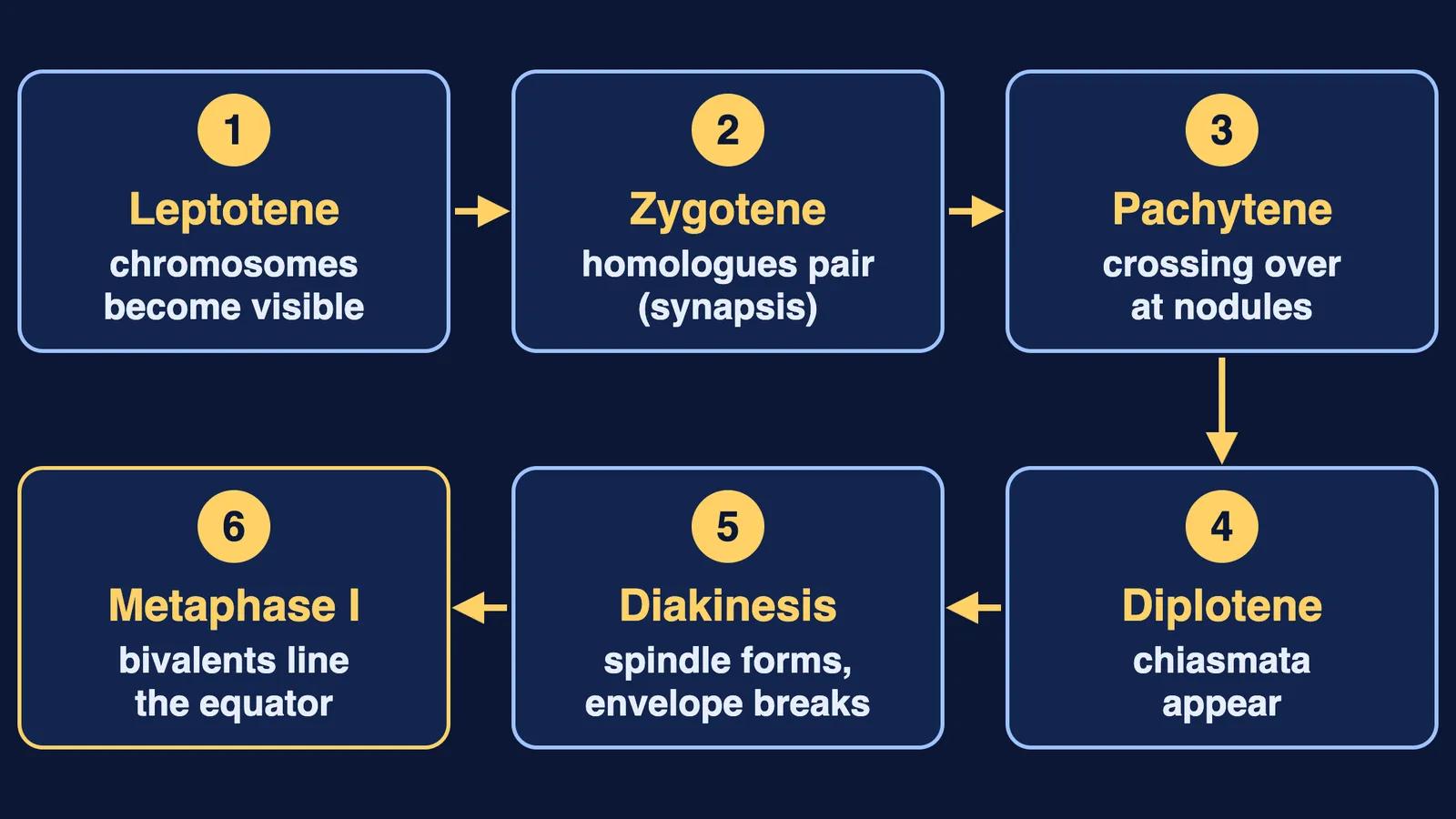
Prophase I (10.4.1): leptotene, zygotene, pachytene, diplotene, diakinesis. Diakinesis leads into metaphase I.
Meiosis as a whole (10.4 to 10.4.2): one S phase, then prophase I to telophase I (a dyad of cells), a short interkinesis with no DNA replication, then prophase II to telophase II, ending as a tetrad of four haploid cells.
NCERT describes the plant cell plate and the animal furrow (10.2.5) as two ways of dividing the cytoplasm, not as numbered steps, so no question below depends on an order inside them; they use only the rule that cytokinesis follows karyokinesis.
How do you attack arrange-in-order questions?
Fix the first and the last step before reading the options; that usually leaves two codes standing. Then find the one neighbouring pair those two codes disagree on and ask which comes first. A chromatid cannot leave for a pole before its centromere splits.
Can you put these steps in NCERT's order?
Q1. A. Nuclear envelope finishes disintegrating B. Chromosomal material starts to condense C. Daughter chromosomes move to the poles, centromere leading D. Nuclear envelope forms round each cluster E. Fibres attach to kinetochores; chromosomes align on the plate. (1) B-E-A-C-D (2) B-A-E-C-D (3) A-B-E-C-D (4) B-A-C-E-D
Q2. For an animal cell: A. Centriole duplicates while DNA replicates B. Cell grows, metabolically active, without copying DNA C. Proteins are made for mitosis as growth continues D. Centrosomes begin moving to opposite poles E. A furrow divides the cytoplasm. (1) A-B-C-D-E (2) B-C-A-D-E (3) B-A-D-C-E (4) B-A-C-D-E
Q3. A. Interkinesis B. Homologous chromosomes separate C. DNA replicates, giving sister chromatids D. Centromeres split and sister chromatids move apart E. A dyad of cells forms. (1) C-E-B-A-D (2) C-B-A-E-D (3) C-B-E-A-D (4) B-C-E-A-D
Q4. A. Each centromere splits; chromatids are pulled by shortening microtubules B. Nuclear membrane disappears; chromosomes compact again C. Nuclear envelopes enclose the groups; cytokinesis gives four haploid cells D. Chromosomes align at the equator, fibres on sister kinetochores. (1) D-B-A-C (2) B-D-A-C (3) B-A-D-C (4) B-D-C-A
Q5. For a plant cell: A. Centromeres split and chromatids separate B. Chromosomes at the poles decondense C. Daughter chromosomes migrate to opposite poles D. A cell plate, the new wall's precursor, appears E. Spindle fibres attach to kinetochores. (1) E-A-C-B-D (2) E-C-A-B-D (3) E-A-C-D-B (4) A-E-C-B-D
Q6. A. Fibres from opposite poles attach to the kinetochores of homologous chromosomes B. Meiotic spindle assembles; the nuclear envelope breaks down C. Nuclear membrane and nucleolus reappear; cytokinesis follows D. Homologues separate, sister chromatids still held at their centromeres. (1) B-A-D-C (2) A-B-D-C (3) B-D-A-C (4) B-A-C-D
Answers. 1: (2). Full loss of the envelope marks the start of metaphase (10.2.2). 2: (4). G1 growth, centriole copied in S, G2 protein synthesis, centrosomes move in prophase (10.1.1, 10.2.1). 3: (3). The dyad follows telophase I, then interkinesis (10.4.1). 4: (2). Prophase II, metaphase II, anaphase II, telophase II (10.4.2). 5: (1). Anaphase, then telophase, then cytokinesis (10.2.3 to 10.2.5). 6: (1). Diakinesis leads into metaphase I, then anaphase I and telophase I (10.4.1).
Which before, after and out-of-place questions test the same orders?
Q7. In mitosis, which event comes immediately after the nuclear envelope has completely disintegrated? (1) Chromosomal material begins to condense (2) Spindle fibres attach to kinetochores (3) Centromeres split (4) A nuclear envelope forms round each cluster
Q8. Which stage comes immediately after interkinesis? (1) S phase (2) Prophase II (3) Telophase I (4) Metaphase II
Q9. One step is misplaced: condensation begins, nuclear envelope fully disintegrates, cell plate forms at the centre, chromosomes align on the metaphase plate, centromeres split, chromosomes decondense at the poles. Which single step must move? (1) Centromeres split (2) Alignment on the plate (3) Decondensation (4) Cell plate formation
For Q10 to Q12: (1) Both I and II are correct (2) Both are incorrect (3) I is correct, II is incorrect (4) I is incorrect, II is correct.
Q10. I: In meiosis II, the nuclear membrane disappears before fibres attach to the kinetochores of sister chromatids. II: In mitotic telophase, the nuclear envelope forms before the chromosomes reach the poles.
Q11. I: Meiosis I starts only after the parental chromosomes have replicated in S phase. II: In anaphase II, sister chromatids move apart before the centromere holding them splits.
Q12. I: In M phase, division of the cytoplasm comes before division of the nucleus. II: In prophase, centrosomes duplicated during interphase begin moving towards opposite poles.
Answers. 7: (2). Envelope loss opens metaphase, where fibres attach to kinetochores (10.2.2). 8: (2). Interkinesis is followed by prophase II, with no replication between (10.4.1). 9: (4). Cytokinesis comes last, after telophase (10.2.5). 10: (3). Envelopes form round clusters that have reached the poles (10.2.4). 11: (3). Anaphase II begins with the centromere splitting (10.4, 10.4.2). 12: (4). M phase starts with karyokinesis (10.1.1).
Where should you practise next?
For other formats on this chapter, try the statement and match-the-list set, the diagram-based questions and the NCERT exceptions and odd-one-out set.
Not sure which division to revise first? Fermi's AI tutor works out what you already know and builds a plan for the session.