

On this page
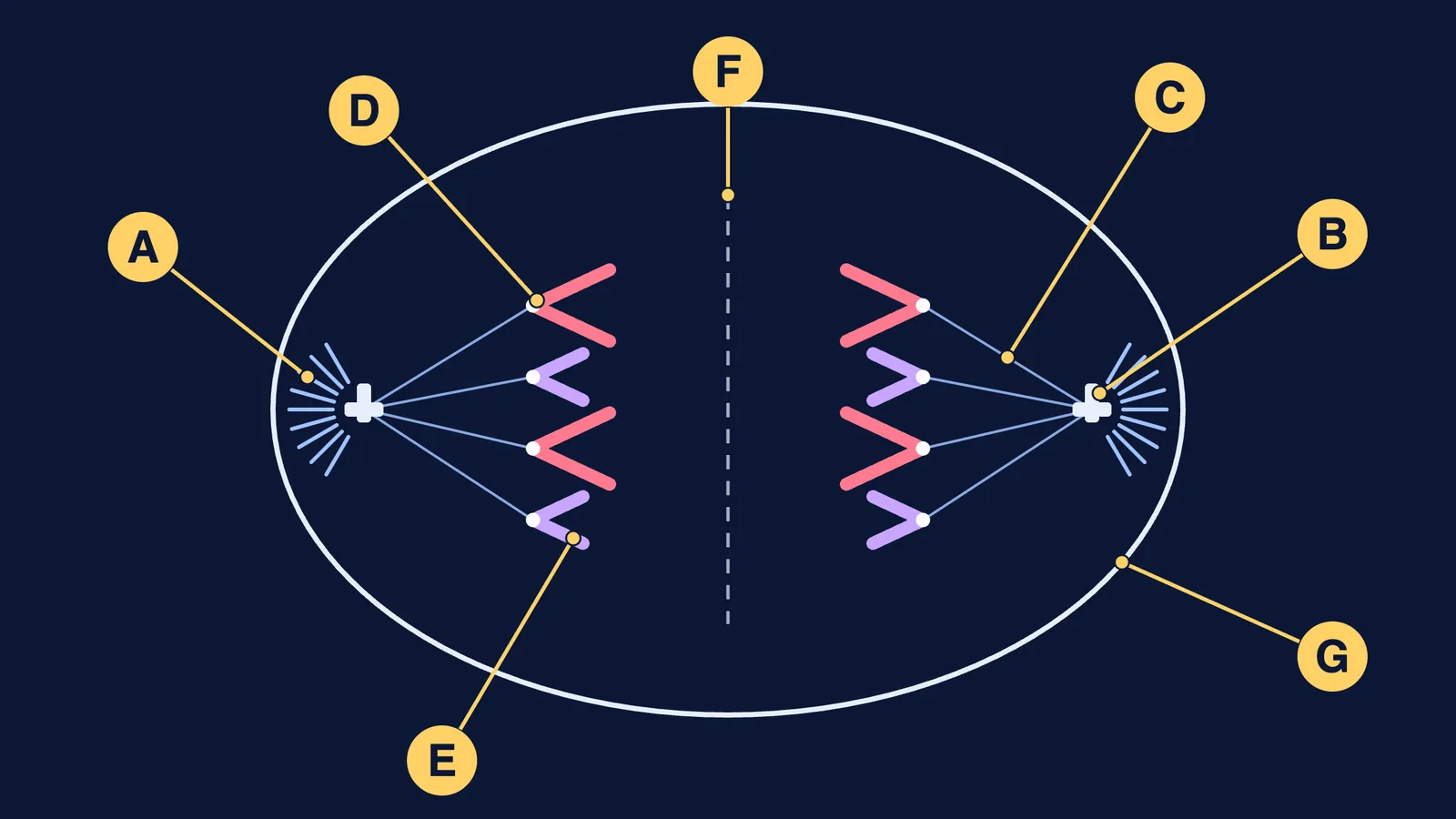
The NMC's NEET (UG) 2026 syllabus puts cell division (the cell cycle, mitosis and meiosis) under Unit 3: Cell Structure and Function, and NCERT's Class 11 Biology treats it in Chapter 10. This set has 13 original figure questions: six use the lettered anaphase cell above, seven put other figures into words. None comes from a past paper.
What should you check before answering a cell division figure?
Find the two poles and the equator first; every part sits at a pole, on the way to one, or on the middle line.
Count chromatids per chromosome and look for paired homologues to tell mitosis, meiosis I and meiosis II apart.
Follow each leader line to its dot: one chromosome can carry two letters.
For Statement I/II items, the codes are: (1) Only I is right (2) Only II is right (3) Both are right (4) Neither is right.
Questions 1 to 6 on the lettered anaphase cell
How to attack: name all seven letters yourself before reading options. Reasons come from section 10.2 of NCERT Chapter 10.
Q1. Which stage does the schematic show? (1) Metaphase of mitosis (2) Anaphase of mitosis (3) Anaphase I (4) Telophase of mitosis
Answer: (2). Single chromatids head to opposite poles; in anaphase I, homologues keep both chromatids.
Q2. One stage earlier, how were the two chromatids of each chromosome attached? (1) Both to fibres from the same B (2) Each to fibres from a different B (3) Only one chromatid was attached (4) Both to G
Answer: (2). At metaphase, sister chromatids attach to fibres from opposite poles.
Q3. Pair each letter in List-I with one entry in List-II. List-I: (i) A (ii) C (iii) D (iv) F. List-II: (p) Plane where chromosomes lined up in the previous stage (q) Rays of microtubules spreading out around B (r) Fibre ending at a kinetochore (s) Region of a daughter chromosome kept nearest the pole. Options: (1) i-r, ii-q, iii-s, iv-p (2) i-p, ii-r, iii-s, iv-q (3) i-q, ii-r, iii-s, iv-p (4) i-q, ii-s, iii-r, iv-p
Answer: (3). Asters radiate from centrosomes; the centromere leads.
Q4. Statement I: Each arm marked E belongs to a chromatid that parted from its sister when the centromere split at the start of this stage. Statement II: On reaching the poles, these chromosomes stay distinct and countable through telophase.
Answer: (1). In telophase, chromosomes decondense and lose their individuality.
Q5. Counting every daughter chromosome drawn, how many chromosomes did this cell enter mitosis with, and how many chromatids did it hold at metaphase? (1) 4 and 8 (2) 8 and 8 (3) 8 and 16 (4) 4 and 4
Answer: (1). Each pole gets one chromatid of every chromosome: four parent chromosomes, eight chromatids.
Q6. After nuclear division, how will this animal cell split its cytoplasm? (1) A furrow in G deepens until it meets in the centre (2) A cell plate forms along F and grows outward (3) G stays whole, giving a syncytium (4) The A structures fuse
Answer: (1). Animal cells furrow the plasma membrane; the cell plate is the plant route.
Answer key for the lettered diagram
A: aster
B: centrosome (drawn as two centrioles)
C: spindle fibre
D: centromere of a daughter chromosome
E: trailing arm of a daughter chromosome
F: equatorial (metaphase) plate
G: plasma membrane
How do you solve figure questions with no figure printed?
How to attack: sketch only what the stem says, then test each option. Reasons come from sections 10.1, 10.4 and 10.5 of NCERT Chapter 10.
Q7. A cell cycle wheel splits interphase into three arcs. Reading onward from the end of M phase, they come in which order? (1) G2, S, G1 (2) G1, S, G2 (3) S, G1, G2 (4) G1, G2, S
Answer: (2). G1 precedes DNA synthesis in S; G2 follows it and leads into M phase.
Q8. On the same wheel, an arrow leaves G1 for G0. Statement I: Cells on this branch have shut down their metabolism. Statement II: They can resume dividing when the organism needs it.
Answer: (2). NCERT says G0 cells stay metabolically active and proliferate only when called on.
Q9. Statement I: A telophase I drawing shows the nuclear membrane and nucleolus reappearing. Statement II: Its chromosomes are as fully extended as in an interphase nucleus.
Answer: (1). Chromosomes disperse somewhat but never reach the extended interphase state.
Q10. A pachytene figure marks recombination nodules on a bivalent. At these sites, crossing over occurs between: (1) sister chromatids of one homologue (2) non-sister chromatids of the two homologues (3) two non-homologous chromosomes (4) chromatids of two different bivalents
Answer: (2). NCERT places crossing over between non-sister chromatids of homologous chromosomes.
Q11. Statement I: In a prophase II drawing, meiosis II has begun straight after cytokinesis, chromosomes usually not yet fully elongated. Statement II: By the end of prophase II, the nuclear membrane has disappeared.
Answer: (3). NCERT states both for prophase II.
Q12. Match meiosis drawings with stages. List-I: (i) Metaphase I (ii) Anaphase I (iii) Anaphase II (iv) Telophase II. List-II: (p) Each centromere splits; chromatids pulled by shortening microtubules (q) Four haploid cells after cytokinesis (r) Bivalents line the equatorial plate (s) Homologues part, each still with both chromatids. Options: (1) i-s, ii-r, iii-p, iv-q (2) i-r, ii-p, iii-s, iv-q (3) i-r, ii-s, iii-q, iv-p (4) i-r, ii-s, iii-p, iv-q
Answer: (4). Homologues part in meiosis I, sister chromatids in meiosis II.
Q13. A flow figure runs: diploid parents, meiosis, haploid gametes, fertilisation, diploid zygote. What does it show? (1) Meiosis keeps the species' chromosome number constant across generations (2) Fertilisation halves the chromosome number (3) Gametes form by mitosis of diploid cells (4) Meiosis doubles the chromosome number
Answer: (1). Meiosis halves the number and fertilisation restores it.
How should you use your score on this set?
Redraw the anaphase cell one stage earlier, with every D on line F.
Sort each wrong answer: did you misjudge a shape or forget a line? Reread that NCERT paragraph.
Then switch format: the cell cycle statement and match-the-list set, the cell cycle assertion-reason questions or the cell cycle practice questions with solutions.
Not sure where your gaps in cell division lie? Fermi's AI tutor works out what you already know and builds a plan for the session.


