On this page
Here are ten original practice items on Cell Cycle and Cell Division: six assertion-reason questions and four Statement I / Statement II pairs, easy to hard. Every statement was checked against NCERT Class 11 Biology, Chapter 10 (Reprint 2026-27). The chapter sits in Unit III, Cell: Structure and Function, of the CBSE Class XI Biology syllabus for 2026-27.
How do you answer assertion-reason questions on the cell cycle?
Use these keys for every question below.
Assertion-reason:
(A) Both A and R are true and R is the correct explanation of A.
(B) Both A and R are true but R is NOT the correct explanation of A.
(C) A is true but R is false.
(D) A is false but R is true.
Statement pairs:
(A) Both statements are correct.
(B) Both statements are incorrect.
(C) Statement I is correct, Statement II is incorrect.
(D) Statement I is incorrect, Statement II is correct.
Judge A alone, then R alone. Only if both are true, read "A, because R" and ask whether NCERT gives R as the reason. Most false lines here put an event in the wrong stage.
Shaky on the chapter? Start with our cell cycle and cell division Class 11 guide.
Assertion-reason questions on cell cycle and cell division
Q1 (easy). Assertion (A): Mitosis is also called equational division. Reason (R): The parent cell and the cells it produces by mitosis have the same number of chromosomes.
Answer: (A). Both are true, and NCERT section 10.2 gives R as the reason, with the word "since". Trap: thinking "equational" refers to equal-sized daughter cells.
Q2 (easy). Assertion (A): Cells in the quiescent stage (G0) no longer proliferate unless the organism needs them to. Reason (R): Cells in G0 are metabolically inactive.
Answer: (C). A is true. R is false: NCERT says cells in G0 remain metabolically active; they have simply exited G1 and stopped dividing. Trap: reading "inactive stage" as "inactive cell".
Q3 (medium). Assertion (A): Metaphase is the stage at which the morphology of chromosomes is most easily studied. Reason (R): By metaphase, the condensation of chromosomes is complete.
Answer: (A). Both are true, and NCERT section 10.2.2 links them: condensation is complete, so chromosomes are seen clearly and their shape is easiest to study. Trap: picking (B) because condensation sounds like a prophase fact.
Q4 (medium). Assertion (A): Interphase is a resting phase in which the cell does nothing but wait for the next division. Reason (R): In human cells in culture, which divide about once every 24 hours, interphase lasts more than 95% of the cycle.
Answer: (D). A is false: NCERT says interphase, though called the resting phase, is when the cell grows and replicates its DNA to prepare for division. R is true, as stated in NCERT section 10.1.1. Trap: taking the old name "resting phase" literally.
Q5 (hard). Assertion (A): Meiosis II resembles a normal mitosis. Reason (R): There is no replication of DNA during interkinesis.
Answer: (B). Both are true, but NCERT gives no such link. The resemblance lies in the division itself: as in mitosis, centromeres split and sister chromatids separate, here in anaphase II. If anything, the missing replication is a difference, since a mitotic division follows an S phase. Trap: any true fact about interkinesis feels like a fair reason.
Q6 (hard). Assertion (A): At the end of anaphase I, each pole has half the chromosome number of the parent cell. Reason (R): In anaphase I, centromeres split and sister chromatids move to opposite poles.
Answer: (C). A is true. R is false: in anaphase I homologous chromosomes separate while sister chromatids stay joined at their centromeres, which split only in anaphase II. Trap: copying mitotic anaphase onto meiosis I.
Statement I and Statement II questions on cell division
Q7 (easy). Statement I: In animal cells, the centriole duplicates in the cytoplasm during S phase. Statement II: During G2, proteins are synthesised in preparation for mitosis while cell growth continues.
Answer: (A). Both match NCERT section 10.1.1. Trap: assuming S phase happens only in the nucleus.
Q8 (medium). Statement I: Yeast can progress through the cell cycle in only about 90 minutes. Statement II: In animals, mitosis happens only in diploid cells, without exception.
Answer: (C). Statement I is in NCERT section 10.1. Statement II fails on "without exception": NCERT names male honey bees, whose haploid cells divide by mitosis. Trap: missing the absolute word.
Q9 (medium). Statement I: Cells at the end of mitotic prophase still show the nucleolus and nuclear envelope under the microscope. Statement II: The nucleolus, Golgi complex and ER reform during anaphase.
Answer: (B). Both are incorrect. NCERT says cells at the end of prophase show no Golgi complex, ER, nucleolus or nuclear envelope, and these reform in telophase. Trap: each line is one stage off.
Q10 (hard). Statement I: Meiosis involves two cycles of DNA replication, one before each nuclear division. Statement II: In the oocytes of some vertebrates, diplotene can last for months or years.
Answer: (D). Statement I is wrong: NCERT section 10.4 says meiosis has two cycles of nuclear and cell division but only a single cycle of DNA replication. Statement II is correct. Trap: two divisions make two replications feel natural.
How should you use this set?
Do all ten in 12 minutes without notes, writing T or F above each line before choosing a key.
Sort every miss: a wrong fact (reread that NCERT section) or a wrong link (run the "A, because R" test again).
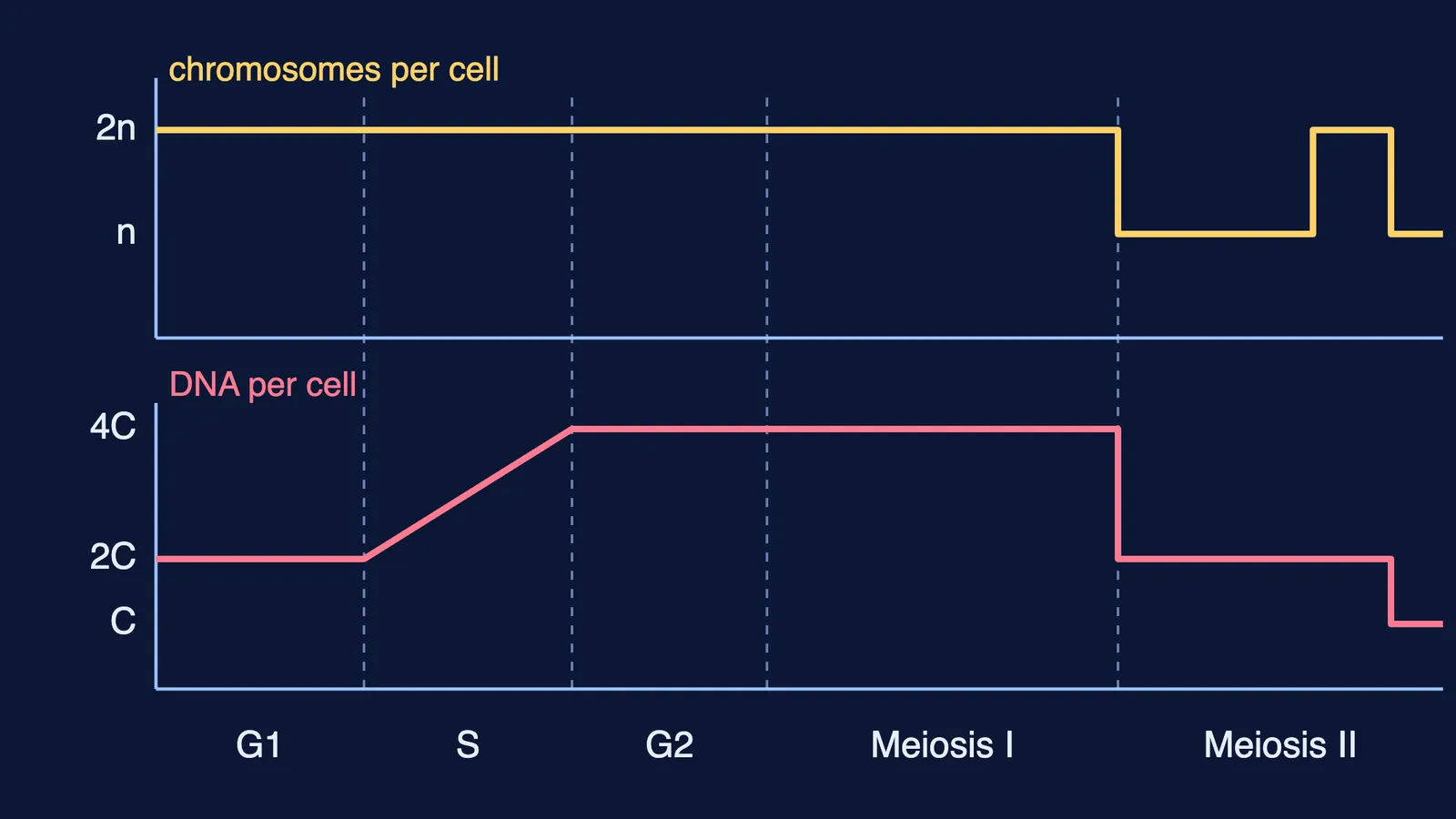
For a counting miss, track chromosome number (n) and DNA content (C) through every stage, as NCERT exercise 16 asks; the diagram above does this for meiosis.
Each key appears two or three times, so a run of one letter means nothing.
If you cannot picture how anaphase I differs from anaphase II, the Fermi Concept Library has every concept in biology with its own lesson and its place in the map. For the format itself, read our assertion-reason strategy guide, then try the cell cycle and cell division practice questions with solutions.