

On this page
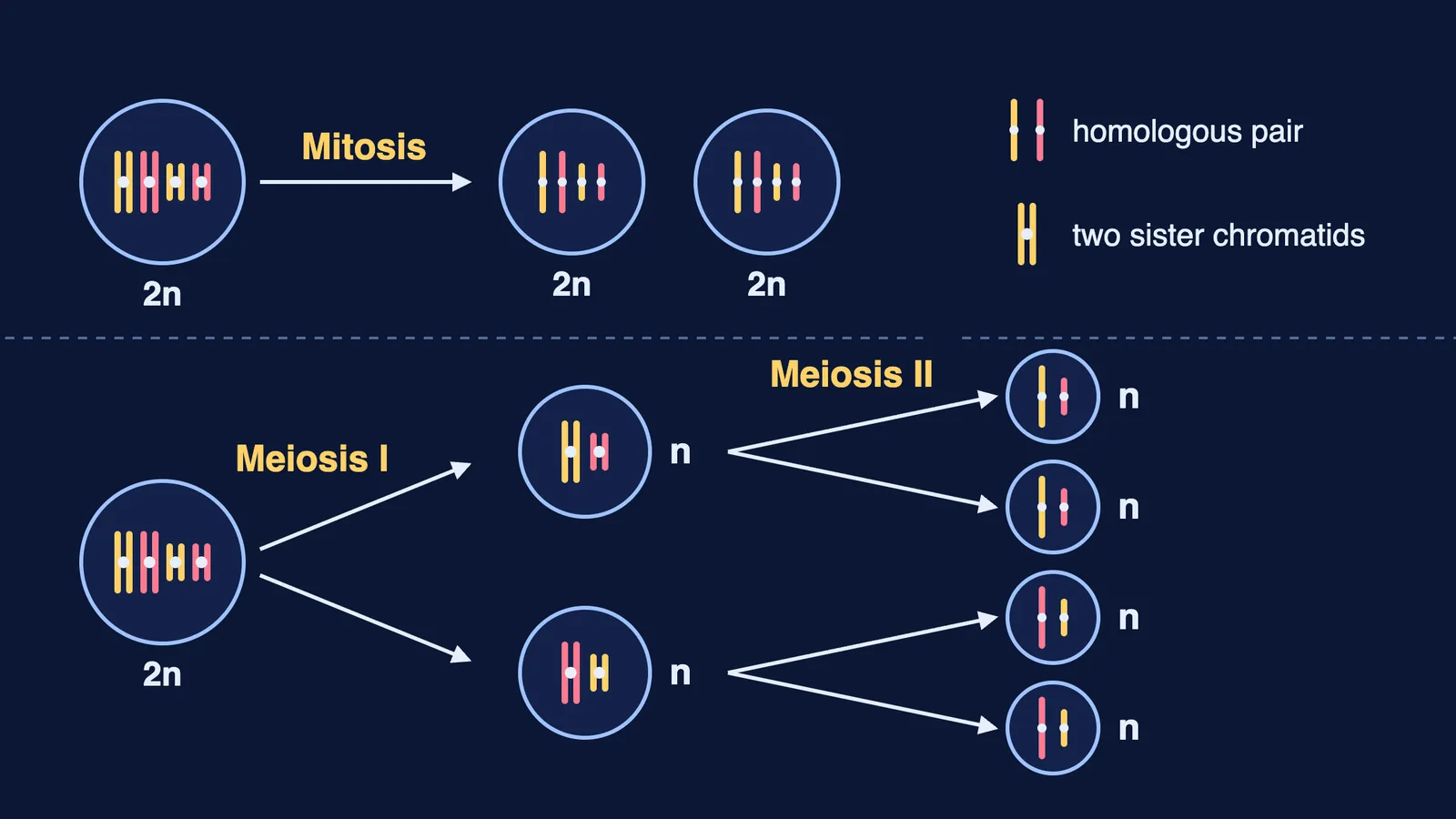
Cell division is Chapter 10 of NCERT Class 11 Biology, and the NEET (UG) 2026 syllabus lists it under Unit 3: Cell Structure and Function. These 14 original questions run from G1 to the tetrad; none is a past-paper item or forecast.
The NEET (UG) 2026 Information Bulletin sets 90 Biology questions in a 180-question paper; a right answer scores +4, a wrong one −1.
How do you crack two-statement questions on cell division?
How to attack this format: ask "when?" and "where?" of each statement; a false one here usually puts a real event in the wrong stage or place.
Codes for Q1 to Q5: (1) I and II hold; (2) I and II fail; (3) I holds, II fails; (4) I fails, II holds.
Q1. Statement I: In a plant cell, the new wall starts at the centre and grows outward to the lateral walls. Statement II: The cell plate represents the middle lamella between the two new walls.
Answer: (1). NCERT section 10.2.5 states both.
Q2. Statement I: Cytokinesis in an animal cell starts as a furrow in the cell wall. Statement II: Kinetochores are disc-shaped structures on the centromere surface.
Answer: (4). The furrow forms in the plasma membrane.
Q3. Statement I: Recombination between homologues is complete by the end of zygotene. Statement II: The enzyme of crossing over is ligase.
Answer: (2). Recombination ends with pachytene; the enzyme is recombinase.
Q4. Statement I: Mitosis in the apical and lateral cambium allows plants to keep growing for as long as they live. Statement II: Meiosis lowers genetic variability between generations.
Answer: (3). Per NCERT section 10.5, meiosis raises variability.
Q5. Statement I: After telophase I, chromosomes uncoil fully, as in an interphase nucleus. Statement II: Meiosis II starts right after cytokinesis, often before chromosomes finish elongating.
Answer: (4). Chromosomes disperse only partly, short of the interphase state.
How do you check a "which are correct" list?
How to attack this format: first judge a letter that sits in some codes but not others; one verdict often removes half the choices.
Q6. Which are correct about the significance of mitosis? (A) It usually gives diploid cells with identical genetic complement. (B) It brings back the nucleus-to-cytoplasm ratio that cell growth upsets. (C) It replaces cells of the upper epidermis, gut lining and blood. (D) It halves the chromosome number.
Options: (1) A and D only (2) A, B and C only (3) B and C only (4) A, B, C and D
Answer: (2). Halving is meiosis; mitosis is equational.
Q7. Which are correct about mitotic metaphase and anaphase? (A) Metaphase begins when the nuclear envelope has fully disintegrated. (B) Both sister chromatids attach to fibres from the same pole. (C) In anaphase, the centromere leads and the arms trail. (D) The plane where chromosomes line up is the metaphase plate.
Options: (1) A, C and D only (2) B and C only (3) A and B only (4) C and D only
Answer: (1). Sister chromatids connect to fibres from opposite poles.
How do you work through match-the-list items on mitosis and meiosis?
How to attack this format: if List-I is a sequence, like the prophase I substages, put the List-II clues in time order; the orders line up. Otherwise match the most specific clue first. Our guide to NEET match-the-list questions works one through.
Q8. List-I: (A) Leptotene (B) Pachytene (C) Diplotene (D) Diakinesis. List-II: (I) Spindle assembles; nuclear envelope breaks down (II) Compaction continues throughout (III) Each bivalent shows four distinct chromatids (IV) Recombined homologues pull apart except at crossover sites.
Options: (1) A-II, B-IV, C-III, D-I (2) A-III, B-II, C-IV, D-I (3) A-II, B-III, C-IV, D-I (4) A-I, B-III, C-IV, D-II
Answer: (3). The clues follow prophase I in NCERT section 10.4.1.
Q9. List-I: (A) Syncytium (B) Dyad of cells (C) Tetrad of cells (D) Interkinesis. List-II: (I) Four haploid cells after telophase II (II) Multinucleate state when cytokinesis does not follow karyokinesis (III) Short gap between the meiotic divisions (IV) Two cells after telophase I.
Options: (1) A-II, B-I, C-IV, D-III (2) A-III, B-IV, C-I, D-II (3) A-II, B-IV, C-III, D-I (4) A-II, B-IV, C-I, D-III
Answer: (4). NCERT's syncytium example is coconut's liquid endosperm.
Q10. List-I: (A) Chromosomes decondense and lose individuality (B) Condensation begins; centrosomes move apart (C) Centromeres split; daughter chromosomes migrate (D) Metabolically active growth without DNA replication. List-II: (I) Prophase (II) G1 phase (III) Telophase (IV) Anaphase
Options: (1) A-III, B-I, C-IV, D-II (2) A-I, B-III, C-IV, D-II (3) A-III, B-I, C-II, D-IV (4) A-IV, B-I, C-III, D-II
Answer: (1). Chromosomes decondense in telophase, the last stage of karyokinesis.
Q11. List-I: (A) Asters (B) Mitotic apparatus (C) Bivalent (D) Chiasmata. List-II: (I) X-shaped links between recombined homologues (II) Microtubules radiating from a centrosome (III) Two asters with the spindle fibres (IV) A pair of synapsed homologues
Options: (1) A-III, B-II, C-IV, D-I (2) A-II, B-III, C-IV, D-I (3) A-II, B-III, C-I, D-IV (4) A-IV, B-III, C-II, D-I
Answer: (2). Asters plus spindle fibres make the mitotic apparatus.
How do you answer single-correct MCQs on this chapter?
How to attack this format: first decide whether the stem is set in mitosis, meiosis I or meiosis II; most wrong options are true of another division.
Q12. A plant has 2n = 22. How many bivalents align at metaphase I?
(1) 44 (2) 22 (3) 11 (4) None
Answer: (3). One bivalent per synapsed homologous pair: 22 chromosomes, 11 pairs.
Q13. In metaphase II, spindle microtubules attach to the kinetochores of:
(1) homologous chromosomes (2) sister chromatids (3) bivalents (4) non-sister chromatids
Answer: (2). Homologues separated in meiosis I; meiosis II resembles mitosis.
Q14. Which event belongs to cytokinesis, not karyokinesis?
(1) Mitochondria and plastids are shared out (2) The nucleolus reforms (3) Chromatids move to the poles (4) The nuclear envelope disappears
Answer: (1). NCERT places organelle sharing at cytoplasmic division.
How do you learn from the questions you missed?
Answer all 14 with NCERT closed, circling the word that settled each.
Trace each miss to its NCERT paragraph and name what you swapped.
Retry just the wrong ones after two days. For a different format, see our cell cycle assertion-reason questions or the graded cell cycle practice questions with solutions.
Mixing up meiosis I and II under time pressure? Fermi's AI tutor works out what you already know and builds a plan for the session.


