On this page
Burning magnesium is too hot and fast to measure cleanly in a simple calorimeter, yet data tables list ΔfH° of MgO as −601.6 kJ/mol. In 1871 a chemist named A. Ditte, publishing in the Paris Comptes rendus, got such a number without burning anything: dissolve the metal in acid, dissolve its oxide in the same acid, and subtract. That is the Hess's law cycle of Class 11 thermodynamics. We read his work in the English abstracts of the Journal of the Chemical Society, volume 24 (1871), on the scanned pages at the Internet Archive. Modern values are from the CODATA Key Values for Thermodynamics.
What did Ditte measure in 1871?
The page 643 abstract gives the plan. "By measuring the quantities of heat made sensible, when equivalent weights of magnesium and magnesia are acted upon by similar liquids, and taking the difference, he ascertained the quantity of heat produced when magnesium is oxidized at the expense of hydrogen." He then added "Favre and Silbermann's determination of the heat of combustion of hydrogen" to reach the heat of burning magnesium in oxygen.
He dissolved "a known weight of pure magnesium in dilute sulphuric acid, and afterwards" dissolved "magnesia in the same medium under similar circumstances." Both runs were made in "a Favre and Silbermann's mercurial calorimeter."
He got 6,187 heat units per gram and 74,246 per equivalent. The abstract does not name the unit; we take it as gram-calories, which agrees with modern data to within a few per cent.
How do you turn Ditte's numbers into kJ/mol?
In 1871 an equivalent of magnesium was 12 g, the mass that combines with 8 g of oxygen. Two checks:
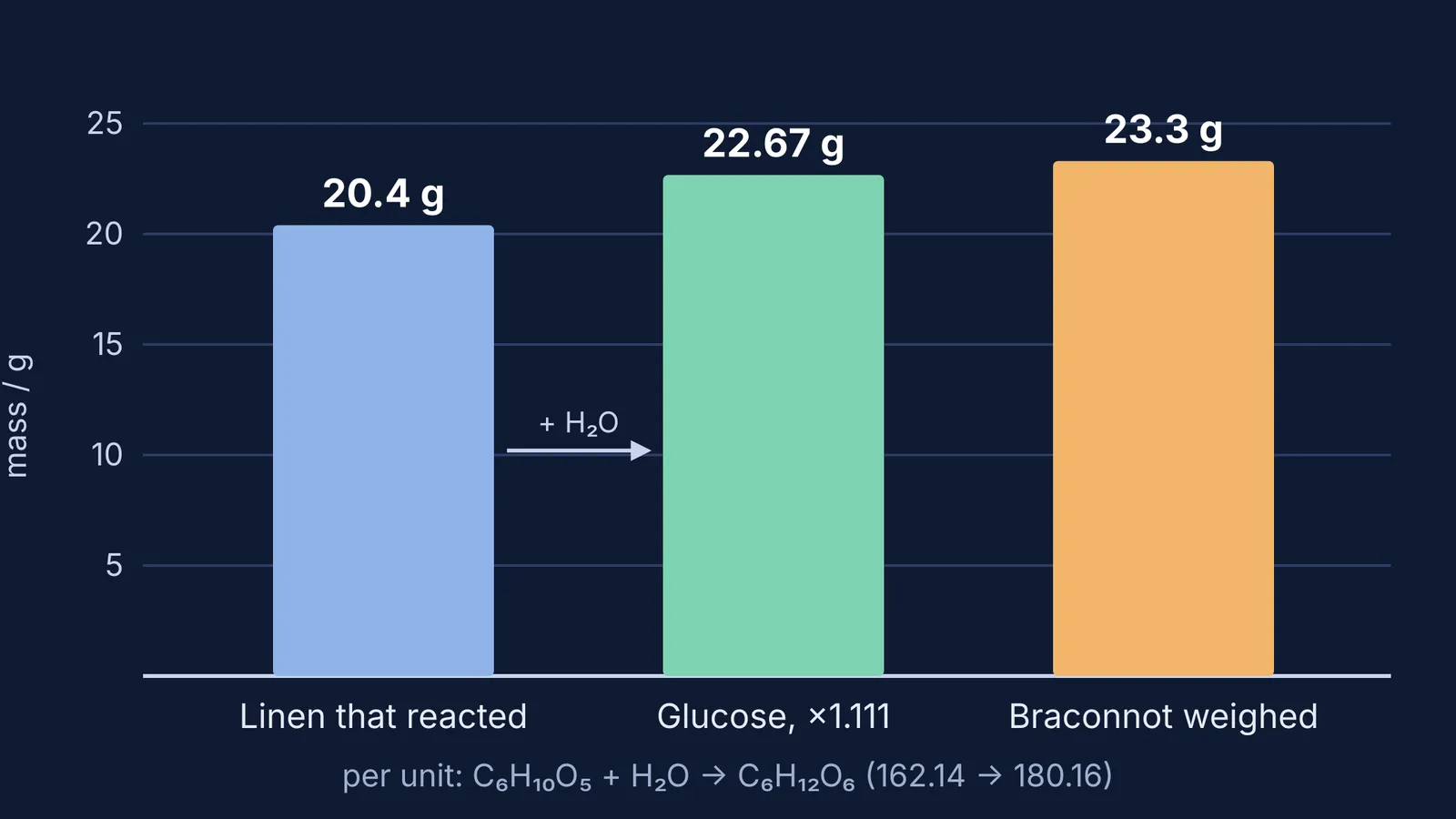
6,187 × 12 = 74,244, which matches 74,246. So "per gram" means per gram of metal, not of oxide.
One mole of MgO (24 g Mg + 16 g O) is two equivalents. So kJ/mol = 2 × value × 4.184 ÷ 1000.
For the sulphuric acid route: 2 × 74,246 × 4.184 ÷ 1000 = 621.3 kJ/mol. The modern value is 601.60 kJ/mol, so Ditte was 3.3% high.
Did a second route give the same answer?
Ditte checked by a different reaction. "By acting on magnesium with iodic acid, magnesium iodate is formed, and iodine liberated." Written as a balanced equation (ours, not the abstract's):
5Mg + 12HIO₃ → 5Mg(IO₃)₂ + I₂ + 6H₂O
Atoms and electrons balance (5 Mg lose 10 e⁻; 2 I gain 10 e⁻). Using "a previous determination of the heat of formation of iodic acid", he got 73,109 and 72,671 in two runs, mean 72,890 per equivalent. That is 609.9 kJ/mol, only 1.4% above the modern value.
The two routes differ by 1,356 heat units, or 1.9%. If enthalpy depends only on the start and end states, they should agree, and with 1871 equipment they nearly do.
Why was the sulphuric acid route higher? The abstract does not say. Here is our modern reading, not Ditte's. In a later paper (page 870) he calcined magnesia at four temperatures, from 350° to a bright red heat. Its density rose from 3.1932 to 3.5699, and its heat of combination with sulphuric acid rose from 16,655 to 20,094 per equivalent. That spread, 3,439, is bigger than the 1,356 gap between his routes, and the first abstract does not say which magnesia he used. By his summary table (page 794) he gave magnesium as 69,222 to 72,890 per equivalent; 74,246 no longer appears.
Why did zinc's answer depend on how the oxide was made?
By the first method zinc gave 44,258 per equivalent, or 370.4 kJ/mol against a modern 350.46 (5.7% high). His second paper (page 793) found why results disagreed. Zinc oxide, "when prepared in different ways, gives different results". Three samples dissolved in dilute sulphuric acid with these heats per equivalent:
White oxide from the hydrate heated four hours at 350°, which "dissolved in dilute sulphuric acid with ease": 10,012.
Hydrate taken briefly to a dull-red heat, which "required some time to dissolve": 11,155.
Light yellow oxide held at a white heat for an hour, which "dissolved with difficulty": 12,288.
His zinc results ran from 43,125 to 45,401. Subtract and both spreads come out at exactly 2,276. That one-for-one match is what the cycle predicts. The heat of forming ZnO is (heat of dissolving Zn) − (heat of dissolving ZnO) + (heat of burning H₂). Only the middle term changes with the sample, so every extra unit of heat the oxide gives out on dissolving comes straight off the answer. In kJ/mol that is 360.9 to 379.9, a 19 kJ/mol range from the oxide alone.
Notice the direction: the hardest-heated oxide released the most heat, as with his magnesias, a trend Ditte called "opposed to the ordinarily received opinion". The abstracts do not explain it, and neither can we.
This is why ΔfH° comes with a standard state: "zinc oxide" is not one substance until you say which form. Tables use the most stable form at 1 bar, usually at 298 K, as explained in why the standard enthalpy of formation of elements is zero.
Worked example: how do you find ΔfH of MgO from two acid reactions?
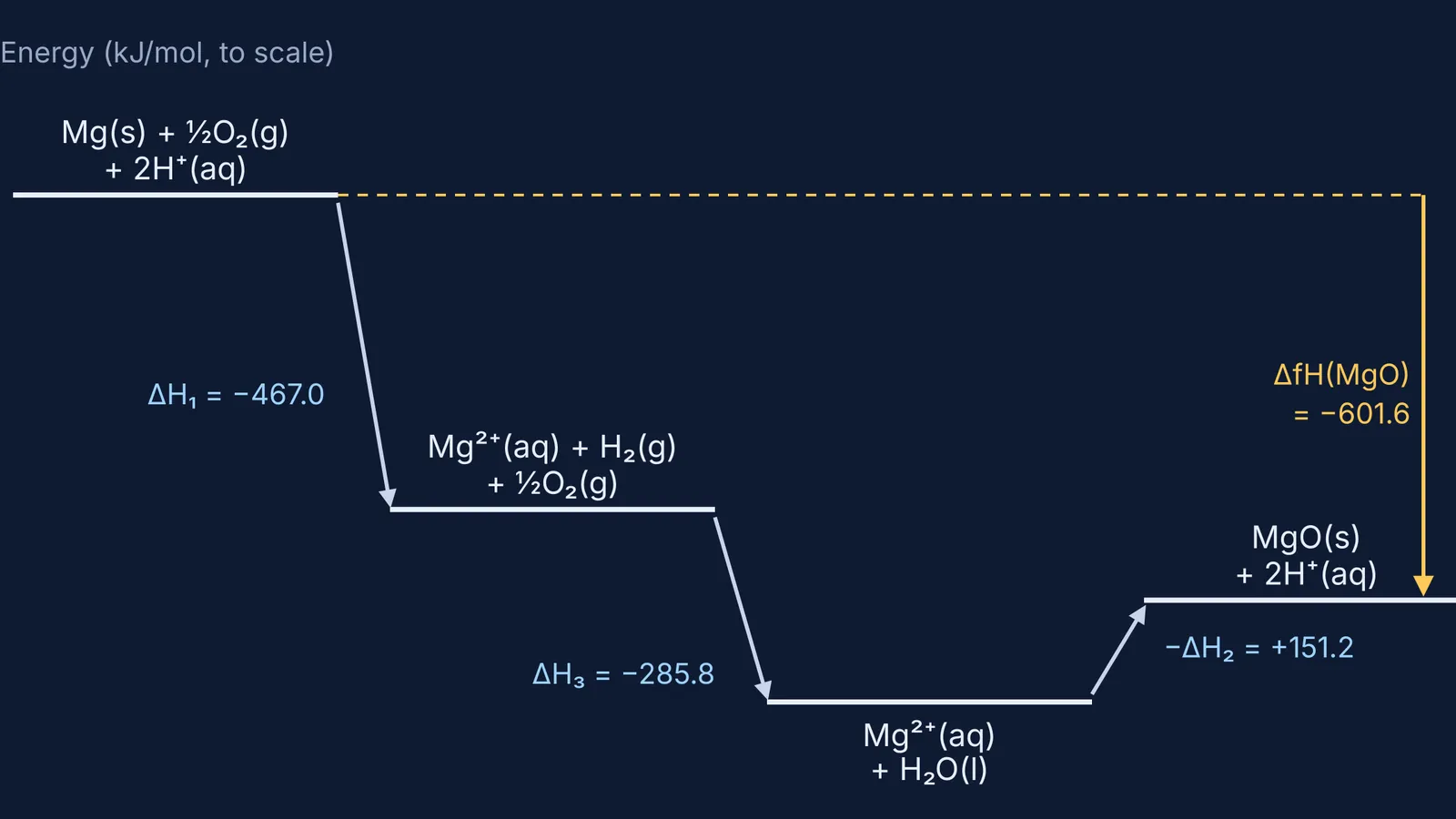
Values rounded from CODATA (25 °C, dilute acid):
Mg(s) + 2H⁺(aq) → Mg²⁺(aq) + H₂(g), ΔH₁ = −467.0 kJ/mol
MgO(s) + 2H⁺(aq) → Mg²⁺(aq) + H₂O(l), ΔH₂ = −151.2 kJ/mol
H₂(g) + ½O₂(g) → H₂O(l), ΔH₃ = −285.8 kJ/mol
Target: Mg(s) + ½O₂(g) → MgO(s).
Keep equation 1. Mg is on the left, as in the target.
Reverse equation 2. MgO must be a product: Mg²⁺(aq) + H₂O(l) → MgO(s) + 2H⁺(aq), ΔH = +151.2 kJ/mol.
Keep equation 3. It supplies the ½O₂.
Cancel. 2H⁺, Mg²⁺, H₂ and H₂O each appear once on each side. What remains is Mg + ½O₂ → MgO.
Add. ΔfH(MgO) = −467.0 + 151.2 − 285.8 = −601.6 kJ/mol.
Because ΔH₂ here comes from table values, the cycle must close. In Ditte's units, dissolving magnesia is about 18,072 per equivalent today, inside his 16,655 to 20,094 range.
For more cycle problems, the Fermi Problem Library has a step-by-step solver that explains the reasoning. The general method for building cycles is in Hess's law and enthalpy calculations, and the law's own history is in Germain Hess and the law of constant heat summation.
Where does this sit in your syllabus?
Class 11 Thermodynamics: Hess's law, enthalpy of formation, standard state and enthalpy of solution. If you are preparing for JEE Main and Advanced, Fermi Test Prep is test prep for both exams with an AI tutor.
One coda from the same volume. On page 878 Julius Thomsen wrote that Favre and Silbermann's mercury calorimeter "may be useful for comparative" work but "is useless for absolute determinations". Ditte subtracted two runs in one instrument, so a fixed error would partly cancel (our reasoning, not the sources').
Quick checklist
Ditte found MgO's heat of formation by dissolving Mg and MgO in the same dilute acid, then adding the heat of burning hydrogen.
His two routes gave 621.3 and 609.9 kJ/mol, 1.9% apart. The modern value is 601.6.
One equivalent is half a mole of oxide: kJ/mol = 2 × heat units × 4.184 ÷ 1000.
Three zinc oxides changed his zinc result by 2,276 heat units, exactly the change in their heats of solution.
That is why ΔfH° names a standard state.