

On this page
Germain Hess was a Swiss-born chemist who worked in Russia and laid the foundation for thermochemistry. His key insight—that the heat released or absorbed in a chemical reaction depends only on the starting materials and the final products, not the path between them—became known as Hess's law of constant heat summation.
Born on 7 August 1802 in Geneva, Hess's family moved to the Russian Empire in 1805 (Wikipedia). He studied medicine at the Imperial University of Dorpat (now Tartu, Estonia), qualifying as a physician in 1825. A meeting with the renowned Swedish chemist Jöns Jakob Berzelius turned Hess's focus entirely to chemistry. By 1830, he was researching and teaching full-time, later becoming an adjunct professor of chemistry at the St. Petersburg Academy of Sciences.
What is Hess's law of constant heat summation?
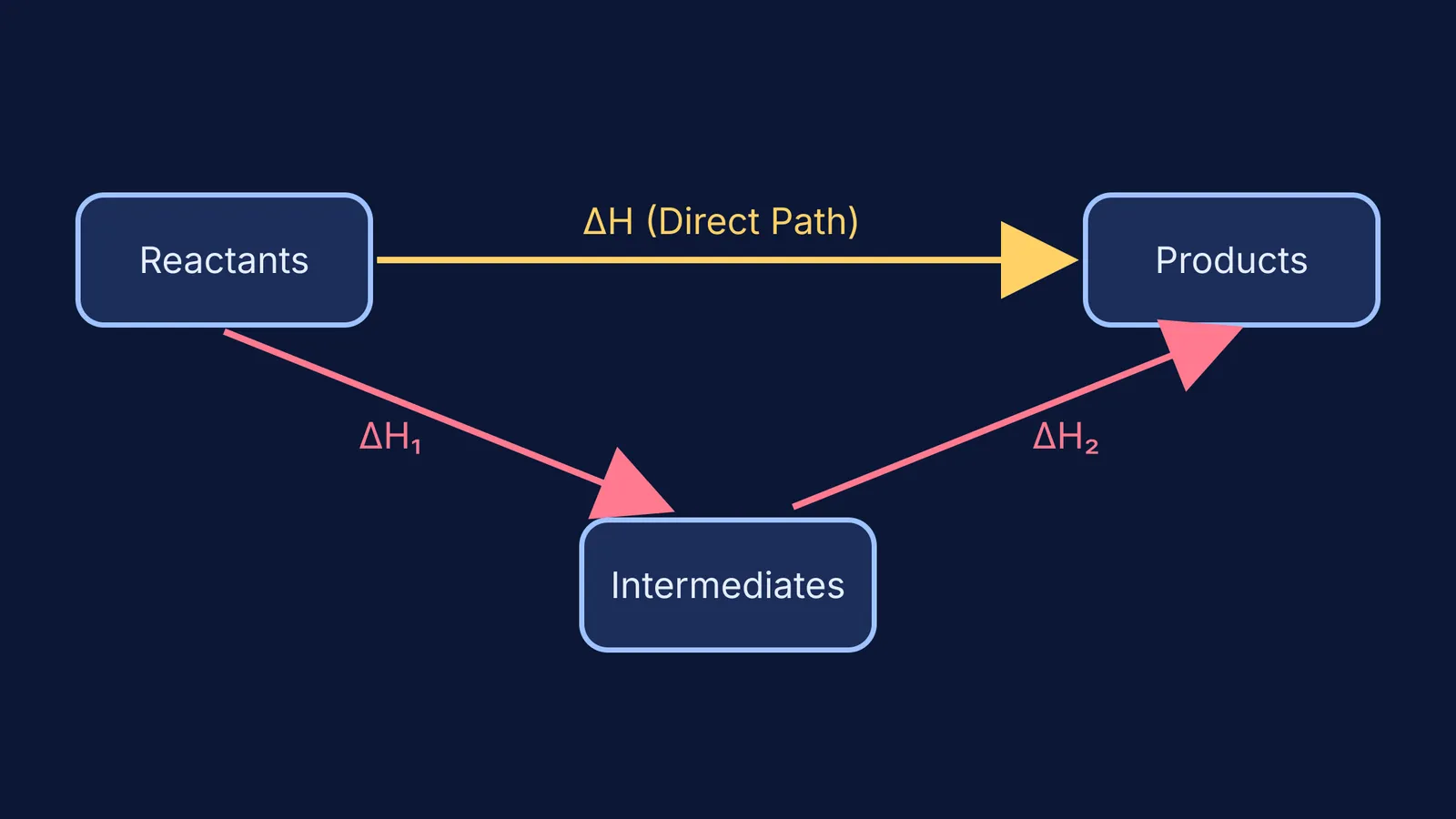
Hess's law states that the total enthalpy change during the complete course of a chemical reaction is independent of the sequence of steps taken (Wikipedia). In thermodynamics, this means enthalpy is a state function: its change depends only on the initial and final states of the system.
If a reaction can take place by several different routes, the overall enthalpy change (ΔH) remains the same. The formula for the standard enthalpy of reaction is the sum of the standard enthalpies of formation of the products minus the sum of the standard enthalpies of formation of the reactants: ΔH°(reaction) = Σ ΔfH°(products) − Σ ΔfH°(reactants)
This law preceded the first law of thermodynamics, which was later stated in 1845. In 1842, Julius Robert von Mayer would state a more general principle of energy conservation, but Hess's work was a crucial early formulation of the idea that energy is conserved during chemical transformations (Wikipedia).
How did Hess discover his law with sulfuric acid?
Hess was primarily an experimental chemist interested in how chemical affinity related to heat. In 1840, he published his most famous paper outlining his law on thermochemistry (Wikipedia).
His experiments focused on various hydrates of sulfuric acid. He showed that the heat released when these hydrates formed was always the same, whether the reactions proceeded directly or through intermediate steps (Wikipedia). By carefully measuring the heat evolved during these reactions using early calorimetry methods, Hess demonstrated that the intermediate stages did not affect the total heat outcome.
How do we use Hess's law in chemistry today?
Hess's law allows the enthalpy change for a reaction to be calculated even when it cannot be measured directly (Wikipedia). By performing basic algebraic operations on the chemical equations and using previously determined values for the enthalpies of formation, chemists can find the overall energy change.
This is particularly useful for finding the heats of formation of unstable intermediates, such as carbon monoxide (CO) or nitric oxide (NO), or measuring the heat changes in phase transitions and allotropic transformations. It also helps in constructing Born–Haber cycles to determine the lattice energies of ionic substances.
When you are studying these cycles, keeping track of the signs and steps can be tricky. If you get stuck on the calculations, Fermi's AI tutor can work out what you already know and build a plan for the session, writing on a board to help you master enthalpy calculations step by step. You can also explore the Fermi Problem Library, which features a step-by-step solver that explains the reasoning behind each thermodynamic step rather than just printing an answer.
A worked example of Hess's law
To see the law of constant heat summation in action, consider the combustion of carbon (graphite) to form carbon dioxide (Wikipedia). This process can happen in one direct step or in two intermediate steps involving carbon monoxide.
Direct step: C(graphite) + O2(g) → CO2(g) ΔH = −393.5 kJ/mol
Two-step path:
Carbon forms carbon monoxide: C(graphite) + 1/2 O2(g) → CO(g) (ΔH = −110.5 kJ/mol)
Carbon monoxide forms carbon dioxide: CO(g) + 1/2 O2(g) → CO2(g) (ΔH = −283.0 kJ/mol)
If you add the two intermediate reactions together, the CO(g) terms cancel out on both sides, leaving the direct equation. When you add their enthalpy changes (−110.5 kJ/mol + −283.0 kJ/mol), the sum is exactly −393.5 kJ/mol. The total heat released is identical, proving Hess's law holds true regardless of the path.
The legacy of Germain Hess
Beyond his foundational law, Hess proposed the law of thermoneutrality in 1842, which states that no heat is evolved in the exchange reactions of neutral salts in aqueous solution (Wikipedia). An explanation for this would only come 45 years later through Svante Arrhenius's theory of electrolytic dissociation.
Hess was highly influential in the development of chemistry in Russia. His book *Osnovania Chistoy Khimii* (Fundamentals of Pure Chemistry) went through seven editions and remained the standard Russian textbook for undergraduate chemistry until 1861. He also discovered that the oxidation of sugars yielded saccharic acid, and the mineral hessite (silver telluride) was named in his honour. He died prematurely at age 48 in St. Petersburg on 12 December 1850 (Wikipedia).
If you are working through the concepts of energy and heat, reviewing related topics can solidify your understanding. Read more about Hess's law and enthalpy calculations: building cycles that work and Thermodynamics sign conventions: physics vs chemistry, explained. For practical applications, explore Calorimetry and heat transfer: mixing, melting and conduction.


