On this page
If you study for JEE or NEET, you meet the first law of thermodynamics twice: once in physics and once in chemistry. The two books write it differently, and students who switch between them in one sitting often get a sign wrong. Both versions describe the same thing, conservation of energy. The difference is only which direction of work counts as positive.
What does each textbook say?
Physics. NCERT's Class 11 Physics chapter on thermodynamics writes ΔQ = ΔU + ΔW, where ΔQ is "Heat supplied to the system by the surroundings" and ΔW is "Work done by the system on the surroundings". OpenStax University Physics writes the same law as ΔE_int = Q − W, with "Work done by system W>0" and "Heat added to system Q>0" (OpenStax, first law of thermodynamics).
Chemistry. NCERT's Class 11 Chemistry unit on thermodynamics writes ΔU = q + w, where w is work done on the system, and gives expansion work as w = −p_ex(V_f − V_i). It adds a footnote worth reading: "Earlier negative sign was assigned when the work is done on the system and positive sign when the work is done by the system. This is still followed in physics books, although IUPAC has recommended the use of new sign convention." OpenStax Chemistry 2e agrees: "The work, w, is positive if it is done on the system and negative if it is done by the system" (OpenStax Chemistry 2e, enthalpy).
So heat into the system is positive in both. Only work flips.
Worked example 1: a gas that expands
A gas absorbs 500 J of heat and expands against a constant external pressure of 1 bar, from 2.0 L to 5.0 L.
First, the size of the work. NCERT's equilibrium unit gives 1 bar = 10⁵ Pa, and 1 L = 10⁻³ m³, so 1 bar L = 100 J. The gas expands by 3.0 L, so the work has magnitude 300 J.
Physics: Q = +500 J, W = +300 J (done by the gas). ΔU = Q − W = 200 J.
Chemistry: q = +500 J, w = −300 J (the gas does work, so work done on it is negative). ΔU = q + w = 200 J.
Worked example 2: a gas that is compressed
You do 200 J of work compressing a gas, and it loses 50 J of heat to the surroundings.
Physics: Q = −50 J, W = −200 J. ΔU = −50 − (−200) = +150 J.
Chemistry: q = −50 J, w = +200 J. ΔU = −50 + 200 = +150 J.
That check works because work depends on the path between two states (OpenStax, work, heat and internal energy), while internal energy is a state function, so its change is path independent and is zero over any closed cycle (OpenStax, first law of thermodynamics).
Where do students mix them up?
Two minus signs at once. Using w = −pΔV (chemistry) inside ΔU = Q − W (physics) cancels the sign you needed.
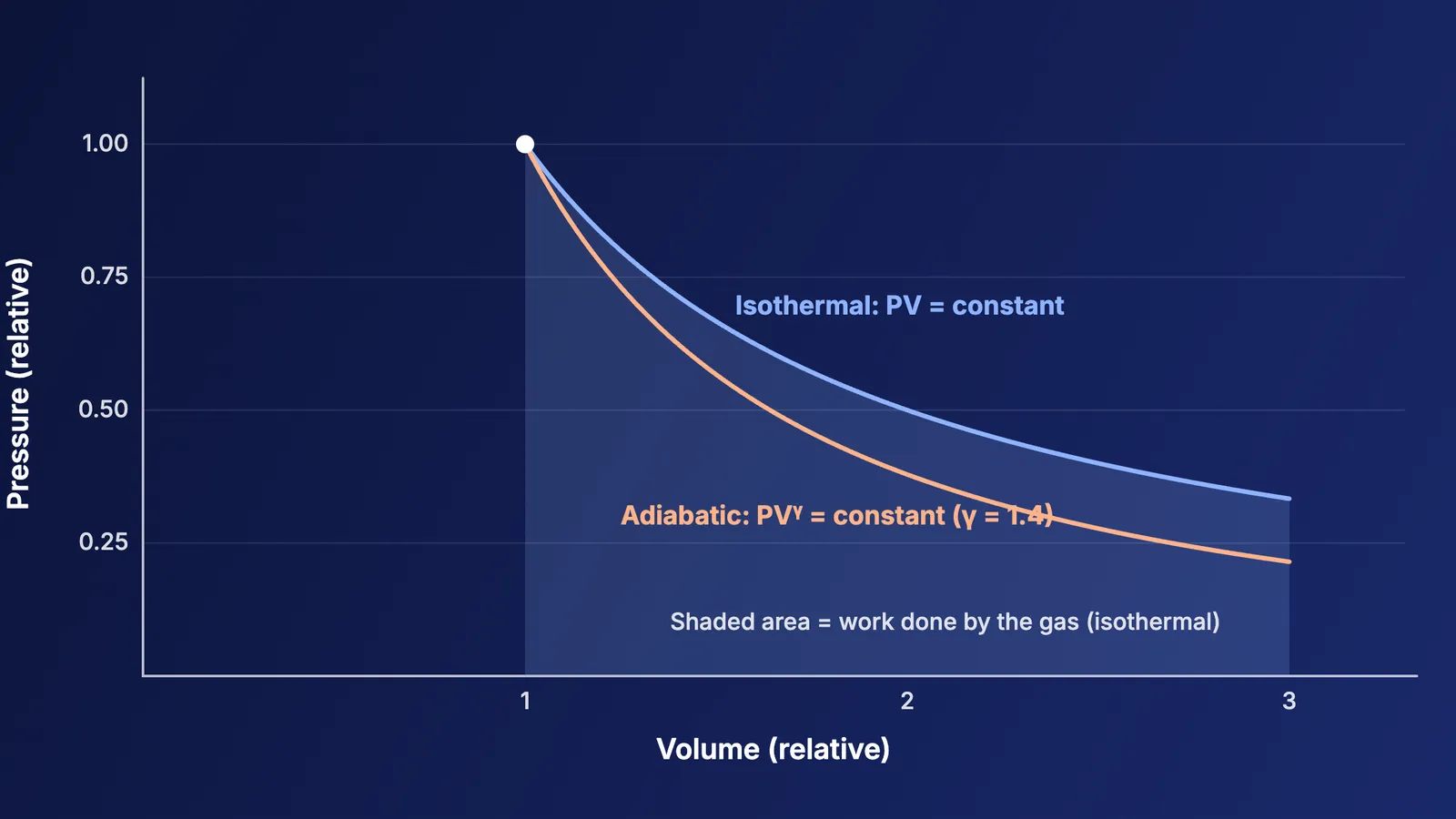
Graph areas. On a p–V graph, the area under the curve is the work done by the gas, which OpenStax says "is positive for expansion and negative for compression" (OpenStax, work, heat and internal energy). In chemistry, that same area enters as −w.
Enthalpy signs. NCERT Chemistry notes that ΔH is positive for endothermic reactions; heat released by the system is negative. Writing +q for heat given out is a physics-style slip in a chemistry answer.
Units. L bar and L atm are not the same unit, and R has different values in each. Convert to joules before you combine terms; our dimensional analysis check catches many of these.
A translation routine you can use in the exam
At the top of your working, write which convention you are using: "physics, W by gas" or "chemistry, w on gas".
For each energy transfer, decide in words: into the system or out of it?
Heat in is positive in both conventions.
If the gas expands, physics W is positive and chemistry w is negative. If it is compressed, the reverse.
Compute ΔU, then redo it quickly in the other convention. The numbers must agree.
It helps to put both forms side by side on one page of your notes rather than in separate subject notebooks. Our guide to making your own formula sheet shows how to build that page and then test yourself on it.
If the idea underneath, that internal energy is a state function while heat and work are not, still feels shaky, the Fermi Concept Library covers every concept in physics, chemistry, biology, mathematics and computing, each with its own lesson and its place in the map.