On this page
Every order here is from NCERT Class 12 Biology, Chapter 9 (Reprint 2026-27), which the NMC NEET (UG) 2026 syllabus places in Biology Unit 9. All 12 questions are original.
Which sequences does NCERT give in Biotechnology: Principles and Processes?
First recombinant DNA, 1972 (9.1): restriction enzyme cuts an antibiotic resistance gene from a plasmid → DNA ligase links it to a *Salmonella typhimurium* plasmid → transfer into *E. coli* → host DNA polymerase copies it.
Restriction enzyme timeline (9.1, 9.2.1): two phage-restricting enzymes isolated (1963) → Hind II, five years later → Cohen and Boyer (1972) → over 900 enzymes known today.
Cut DNA to usable fragment (9.2.1): agarose gel electrophoresis → ethidium bromide staining → UV shows orange bands → bands cut out and extracted (elution) → fragments joined with vectors.
Selecting recombinants with pBR322 (9.2.2): ligate at BamH I in the tetracycline resistance gene → transform *E. coli* → plate on ampicillin → move to tetracycline, where recombinants fail to grow.
DNA into a bacterium (9.2.3): calcium (divalent cation) treatment → incubate with DNA on ice → brief 42 °C heat shock → back on ice.
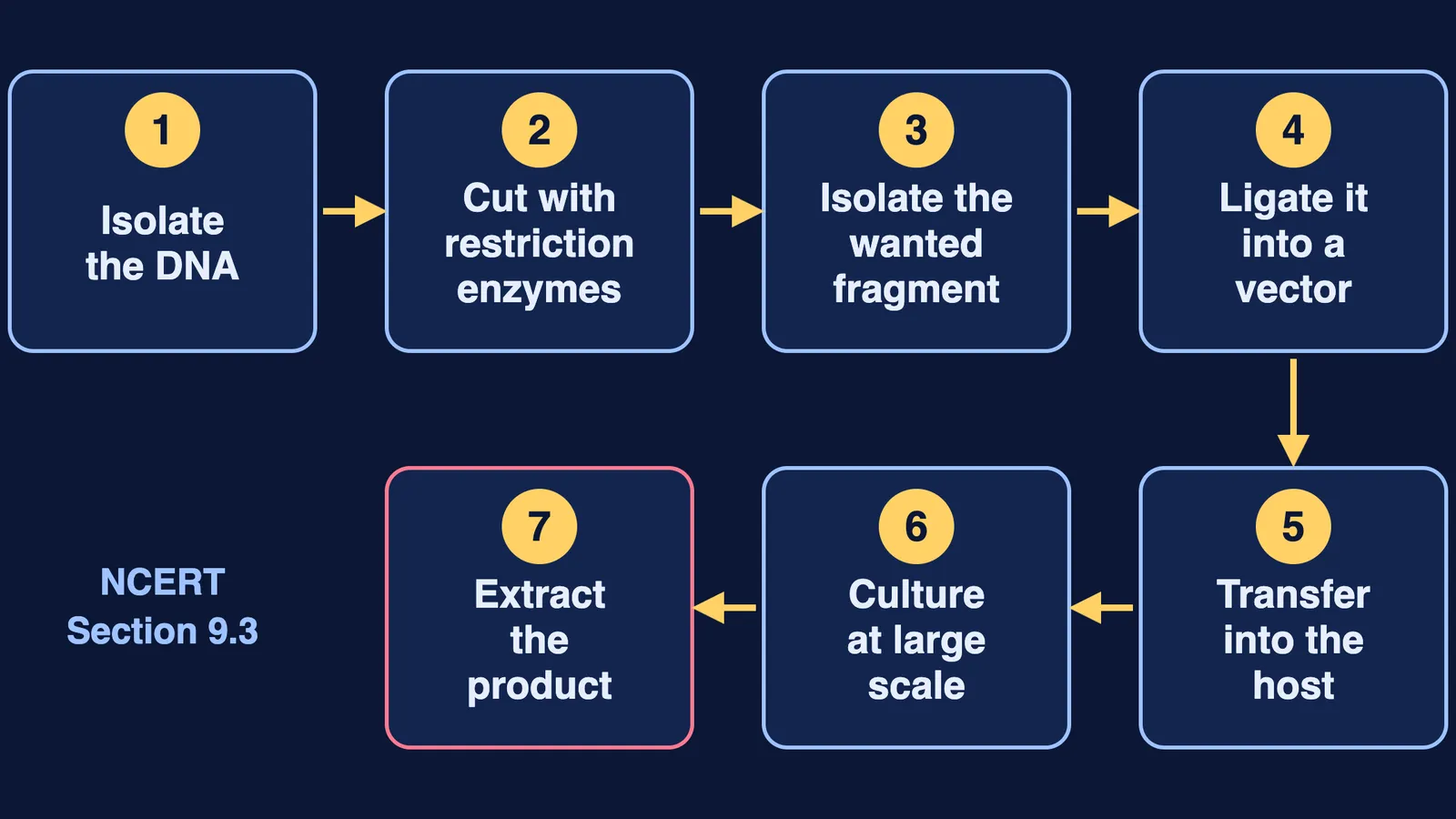
Recombinant DNA technology (9.3): isolate DNA → fragment it with restriction endonucleases → isolate the desired fragment → ligate into a vector → transfer into the host → culture at large scale → extract the product.
Isolating DNA (9.3.1): lysozyme, cellulase or chitinase opens cells → ribonuclease and protease remove RNA and proteins → chilled ethanol precipitates DNA → threads spooled out.
Clone to product (9.3.5, 9.3.6): optimise expression → large-scale production in bioreactors → separation and purification (downstream processing) → formulation with preservatives → clinical trials, for drugs.
How do you attack arrange-in-the-correct-order questions?
Pin the opening and closing steps and strike every code that breaks either. Where two codes survive, find the adjacent pair they disagree on and ask whether the later step could happen without the earlier one.
Arrange-in-order questions
Q1. Cut DNA to usable fragment: A. Bands cut out and DNA extracted B. Staining with ethidium bromide C. Agarose gel electrophoresis D. Fragments joined with cloning vectors E. Exposure to UV light (1) C, E, B, A, D (2) C, B, A, E, D (3) C, B, E, A, D (4) B, C, E, A, D Answer: (3). Bands show only after staining, then UV; eluted DNA is joined to vectors (9.2.1).
Q2. Isolating DNA: A. Chilled ethanol added B. Lysozyme, cellulase or chitinase treatment C. Threads spooled out D. Ribonuclease and protease treatment (1) B, A, D, C (2) D, B, A, C (3) B, D, C, A (4) B, D, A, C Answer: (4). Cells open first; purified DNA precipitates only after ethanol (9.3.1).
Q3. Making *E. coli* take up a plasmid: A. Back on ice B. Calcium treatment C. Brief 42 °C D. On ice with the recombinant DNA (1) B, D, C, A (2) D, B, C, A (3) B, C, D, A (4) B, D, A, C Answer: (1). Competence first; the heat shock sits between two ice steps (9.2.3).
Q4. The first recombinant DNA: A. Moved into *E. coli* B. Resistance gene cut out by a restriction enzyme C. DNA ligase joins it to the *Salmonella* plasmid D. Host DNA polymerase makes copies (1) C, B, A, D (2) B, A, C, D (3) B, C, A, D (4) B, C, D, A Answer: (3). Cut, join, transfer, then copy in the new host (9.1).
Q5. pBR322 selection: A. Plate on ampicillin B. Ligate at BamH I in the tetracycline resistance gene C. Transfer to tetracycline D. Introduce plasmids into *E. coli* (1) D, B, A, C (2) B, D, C, A (3) B, A, D, C (4) B, D, A, C Answer: (4). Ampicillin picks transformants; tetracycline then exposes the inserts (9.2.2).
Q6. Cloned gene to drug: A. Separation and purification B. Optimising expression of the target protein C. Formulation with preservatives D. Bioreactor production E. Clinical trials (1) B, D, A, C, E (2) D, B, A, C, E (3) B, D, C, A, E (4) B, D, A, E, C Answer: (1). Scale-up follows optimisation; the formulation is what goes to trials (9.3.5, 9.3.6).
Q7. Time order: A. Hind II isolated B. Two phage-restricting enzymes isolated C. First recombinant DNA D. Over 900 restriction enzymes known (1) A, B, C, D (2) B, A, C, D (3) B, C, A, D (4) B, A, D, C Answer: (2). 1963, then five years on, then 1972, then today (9.1, 9.2.1).
Before-after, out-of-place and statement questions
Q8. What comes straight after optimising the conditions that induce expression of the target protein? (1) Formulation with preservatives (2) Large-scale production in bioreactors (3) Clinical trials (4) Separation and purification Answer: (2). Only then does NCERT consider large-scale production (9.3.5).
Q9. In loading competent *E. coli* with recombinant DNA, what follows the brief 42 °C step? (1) Calcium treatment (2) Putting the cells back on ice (3) Incubation with the DNA on ice (4) Plating on ampicillin Answer: (2). The heat shock sits between two spells on ice (9.2.3).
Q10. A student writes DNA isolation as: P. chilled ethanol, Q. lysozyme, cellulase or chitinase, R. ribonuclease and protease, S. spooling. Which single step is out of place? (1) P (2) Q (3) R (4) S Answer: (1). Moving P to just after R restores NCERT's order (9.3.1).
Key for Q11 and Q12: (1) both correct (2) both incorrect (3) only I correct (4) only II correct.
Q11. I: In 1972, the host's DNA polymerase copied the recombinant DNA only after its transfer into *E. coli*. II: In NCERT's gel steps, DNA fragments are joined with vectors before elution. Answer: (3). Elution comes first (9.2.1).
Q12. I: Formulation with preservatives comes before separation and purification. II: The two phage-restricting enzymes were isolated nine years before the first recombinant DNA. Answer: (4). Downstream processing comes first, then formulation (9.3.6, Summary); 1963 to 1972 is nine years (9.1, 9.2.1).
How should you review a wrong order?
Rewrite each missed sequence from memory and check it against the list. For other formats, try the statement and match-the-list set, the diagram-based questions and the NCERT exceptions and odd-one-out set.
Which of these eight orders keeps slipping? Fermi's AI tutor works out what you already know and builds a plan for the session.