On this page
Tamarind's sourness comes from tartaric acid, as NCERT's table of natural acids tells you. The Indian standard for tamarind pulp sets a minimum for it and gives a titration to measure it. The calculation line in that method says 1 mL of 0.1 N sodium hydroxide is equivalent to 0.015 g of tartaric acid. If you know tartaric acid is diprotic, you will expect half that. The standard is right, and the reason is an n-factor lesson worth learning for JEE and NEET.
What does the BIS standard for tamarind pulp require?
IS 6364:1993, Tamarind Pulp covers pulp made from mature fruits of Tamarindus indica ("imli"): the rind, the fibrous skeleton and the seeds are removed, and the pulp is sun-dried and pressed into cakes. Its 1993 revision added requirements for total tartaric acid and total reducing sugars.
Table 1, as corrected by Amendment No. 1 (January 1994), asks for:
total tartaric acid, percent, minimum 9
total reducing sugar, percent by mass, minimum 35
moisture, percent by mass, maximum 20
For tartaric acid the method is borrowed from Annex D of IS 5955:1993, Tamarind Concentrate.
How does the tartaric acid test work?
Annex D does not titrate the pulp extract directly. Pulp is rich in sugars and pectin, so the method first isolates the tartrate as a solid. In outline:
Dissolve 2 g of sample in hot water, acidify, and add alcohol so the pectin precipitates. Filter it off.
Neutralise the filtrate with potassium hydroxide, then acidify with acetic acid and add more alcohol.
Keep it in the refrigerator overnight. The standard says to "filter off precipitated bitartrate".
Wash the crystals with ice-cold 80% alcohol, dissolve them in boiling water, and titrate with 0.1 N alkali to phenolphthalein.
The solid is potassium hydrogen tartrate, KHC₄H₄O₆ (M = 188.18), the cream of tartar sold for baking. It is only sparingly soluble in water. Three conditions push it further out of solution: plenty of K⁺ from the KOH (the common-ion effect from Class 11 Equilibrium), alcohol in the solvent, and the cold. The method is selective because it counts only what crystallises as the potassium salt. How completely other fruit acids stay in solution is not something the standard states.
Why is 1 mL of 0.1 N NaOH equal to 0.015 g of tartaric acid?
Tartaric acid, C₄H₆O₆ (M = 150.09), has two COOH groups. Titrated on its own with NaOH, both react:
C₄H₆O₆ + 2NaOH → Na₂C₄H₄O₆ + 2H₂O
Here the n-factor is 2, the equivalent weight is 150.09 / 2 = 75.0, and 1 mL of 0.1 N NaOH (0.1 milliequivalent) would match 0.0075 g.
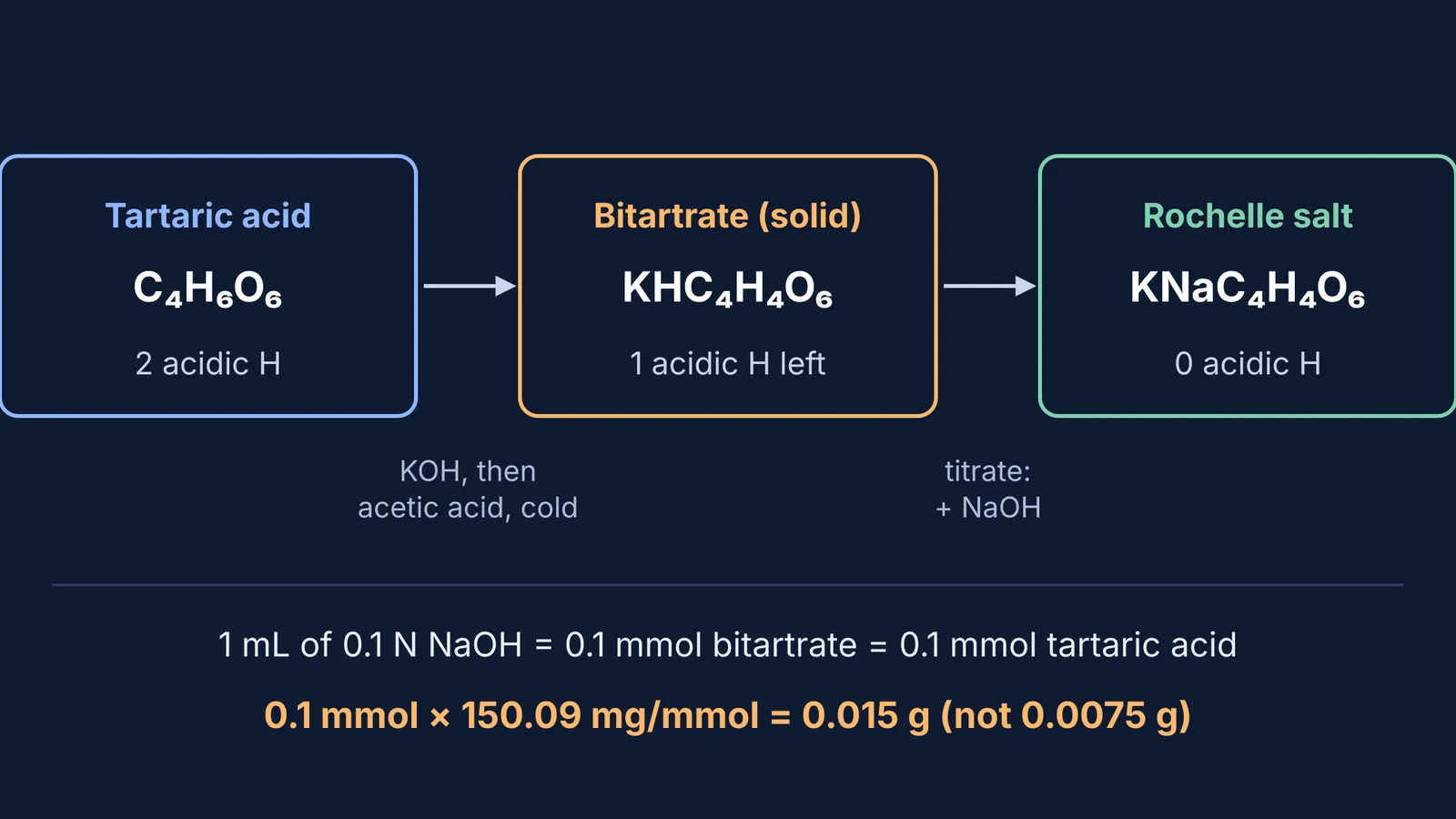
But that is not what sits in the flask. By the time you titrate, every tartaric acid molecule has become one KHC₄H₄O₆. One of its two acidic hydrogens is already replaced by K⁺, so only one is left:
KHC₄H₄O₆ + NaOH → KNaC₄H₄O₆ + H₂O
Count it through:
1 mL of 0.1 N NaOH = 0.1 mmol of OH⁻.
Each KHC₄H₄O₆ uses one OH⁻ (n-factor 1), so 0.1 mmol of bitartrate reacted.
Each bitartrate came from one tartaric acid molecule, so the sample held 0.1 mmol of tartaric acid.
0.1 mmol × 150.09 mg/mmol = 15.01 mg = 0.015 g.
The factor counts a whole mole of tartaric acid per mole of NaOH. This is the idea from our post on n-factor and the equivalent concept: the n-factor belongs to the substance in the reaction you are titrating, not to the parent compound. The same acid can have n = 2 in one titration and n = 1 in another.
Annex D also says to express results "in milli-equivalents (that is, in ml of normal alkali solution) per 100 ml of the product". That is a second way of reporting, next to the gram factor. Keep them apart: milli-equivalents of alkali used, or grams of tartaric acid through the 0.015 factor.
Worked example: does this pulp pass?
A 2.00 g sample of tamarind pulp goes through the Annex D procedure. The redissolved bitartrate needs 13.6 mL of 0.1 N NaOH. Does it meet the 9% minimum?
Tartaric acid by the standard's factor. 13.6 × 0.015 = 0.204 g.
Percentage. 0.204 / 2.00 × 100 = 10.2%. Using the exact factor 0.01501 gives the same 10.2%.
Verdict. 10.2% is above the minimum of 9, so it passes.
The trap. With 0.0075 g per mL, you would get 0.102 g, or 5.1%, and wrongly fail the sample. Using the diprotic factor halves every answer.
Now run it backwards. A 2 g sample at exactly 9% holds 0.18 g of tartaric acid, which is 0.18 / 150.09 = 1.20 mmol. As bitartrate, that needs 12.0 mL of 0.1 N NaOH. If you could titrate the free acid before precipitation instead, both hydrogens would react and the same 0.18 g would need 24.0 mL.
Where does Rochelle salt come in?
Look again at the titration product, KNaC₄H₄O₆. That is potassium sodium tartrate, better known as Rochelle salt; its common form is the tetrahydrate, KNaC₄H₄O₆·4H₂O (M = 282.22).
The very next annex of IS 5955, Annex E, measures reducing sugars with Fehling's solution, and its solution B is "potassium sodium tartrate (Rochelle salt)": 173 g with 50 g of sodium hydroxide, made up to 500 mL. The tartrate holds Cu²⁺ in solution as a complex in the strong alkali, so it does not simply drop out as copper(II) hydroxide. How that copper is then used to count sugar is explained in our post on the Lane–Eynon Fehling titration for honey sugar.
One line on stereochemistry: tartaric acid has two stereocentres, and the story of its meso form is in what is a meso compound.
Where is this on the JEE and NEET syllabus?
Class 11 Some Basic Concepts and Redox: equivalents, n-factor, "the same acid, a different n-factor".
Class 11 Equilibrium: sparingly soluble salts and the common-ion effect.
Class 12 Biomolecules and aldehydes: what is in Fehling's reagent and why.
If n-factor questions still feel slippery, Fermi Test Prep is preparation for JEE Main and Advanced with an AI tutor, and its Concept Library has a lesson on every concept in chemistry.
Quick checklist
The standard titrates KHC₄H₄O₆, not free tartaric acid.
Bitartrate has one acidic H, so n = 1 and 1 mol NaOH counts 1 mol (150 g) of tartaric acid.
1 mL of 0.1 N NaOH = 0.1 mmol = 0.015 g tartaric acid.
IS 6364 minimum: 9% total tartaric acid. A 2 g sample at 9% needs 12.0 mL.
The titration makes KNaC₄H₄O₆, Rochelle salt, the tartrate in Fehling's solution B.