On this page
Each order here comes from the NCERT Class 11 chapter Photosynthesis in Higher Plants (Chapter 11, Reprint 2026-27). The NEET (UG) 2026 syllabus lists the topic in Unit 4, Plant Physiology. All 14 questions are original, not past-paper items or predictions.
Which photosynthesis sequences does NCERT give in order?
Early experiments (11.2), by NCERT's dates: Priestley (1770), Ingenhousz (1730-1799; used Priestley's set-up), Sachs (about 1854), van Niel (1897-1985), then radioisotope proof. Engelmann (1843-1909) has no experiment year, so keep him out.
Capturing light (11.5, 11.6): antenna pigments absorb, energy reaches the reaction centre, its electron is excited, an acceptor takes it.
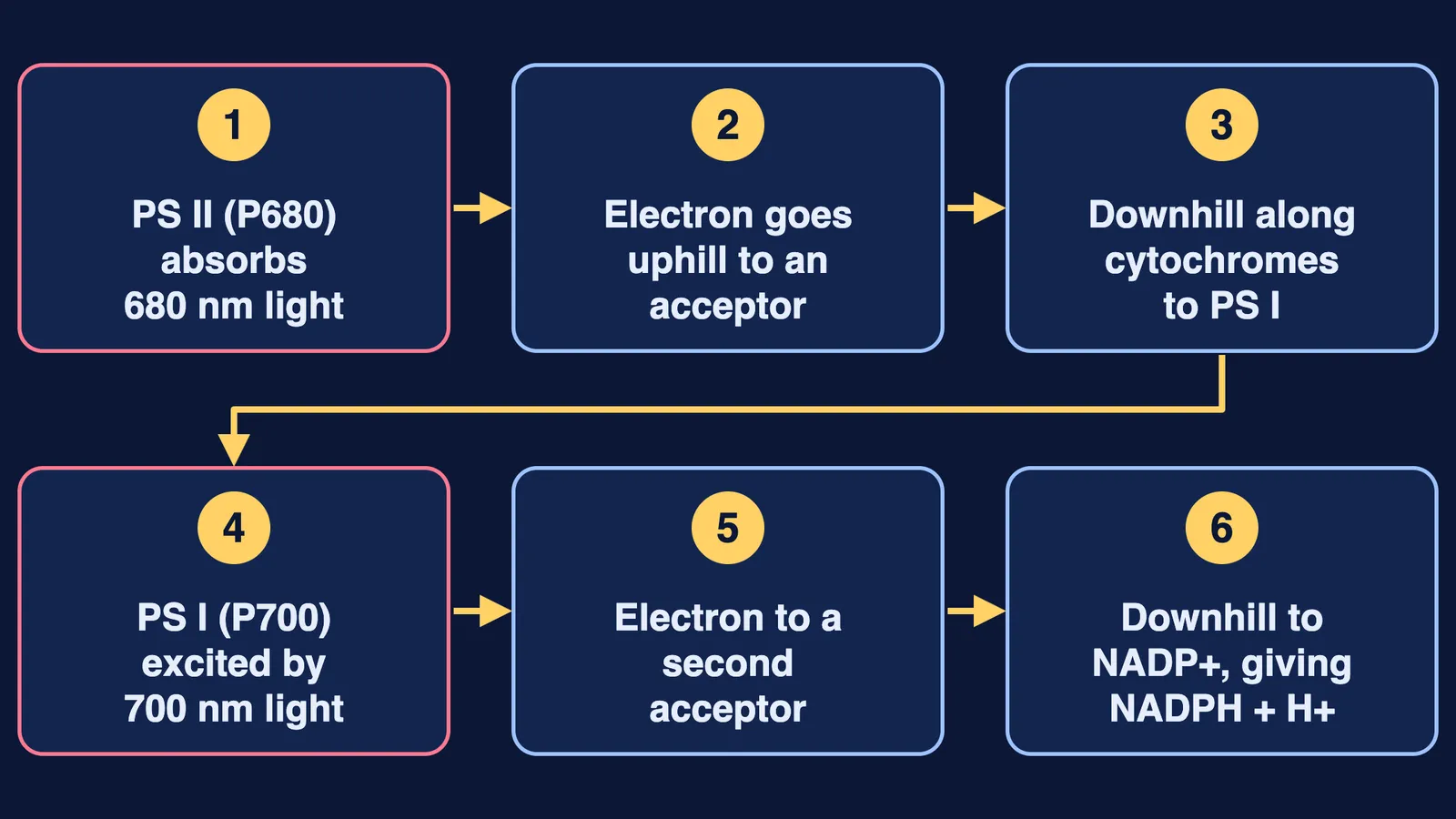
Z scheme (11.6), in the hero above: PS II, uphill to an acceptor, down the cytochromes to PS I, excitation at PS I, a second acceptor, downhill to NADP+.
Cyclic flow (11.6.2): with only PS I working, the excited electron goes to its acceptor and cycles back to PS I: ATP, no NADPH.
Chemiosmosis (11.6.3): protons collect in the lumen, flow through CF0 to the stroma, CF1 changes shape, ATP forms.
First product and acceptor (11.7, 11.7.1): 14C work in algae, PGA first; tests on many plants then found OAA, giving C3 and C4 types. Separately, a 2-carbon acceptor was sought for years before 5-carbon RuBP, then the full cycle.
Calvin cycle (11.7.2): carboxylation of RuBP into two 3-PGA, reduction to triose phosphate using ATP and NADPH, regeneration of RuBP using ATP.
Hatch and Slack pathway (11.8): PEPcase fixes CO2 on PEP in the mesophyll, OAA forms, malic or aspartic acid moves to the bundle sheath and splits; CO2 enters the Calvin cycle and the 3-carbon remnant returns to become PEP.
How do you attack arrange-in-order questions?
Fix the first and last steps; cross out options that disagree. Where the survivors first differ, ask which step supplies the other.
Can you put these photosynthesis steps in NCERT's order?
Q1. A. van Niel studies purple and green bacteria B. Ingenhousz shows sunlight is essential C. Radioisotopes prove the oxygen comes from water D. Priestley's mint keeps a candle burning E. Sachs finds glucose made in green parts. (1) B-D-E-A-C (2) D-B-E-A-C (3) D-E-B-A-C (4) D-B-E-C-A
Q2. A. A primary acceptor picks up the electron B. Antenna pigments absorb light C. Energy reaches the reaction-centre chlorophyll a D. An electron of P680 is excited. (1) C-B-D-A (2) B-C-A-D (3) B-C-D-A (4) B-D-C-A
Q3. A. OAA found as first stable product in another group B. Calvin uses 14C in algae C. Many plants tested D. PGA identified as the first product E. C3 and C4 types named. (1) B-D-C-A-E (2) B-C-D-A-E (3) D-B-C-A-E (4) B-D-A-C-E
Q4. A. CF1 changes shape B. Protons build up in the lumen C. Protons pass through CF0 to the stroma D. ATP is used to fix CO2 E. ATP synthase makes ATP. (1) B-C-A-E-D (2) B-A-C-E-D (3) C-B-A-E-D (4) B-C-E-A-D
Q5. A. Triose phosphate forms B. RuBP regenerated using ATP C. RuBisCO adds CO2 to RuBP D. Two 3-PGA form E. ATP and NADPH are spent. (1) C-E-D-A-B (2) D-C-E-A-B (3) C-D-E-A-B (4) C-D-A-E-B
Q6. A. C4 acids split in the bundle sheath, releasing CO2 B. PEPcase fixes CO2 on PEP C. Malic or aspartic acid moves to the bundle sheath D. OAA forms E. CO2 enters the Calvin cycle. (1) D-B-C-A-E (2) B-D-C-A-E (3) B-D-A-C-E (4) B-C-D-A-E
Q7. A. Search for a 2-carbon acceptor B. 14C used in algal studies C. 5-carbon RuBP identified as acceptor D. PGA found as first product E. Pathway shown to be cyclic. (1) B-A-D-C-E (2) D-B-A-C-E (3) B-D-C-A-E (4) B-D-A-C-E
Answers. 1: (2). Ingenhousz reused Priestley's set-up; Sachs about 1854; van Niel born 1897; isotopes later (11.2). 2: (3). Energy reaches the reaction centre first (11.5, 11.6). 3: (1). The survey followed PGA and found OAA (11.7). 4: (1). Proton flow through CF0 drives the CF1 change that makes ATP (11.6.3). 5: (3). Carboxylation, reduction, regeneration (11.7.2). 6: (2). OAA becomes malic or aspartic acid before transport (11.8). 7: (4). A 3-carbon product suggested a 2-carbon acceptor (11.7.1).
Which before, after and out-of-place questions test the same orders?
Q8. In the Hatch and Slack pathway, what happens to OAA immediately after it forms? (1) It releases CO2 in the mesophyll (2) It forms malic or aspartic acid there (3) It moves unchanged to the bundle sheath (4) It enters the Calvin cycle
Q9. In cyclic flow, what comes right after the excited PS I electron reaches its acceptor? (1) It reduces NADP+ (2) It returns to PS I via the electron transport chain (3) It passes to PS II (4) Water splitting
Q10. In the Calvin cycle, which step comes immediately before triose phosphate forms? (1) ATP and NADPH are used on 3-phosphoglycerate (2) RuBP is regenerated (3) Sucrose and starch form (4) PEPcase fixes CO2
Q11. One step is misplaced: antenna absorbs light, ATP and NADPH used to fix CO2, reaction-centre electron excited, ATP and NADPH form, sugars form. Which step must move? (1) Light absorption (2) Electron excitation (3) Use of ATP and NADPH to fix CO2 (4) Sugar formation
For Q12 to Q14: (1) Both I and II correct (2) Both incorrect (3) Only I correct (4) Only II correct.
Q12. I: Sachs's glucose evidence (about 1854) predates Blackman's law (1905). II: Priestley's 1770 experiments came after his discovery of oxygen.
Q13. I: In C4 plants, OAA forms in the mesophyll before C4 acids are broken down in the bundle sheath. II: In a C4 leaf, PEPcase fixes CO2 in the mesophyll before RuBisCO fixes it in the bundle sheath.
Q14. I: In the Calvin cycle, reduction comes before carboxylation. II: Triose phosphate forms before RuBP is regenerated.
Answers. 8: (2). C4 acids form in the mesophyll, then move (11.8). 9: (2). It cycles back instead of reaching NADP+ (11.6.2). 10: (1). Reduction yields triose phosphate (11.7.2). 11: (3). ATP and NADPH are used after they form (11.6.3, 11.7). 12: (3). Priestley discovered oxygen in 1774 (11.2, 11.10). 13: (1). CO2 released from C4 acids enters the Calvin cycle (11.8). 14: (4). Carboxylation, reduction, then regeneration (11.7.2).
Where should you practise next?
Try the photosynthesis statement and match-the-list set, the diagram-based photosynthesis questions and the NCERT exceptions and odd-one-out set.
Which pathway should you revise first? Fermi's AI tutor works out what you already know and builds a plan for the session.